


 Francais
 Deutsch
 Italiano

Refine Your Search
Puerto Princesa Island Philippines 1945 stock footage and images
- Showing 1597 to 1602 of 9932 results more
 Hide
Color Sound
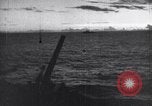
U.S. Task Force attacks Japanese positions on Island of Wotje in Gilbert and Marshall Islands during World War II.
Attack on Wotje Island, February 1, 1942. Crew members move F4F-3 Wildcat's and Douglas Dauntless SBD aircraft across crowded flight deck of the U.S. aircraft carrier, USS Enterprise (CV-6) during raid against Japanese positions in the Gilbert and Marshall Islands, by Task Force 8, of the U.S. Pacific Fleet, commanded by Vice Admiral William Frederick Halsey, Jr, during World War 2. Oversize U.S. stars are evident on the aircraft, at this early stage of the war (1942). Crewmen roll bombs, on dollies, across the deck. F4F Hellcat aircraft sit with engines running as some Douglas Dauntless aircraft commence take off. The destroyer USS Gridley, DD-380 passes abeam the Enterprise at time 00:37. A Curtiss SOC Seagull airplane catapults from the heavy cruiser USS Northampton, CA-26. Several U.S. aircraft seen in flight. View from stern of a U.S. heavy Cruiser as a destroyer crosses her wake, behind. The heavy cruiser USS Northampton, CA-26 and the heavy cruiser USS Salt Lake City, CA-25, in background (time 1:09 to 1:11) bombard Wotje island. Black smoke billows from a ship burning close to shore. Brief glimpse of the heavy cruiser USS Northampton, CA-26's triple battery of 8-inch guns. The heavy cruiser USS Salt Lake City, CA-25 fires a broad side. Scene from the stern of heavy cruiser with fires burning on Wotje Island in background. Formation of Japanese aircraft attacking U.S. ships are fired upon by antiaircraft guns. Black flak bursts seen in the sky. Vice Admiral Halsey consulting with other officers aboard his flagship, USS Enterprise.
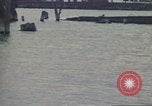
View from Ellis Island of Statue of Liberty on Liberty Island and the World Trade Center in New York, United States.
Shot from Ellis Island looking out to Lower Manhattan and over to Liberty Island and its vicinity in New York City, United States. The recently completed World Trade Center Twin Towers. View of broken piers and debris in water near Ellis Island complex. The Statue of Liberty on Liberty Island.
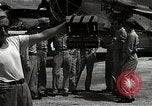
U.S. Military officers at North Field base on Tinian , Marianas Islands, pose in front of the B-29, Enola Gay
Atomic bombing mission in Japan by the United States Army Air Force, during World War II. A U.S. military base in North Field, Tinian Island in Mariana Islands, South Pacific. A group of U.S. Navy and Army Air Force officers stand in front of a B-29 bomber and talk to each other. The name of the B-29 bomber 'Enola Gay' painted on the nose of the bomber.

United States Army 7th Air Force Consolidated B-24 Liberator bombers over Rock Islands, Koror, Palau (WW2)
Aerial view of Rock Islands in Koror, Palau during a United States bombing mission in World War II. An inhabited island with a port and some roads. A squadron of United States Army 7th Air Force Consolidated B-24 Liberator aircraft flying over Koror.
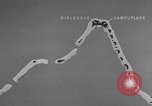
A U.S. ship convoy undertakes a three phase occupation plan for the Marshall Islands during World war II.
A training film on operations of U.S. forces on Kwajalein Atoll in the Marshall Islands during World War II. A map locates Burlesque and Camouflage Islands. The occupation plan for northern landing forces is to occupy and defend the North Carillon group of islands in three phases. The first phase is 'how hour dog day'. Jasper, Ivan, Albert and Allen Islands are included in the phase. Phase II is 'William hour dog plus one day'. Burlesque, Camouflage and Abraham Islands are included in the phase. Operations of phase III include organization of defenses on Burlesque and Camouflage Islands. Capture of the remaining islands is also included in this phase. The Arlington and the Hollis Islands are to be captured. Officers discuss. Smoke rises from naval guns fire. Aerial view of the target area. A ship convoy bombs the main parts of the atoll. Heavy columns of black smoke rise from the bombing. Air support is provided and naval gun fire is carried out according to schedule in phase I. The island is secure after sometime. Animation depicts occupation of the islands and casualties. Japanese men come aboard a ship as they climb a net.
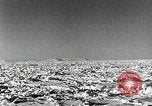
The icebreaker, USS Burton Island, breaking her way through ice sheets Northeast of St. Lawrence island, Alaska
The icebreaker, USS Burton Island, heading Northeast from St. Lawrence Island, Alaska, through ice field. View from bow, as she follows "groove" where ice field has separated and refrozen enabling the icebreaker to easily make way. As she progresses, the ice thickens and she slows, until the USS Burton Island finally stops. The ship's helicopter cranks up and warms up preparing to scout out easier pathways through the ice field. View from the low-flying helicopter, of a polar bear moving across ice flows. view of the icebreaker from returning helicopter. Since no "leads" could be found, the ship must use engine power. View of the engine room where sailors start more engines to increase the icebreaker's driving power. The icebreaker backs down from the ice sheet, and then as Captain calls for more forward power, a sailor on deck advances control, and the ship begins to break her way forward, through the ice.
CRITICALPAST.COM: About Us | Contact Us | FAQs - How to Order | License Agreement | My Account | My Lightboxes | Shopping Cart | Advanced Search | Featured Collections | Website Terms & Conditions | Privacy Policy ©2026 CriticalPast LLC.
License Agreement |
Terms & Conditions |
Privacy Policy
©2026 CriticalPast LLC.