


 Francais
 Deutsch
 Italiano

Refine Your Search
Puerto Princesa Island Philippines 1945 stock footage and images
- Showing 1615 to 1620 of 9932 results more
 Hide
Color Sound
Second Sino-Japanese War
Opening scene shows formation of Japanese Mitsubishi G3M bombers in flight. View of bombardier at bomb sight inside a bomber. Bombs falling from the aircraft, upon the Chinese city of Shanghai, on a day in September, 1937. Ground level view of bomb exploding and Chinese civilians running for cover. A huge explosion throwing earth up. Aerial view of smoke rising from bomb strikes below. More ground views of bombs destroying structures. Chinese people fleeing across a bridge. Cluster of bombs falling from a Japanese airplane. More explosions and destruction. view from a G3M bomber, of others with bombs falling from them. View from above of civilians filling a street as they run for shelter. People on the ground rushing in all directions. Some are in horse-drawn carriages with luggage on top and other in rickshaws, apparently fleeing the city altogether. Bombing victims lying on the ground near destroyed structures. Heavy dark smoke rising from the attacks. Scene shifts to Japanese army officers entering the Yasukuni shrine in Tokyo. Behind them is A Shinto Tori (Gate) and behind that, the monument (statue) of Omura Masujiro. Scene shifts again, to view of the Temple of Heaven, an ancient Imperial Sacrificial Altar in Peking (Beijing) China. Chinese agriculture. Crowds of Chinese people. Stone statue of traditional Chinese lion. Picture of 1851 oil-on-canvas painting by the German American artist Emanuel Gottlieb Leutze, of Washington crossing the Delaware. Drawing of 15th century ship similar to one in Columbus'1492 voyage to America. Drawing of Roman Empire era building. Michelangelo’s statue of Moses. Drawing of ancient Egyptian pyramid and statue. Drawing of Chinese city and environs representing 4 thousand years ago. Extant ancient Chinese shrines and statues. Animated Relief map of China and surrounding countries of U.S.S.R., India,Burma,Thailand, Indo-China, Philippines, and Japan. Animation outlines China Proper. It also shows Manchuria and scenes from there of desolate mountainous land, with miners at work extracting raw materials. Mongolia and Sinkiang are outlined. The Gobi desert is seen with a long camel caravan crossing it. Closeup of nomads transporting animal skins by camel. The last region outlined is Tibet. The ice covered Himalayan mountains are shown. Buddhist monks praying in the courtyard of a shrine in Tibet. The Yellow, Si Kiang, and Yangtze Rivers are shown on the map. Views of Chinese sailing vessels.
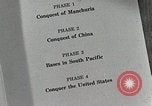
Japanese aggression in China and various events leading to Japanese attack on U.S. at Pearl Harbor (WW2)
A hand writes check marks beside “Bases in the South Pacific” and “Conquer the United States” on the summary report purporting to reflect phases of Japanese so-called "Tanaka Plan". Animated map shows pressure by German forces in offensive against Soviet Union and illustrates German air war against Britain. Scenes of bombing destruction in Britain, including overturned double-decker bus in ruins of buildings. A Nelson Class British battleship viewed from dead ahead. She is followed by the aircraft carrier HMS Illustrious. The U.S. Capitol building in Washington, DC. American newspaper headline reads: "Navy Bill Passes House." and "Huge Sum Voted for Two Ocean Navy." A line of U.S. Navy battleships underway, led by the USS Mississippi (BB-41). A field full of U.S. M3 Lee tanks moving in formation, as they are overflown by several Douglas B-18 bombers. Assembled Japanese leaders in a forum. Japanese Naval officers in a planning conference. Closeup shows Admirals Shigeyoshi Inoue and Raizō Tanaka pointing at a chart and conversing as other officers look on. Next, bomb bursts and black smoke rises as the attack on Pearl Harbor is underway. The USS West Virginia, USS Tennessee, and the USS Arizona, burning on Battleship row, during the attack. Generalissimo Chiang Kai-Shek with staff officers walks to a waiting car. Forces allied with China, including American troops marching; British troops marching; and Dutch Colonial troops marching (in Batavia, the Capital of the Dutch East Indies). Japanese troops continuing their conquest of China, firing a field piece, and infantry charging. Newspapers announce Japanese advances into Malay Peninsula and Hong Kong. Others cite the Fall of Singapore and the Fall of Corregidor in the Philippines (6 May, 1942). Animated map shows Japanese occupation encompassing Indochina, Thailand, and Burma (with loss of the Burma Road) all of which compounded China's war efforts.

An F4U Corsair airplane rounds out high and crashes on deck of USS Bunker Hill during World War II
Slow motion footage of an F4U Corsair airplane rounding out too high as it lands on the USS Bunker Hill during World War 2 Battle of Philippine Sea and Marianas Campaign. The F4U bounces over all visible restraining cables and continues to crash further along the flight deck. Final impact is obscured from view by deck crew personnel who step onto deck to respond to the crash.

President Ronald Reagan gives a speech about East West relations at the Brandenburg Gate in Berlin, Germany.
United States President Ronald Reagan addressing people at the Brandenburg Gate (Pariser Platz, 10117 Berlin, Germany) in Berlin, Germany. Large crowd gathers People stand with the United States flags. Dignitaries on the platform. The flags on the platform. President at the podium gives a speech in front of the crowd. The crowd applauds. He discusses the free state of prosperity and well-being. He talks about the relations between the East and the West and arms control. He also discusses the Soviet's challenge to the Western Allianz about nuclear weapons. President Reagan suggests nuclear weapons and the chemical weapons should be eliminated. He talks about the 1986 restoration of democracy in the Philippines, freedom in Europe and the technological advancements taking place. He says that the West is ready to cooperate with the East as and when needed.
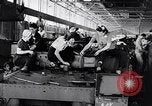
War materiel production by American women at factories in the United States (WW2)
American women at work in war production factories during World War II. A woman working on a lathe answer why she is contributing to the war effort. They produce various war materials. They are asked about their engagement in producing the war materials. They cite their reasons for producing these materials. “My husband is a prisoner of the Japs in the Philippines. If he’d have a few more of these shells out in the pan, maybe he’d still be fighting. Whenever I get a bit tired, I think of him on that death march.” a woman answers, clenching a handful of shells from a container. They produce equipment useful in war and other products. A woman working on the plexiglass nose turret of a bomber aircraft in an airplane manufacturing plant. They wear uniforms and work on machines to produce for the war effort.

Admiral Richard E. Byrd lands on Antarctica for his polar expedition.
Relates to the U.S. Antarctic expedition,Operation High Jump. American carrier ship USS Philippine Sea is radioed by the flag ship. Admiral Richard Byrd orders the DC-3s (also known as R4D) to take off from the deck. The DC-3s take off from the deck by means of jet propulsion devices. Admiral Byrd's plane lands on the Antarctic ice. He meets and greets the fellow officers. Expedition team is caught in heavy blizzard. Snow is cleared off aircraft, tents and equipment after the blizzard subsides. Admiral Byrd reviews his men and U.S. flag is raised.
CRITICALPAST.COM: About Us | Contact Us | FAQs - How to Order | License Agreement | My Account | My Lightboxes | Shopping Cart | Advanced Search | Featured Collections | Website Terms & Conditions | Privacy Policy ©2026 CriticalPast LLC.
License Agreement |
Terms & Conditions |
Privacy Policy
©2026 CriticalPast LLC.