


 Francais
 Deutsch
 Italiano

Refine Your Search
Puerto Princesa Island Philippines 1945 stock footage and images
- Showing 1639 to 1644 of 9932 results more
 Hide
Color Sound
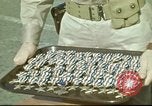
U.S. Army Lieutenant General Emmons decorates officers and men of the U.S. Submarine Trout (SS-202)
View of trays containing silver stars and other U.S. military decorations. U.S. Army Lieutenant General Delos C. Emmons, commanding general of the Hawaiian department, decorates the officers and men of the submarine USS Trout in ceremonies held at Pearl Harbor, in recognition of their successful performance of a mission for the war department in enemy controlled waters in World War 2. At the left is Lieutenant Commander Frank W. Fenno, captain of the Trout. Assisting the general is Lt. Col. E.B. Whisner, secretary of the general's staff. View of Army band and honor guards on dock. U.S. Navy officers in ranks behind Army Color Guard. Standard bearer carrying General's flag. Scene shifts again to deck of the USS Trout. The General's three-star flag flies from the Trout's mast. (Note: The mission of the Trout was to deliver anti-aircraft ammunition to the U.S. forces defending Corregidor. Fenno's sub was called on to deliver the ammunition because surface ships and aircraft were unable to penetrate the tight Japanese defenses. The mission was classified as "top secret." The USS Trout delivered the munitions and then brought back more than 6 tons of Philippine gold and 630 bags of silver, as ballast. Commander Fenno was awarded the Navy Cross and the Distinguished Service Cross, by the United States Army, and the officers and enlisted men of the Trout each received the Silver Star for successfully completing this unusual and dangerous mission. The USS Trout received a Presidential Unit Citation.)
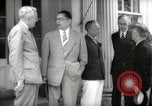
Foreign diplomats leave the White House in Washington D.C., United States during World War II.
Foreign diplomats at the White House in Washington D.C., United States during World War II. Foreign Diplomats leave White House. Diplomats from left to right includes Canadian Minister to United States Leighton McCarthy, Chinese Foreign Minister T. U. Swong, Finance Minister of New Zealand Walter Nash, Australian Diplomat Owen Dixon, British Ambassador to United States Viscount Halifax, President of Philippine Commonwealth Manuel Quezon. Diplomats get into cars.

Ship USS Trout (SS-202) unloads a cargo of gold on USS Detroit (CL-8) at Pearl Harbor in Oahu, Hawaii during World War II.
United States Navy Tambor-class submarine USS Trout (SS-202), returning from its second war patrol, unloads gold at Pearl Harbor in Oahu, Hawaii during World War II. USS Trout (SS-202) comes alongside Omaha-class light cruiser USS Detroit (CL-8) at Pearl Harbor to unload a cargo of gold that she had evacuated from Corregidor in the Philippines. Captain and crew members on the deck of USS Trout submarine tied up alongside USS Detroit cruiser. High ranking officers on the deck of the submarine. Crew members work in the background. The crew members on the submarine transfer 20 tons of gold bars and bags of silver pesos from the hold of the sub to the USS Detroit. Each gold bar was worth $23,000 and each sack contained 1,000 silver pesos. The total value was near 10 million dollars.

Nameplates of the war heroes of each historical conflict and replicas of medals at the Pentagon Hall of Heroes
The Hall of Heroes at the Pentagon in the United States. Replicas of three medals in the hall. Nameplates of the war heroes of each historical conflict on the wall. Names of the soldiers and officers who served the best in the wars. Names under the nameplates reading: 'Civil War (1861-1865), 'Indian Campaign (1861-1898)'. Other nameplates read: 'Philippine Insurrection (1899-1913)', 'China Relief Expedition-Boxer Rebellion (1900)' and 'Vietnam (1964-Present)'. (Vietnam War period).

Meeting supply needs for U.S. soldiers in battle during World War 2
A film titled: 'Substitution and Conversion' on provision of supplies to soldiers in the European Theater during World War II. A slowly revolving relief globe. The Philippines on a map. Malaya, Borneo and Sumatra are also located. Narrator notes that a large quantity of raw materials was lost at these places during the war. Exterior of the Pentagon building in Arlington Virginia, outside Washington DC. Clerks working at their desks inside the building. A coat and hat rack filled with items belonging to civilian and military workers in the Pentagon. A convoy of ships underway at sea. Elevated view of columns of many U.S. Army soldiers standing at attention during a review. Closeup views of an American Army soldier showing his uniform and his equipment including helmet, rifle, gasmask, leggings, bayonet, ammunition belt, first aid kit, canteen, blanket roll, haversack. Soldiers stand in formation. Cots with netting on them in a barracks area. Corps of engineers soldiers building a wooden bridge over a waterway. Bomber aircraft and fighter aircraft in lines at an airfield. Columns of tanks parked in a field. Heavy artillery being towed on a roadway. Half track armored vehicles rolling by. View of tanks rolling by, and an anti-aircraft gun being cranked into position. Soldiers loading artillery shells from a storage area into a truck. View of storage tanks for gasoline. Convoy of supply trucks moving on a road. Closup view of train locomotive and its cars moving at and past camera position. Aircraft overhead in formation. View of ships at sea in convoy below. Animated map shows that 7 tons of equipment is required for each American soldier. Giant railroad gun firing. A Navy ship releasing a depth charge and explosion in water. Bombs away view of bombs falling from open bomb doors of a bomber aircraft. American soldiers racing onto a beach head. Animated map shows supply of war equipment to other places all over the world, from the United States.
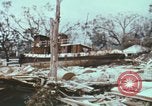
Characteristics and names by which tropical cyclones are known in different places is discussed in the United States.
A documentary in the United States on occurrence of tropical cyclones. A rubbled area after being hit by a tropical cyclone. Soldiers carrying a dead body on a stretcher. Cyclones are known by different names based on their geographical locations. Animation depicts names of cyclones in different areas with the help of a map. In the Western Pacific they are known as typhoons. They are known as Baguio in the Philippines. They are called cyclones in the Indian Ocean and the Bay of Bengal. In Australia they are called Willy-Willy. A cyclone is called a hurricane in the Eastern Pacific, the Gulf of Mexico and the Caribbean. Characteristics of tropical cyclones. Counter clockwise wind flow at the time of a cyclone. The pressure when the tropical cyclone approaches. The eye of the tropical cyclone may be very small or very large in diameter. The strongest winds around an eye average from 90-150 knots. The storm is divided into semicircles for orientation. The right semicircle is considered to be the most dangerous semicircle because of its stronger wind. The left is considered to be relatively less dangerous because of somewhat weaker winds. A demonstration is done by considering ships stuck in both the parts. The ship stuck in the right semicircle revolving in the area. The ship stuck in the left one arrives towards the end and comes out of the storm. Ships underway at sea during a storm. Clouds in the sky. Rain begins to fall. A man checking a parametric center. Animation shows a ship arriving towards the storm center. The ship's radar used to locate the ship's location.
CRITICALPAST.COM: About Us | Contact Us | FAQs - How to Order | License Agreement | My Account | My Lightboxes | Shopping Cart | Advanced Search | Featured Collections | Website Terms & Conditions | Privacy Policy ©2026 CriticalPast LLC.
License Agreement |
Terms & Conditions |
Privacy Policy
©2026 CriticalPast LLC.