


 Francais
 Deutsch
 Italiano

Refine Your Search
Puerto Princesa Island Philippines 1945 stock footage and images
- Showing 175 to 180 of 9932 results more
 Hide
Color Sound

United States army and tanks at the town of Tacloban in Island of Philippine.
United States army takes over village Tacloban in Philippine. A soldier stands besides a pole. House in the background. Smoke arises behind the house. United States tanks on the road. Tanks on the street of town. Houses besides the road. A soldier walks past tank, soldier watch wreckage of village. Soldiers talk to civilians. United States aircraft in flight. (World War II period).

U.S. Army officials with Japanese officials at a surrender conference in the Philippine Islands.
Scenes following Japanese invasion and occupation of the Philippines during World War II. Japanese and United States officials seated in chairs. First Corps Commander General Jones attends a surrender conference with Japanese officials. Japanese officer smoking a cigar. Refugees and United States and Filipino prisoners of war move along a road. The refugees are fed at a Japanese Army field kitchen.
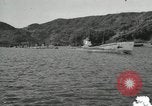
Operation "Road's End" and preparations for destruction of the Japanese submarine fleet moored in Sasebo Bay, Japan
Views from U.S. boat moving among Japanese submarines in Sasebo Bay, Japan, during Operation Road's End, involving the scuttling of the Japanese submarine fleet. Seen are submarines: I-47; I-162; I-156l;n-203;I-158;I-103;107;I-58. An American launch pulls up to I-58 (the sub that sank the USs Indianapolis on July 31, 1945, in the Philippine Sea).Vice-Admiral Robert M. Griffin, Commander of U.S. Naval Forces, Japan, climbs aboard the sub, followed by other members of his party. Admiral Griffin walks the deck of the submarine, followed by a Rear Admiral, who points out some features of the boat to Admiral Griffith. View of the group standing on the deck of the I-58.
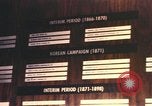
Hall of Heroes at the Pentagon showing hero names from Korean Campaign to the Vietnam War
View of the Hall of Heroes at the Pentagon, in the United States, during the Vietnam War. Names of the war heroes in the hall. Nameplates of the war heroes of each historical conflict on the wall. Names of the soldiers and officers who served the best in the wars. Names under the nameplates reading: 'Interim Period (1866-1870)', 'Korean Campaign (1871)', 'Interim Period (1871-1898)'. Other nameplates read: 'War with Spain (1898)', 'Philippine insurrection (1899-1913)', 'China Relief Expedition-Boxer Rebellion (1900)'. Several other conflicts mentioned in the hall. Other nameplates read: 'World War I (1917-1918)', 'Haitian Campaign (1919-1920), 'Second Nicaraguan Campaign (1925)', 'Word War II (1941-1945) and 'Vietnam (1964-Present).

Writing on nose of the B-29, Enola Gay, parked on Tinian Island, Mariana Islands.
Writing on nose of 313th Bomb Wing B-29 Superfortress aircraft named "Enola Gay" that dropped the first atomic bomb on Hiroshima in World War 2. The aircraft is parked on Tinian Island, Mariana Islands. The writing reads, "First Atomic Bomb, Hiroshima - August 6, 1945."
Japanese bombing and occupation of Philippines; US Army soldiers fight in the Pacific during World War II (WW2)
Animated map of Philippines and Guam. Pre-war scenes of buildings in Philippines before Japanese attack. Flag waving from a building in Manila, Philippines. Filipino civilians running on streets and Japanese planes bombing in Manila during World War II. Fire on a house due to bombing. Scenes of devastated houses. Christ's statue dropped on ground in a church. A bell on the church. An animated map of Pacific region and focuses on Australia. Scene of General Douglas MacArthur. American troops gathered in an Australian port. Japanese attack by air at Port Moresby. U.S. troops debarking. Anti-aircraft guns firing in Midway Island. Admiral Chester W Nimitz decorates heroes of the battle of Midway. Scenes of ships in sea. A plane and some U.S. troops on boats. Scene of U.S. troops in jungle. Animated map of Solomon Islands. U.S. flag on a ship. Fighters and land-based Army bombers fly in air. Soldiers save themselves from firing by plane. Scenes of U.S. soldiers on island. Japanese signboard on a tree.
CRITICALPAST.COM: About Us | Contact Us | FAQs - How to Order | License Agreement | My Account | My Lightboxes | Shopping Cart | Advanced Search | Featured Collections | Website Terms & Conditions | Privacy Policy ©2026 CriticalPast LLC.
License Agreement |
Terms & Conditions |
Privacy Policy
©2026 CriticalPast LLC.