


 Francais
 Deutsch
 Italiano
Refine Your Search
Puerto Princesa Island Philippines 1945 stock footage and images
- Showing 193 to 198 of 9920 results more
more Hide
Hide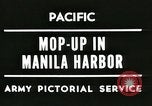
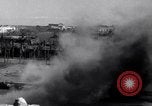
U.S. 1380th Engineers lay a pipeline and pump diesel oil and explosives into them at Manila Harbor in Manila Bay, Philippines.
U.S. Army 1380th Engineers lay a pipe line at Manila Harbor in Manila Bay, Philippines during World War II. The engineers lay the pipes together. The engineers at work in Manila Bay. Fuel tanks and other equipment on the land. The engineers and soldiers walk down the land as the pipe lines are laid together. The engineers pump diesel oil and gasoline mixture into the pipeline. They ignite the mixture using a motor. Fumes rise up as the mixture ignites. A Japanese soldier comes out of a pit. A patrol team catches him. The team questions him. Military ships carry infantry and engineers at Fort Drum, El Fraile Island in Manila Bay. Troops walk down a ramp at Fort Drum. A pipe line hose is set into a vent. A mixture of oil and explosives is pumped into this pipeline. Slow burning fuel, grenades and other explosives lowers into the vent by the engineers. The troops guard the engineers at work. The engineers set up a timer and the troops leave the land. Explosions take place. Smoke rise up from the island.
Soldiers of the First Cavalry Division walk down the bank of Cainte River in Luzon in Philippine Islands
U.S. Army soldiers of the First Cavalry Division cross small stream bridged with a canoe. Soldiers walk down the bank of Cainte river. A bulldozer pulls a string of trucks across the river. Soldiers march across an open field. (World War II period).
Destroyed B-29, its parts and scattered debris viewed the day after it crashed on Tinian in the Northern Marianas Islands.
Remains of United States Army Air Forces B-29A Super fortress that crashed on March 30, 1945, at North Field, Tinian,in the Northern Mariana Islands, during World War 2. Scattered debris on ground. Remaining piece of tail section displays serial number 265283 indicating it is B-29 number 42-65283, nicknamed "Big Wheel," from the 9th Bomb Group, 99th Bomb Squadron. Reportedly, it experienced mechanical problems during a mission to drop mines in Japanese waters. After jettisoning its munitions, it returned to Tinian, but crashed on the shore. Of the 12 crew, only the radar operator survived.
Remains of a United States Army Air Forces B-29 Super fortress that crashed on Tinian in the Northern Mariana Islands., during World War II
Remains of USAAF B-29 number 42-65283 from the 9th Bomb Group, 99th Bomb Squadron, that crashed, 30 March 1945, in World War 2, on Tinian, Northern Mariana Islands. All crew members were immediately killed in the crash, except tail gunner, Sgt. Joseph C. Trullo, Jr., who initially survived but died of his injuries, five days later, and the sole survivor, Radio Operator, Sgt. James Langraf who was injured but eventually recovered. Air Force personnel inspect debris that is scattered across the crash site in sand dunes close to the ocean in the background.
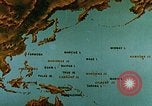
U.S. and Japanese Naval aircraft in aerial combat over the island of Kwajalein in the Pacific Theater during World War II.
The USS Yorktown (CV-10) in the Pacific Theater during World War II. Map of Marcus Island and surrounding islands in Japan. Animation depicts the U.S. fleet's aim to recapture the Philippines and land on the main land of Asia to help their ally China. USS Yorktown underway. A map depicts its advance towards its target of Kwajalein Island in the Marshall Islands. Imperial Japanese Navy Air Service Mitsubishi A6M Zero fighters in flight. U.S. planes in dogfights with Japanese aircraft over Kwajalein Island. Aerial gun camera footage shows United States aircraft attacking Japanese aircraft. Japanese airplane is hit and explodes. Another Japanese airplane falling from sky to crash in water. Heavy bombardment and strafing on land of enemy targets, wrecked aircraft. Black smoke rises from explosions on the burning island. Heavy shelling by surface ships. Assault crafts filled with U.S. Marines and Army soldiers hit the beaches on Kwajalein. U.S. airplanes in flight over the island.
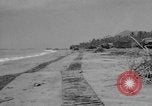
8th Fighter Group unload supplies from an LST and weld holes in oil drums at Leyte beach in the Philippines.
Activities of U.S. Army Air Force 8th Fighter Group at a beach on Leyte Island, Philippines during World War II. Leyte beach in the Philippines. Soldiers unload supplies and equipment from an LST (Landing Ship Tank). A fuel truck hauls a trailer on the beach. Men in a well bail out surface water. The soldiers gather around the new well site. A tractor hauls a fuel truck along the beach. The wheels of the tractor. The soldiers weld holes in oil drums for showers. A welder welds a drum. A soldier fits pipes into the well. The soldiers work on a pipe in the shower well. A latrine tent. Trucks in a motor pool. A scraper on the beach. The soldiers unload equipment from a landing craft onto a truck. They use a crane for carrying supplies. A ship convoy and the landing craft underway at sea.
CRITICALPAST.COM: About Us | Contact Us | FAQs - How to Order | License Agreement | My Account | My Lightboxes | Shopping Cart | Advanced Search | Featured Collections | Website Terms & Conditions | Privacy Policy ©2026 CriticalPast LLC.
License Agreement |
Terms & Conditions |
Privacy Policy
©2026 CriticalPast LLC.