


 Francais
 Deutsch
 Italiano
Refine Your Search
Puerto Princesa Island Philippines 1945 stock footage and images
- Showing 253 to 258 of 9920 results more
more Hide
Hide
Allied American, British and Soviet leaders during the Malta and Yalta Conference.
The Malta Conference in Malta, January - February 1945. The Malta fortification, building and towers. A plane taxis on the Luqa Airport on the island. General Woods, Smith, Marshall and Brehon B. Somervell deplane in Malta. Major General C.P. Woods shakes hands. Lt. General Walter B. Smith met by British Air Commander Whitney Strait. Ambassador W. Abel Hellemen with Major General F. M. Andersen. Arrival of Admiral Ernest J.King at the airport. Field Marshall Sir Harold Alexander, Supreme Allied Commander in the Mediterranean Theater. Admiral Andrew and B. Cunningham greet each other. General George C. Marshall steps off a plane. General Brehon B. Somervell greets England's Foreign Secretary Anthony Eden. On February 2, 1945 an American warship arrives with U.S. President Franklin D. Roosevelt. He is saluted by the British Prime Minister Churchill. Sailors on deck. View of the Montgomery House. Combined meeting of U.S. and British Chiefs of Staff at the Montgomery House. The chiefs are seated around a table, military plans agreed upon. A wall map in the background. Delegates leave for another conference. Policemen control the crowds on either sides of a street. A Russian airport near Yalta in the Crimea. A transport plane lands at the airport. Soviet Foreign Minister Vyacheslav Molotov greets Allied leaders outside a tent. Edward Stettinius U.S. Secretary of State gets off the plane. UK Foreign Secretary Anthony Eden. The flags of three countries fly over the field: US, UK and Soviet Union. Secretary of State outside the tent. Harry Hopkins arrives. Prime Minister Churchill gets off a UK plane. Kremlin Guards form the guard of honor. Franklin D Roosevelt greeted by Russian reception committee. Daughters of Roosevelt and Churchill talk All the delegates around the transport plane. Delegates salute during the national anthem. British Prime Minister and U.S. President inspect the guard of honor after the national anthem. Kremlin Guards march past in review. (World War II period).
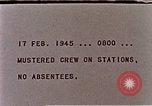
Crew members are inspected aboard USS Franklin in the Pacific Ocean during World War II.
A film to honor and remember the men who served in the U.S. Navy during World War II. A log book entry of USS Franklin (CV-13). Crew on the flight deck of USS Franklin in the Pacific Ocean. Fueling crew in red shirts, aircraft directors in yellow shirts. Men who load armor and aircraft in blue shirts. Men are reviewed by the executive officer. After the inspection men leave for their work. Aircraft taxi on the flight deck on 20th February, 1945. Aircraft of Air Group 35 and 75 take off. Aircraft in a formation flight. Aerial view of the Naval Air Station at Kanoehe, Hawaii. A ship loaded with supplies. Supplies loaded on trolleys. 'Outrigger Canoe Club' at a beach. Fliers on the beach. They sunbathe and enjoy rowing. Sailors board USS Franklin. The ship underway at sea to rejoin task force 58. Escort vessels sail alongside. Aircraft in flight overhead. The ship heads towards Ulithi island. A log book entry. A fleet of ships near Ulithi island. Carrier Hancock in the fleet. The fleet sails towards the island of Honshu, Japan.
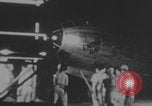
Enola Gay mission to drop “Little Boy” atomic bomb over Hiroshima, Japan (World War 2)
Enola Gay atomic bomb mission over Hiroshima, Japan during World War 2. The Enola Gay, a Boeing B-29 Superfortress bomber, prepares to leave for the Hiroshima mission. Army Armed Forces maintenance men and Enola Gay crew prepare the Enola Gay in Tinian, Northern Mariana Islands, checking their watches as the glance at the horizon. Maintenance men check bomb bay doors before closing. Pilot Colonel Paul Tibbets looks out of cockpit window of Enola Gay. Nose art of Enola Gay is seen. Close up of controls with hand show "starter" and "engine primer." Enola Gay engine starts and one of it propellers turns. The Enola Gay takes off from North Field, in the Northern Mariana Islands. Point of view through B-29 cockpit window as plane speeds down runway. Motion picture cameraman films the take off. The Enola Gay seen overhead as it leaves for Japan. Aerial View of Iwo Jima Island in Japan. The Enola Gay begins slow climb to bombing altitude over Iwo Jima. Crew member, possibly Tibbets, uses a pair of binoculars. Aerial view of Hiroshima. Enola Gay crew check instruments last time before dropping. The Enola Gay begins its bomb run. Crew bombardier turning a dial on a bomb site. View of Enola Gay with bomb bay doors open. Moving gauge pointer as bomb is dropped and seen exiting bomb bay. The Enola Gay banks away from Hiroshima at high speed. Aerial view in color of mushroom cloud forming over Hiroshima after the atomic bomb detonates in the city. (This actually shows the Nagasaki bomb blast from August 9, 1945, not the Hiroshima blast, despite the statements of the narrator in this edited film). Gigantic mushroom cloud from atomic bombing.
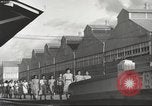
Filipino people going about their routine activities in the Philippines; Filipinos trained by American soldiers.
Part of a 1944 film showing scenes of Filipino people circa 1940, before World War 2. At opening, Filipino women are seen walking alongside a row of factory buildings. A factory room filled with Filipino women dressed in white caps and white uniforms engaged in production at individual individual work stations in a factory. A machine shop filled with Filipino men engaged in metal work. Several people at the window of an office, conducting business with a woman inside. A stock or commodities market office with quotes on tote boards. Women working alongside a moving production line. A woman operating a fabric processing machine. Filipino miners pushing hopper cars of mined ore across a bridge. Miners riding on an engine pulling a train of hopper cars filled with ore from a mine. Filipino longshoremen handling cargoes on a wharf. Scene shifts to an open field where a number of Filipino men are being trained to use firearms during World War 2. One is being coached by an American soldier as he works with a Browning M 1917 water cooled machine gun. Lines of Filipino men firing rifles under supervision of U.S Army trainers. A contingent of uniformed Filipino soldiers, led by an American soldier, marches past a sign, in an camp of tents, reading "A-T Company, 1st Filipino Infantry." Filipino soldiers at a tent camp, being instructed by an American soldier, using a large set of maps. Camera pans over a camp of many tents laid out in order. A formation of Filipino soldiers marches between tents. An American soldier opening his foot locker at his quarters. An illustrated portrait of General Douglas MacArthur. A formation in a field with a Filipino band playing and a Color Guard carrying the American and Filipino flags. A large group of Filipino children walking along a path. A Filipino boy lying on the floor in his home, reading a large book. Filipino school girls seated at benches next to tables. Women doing laundry at an outdoor pond. Next, an actor in khaki clothing sits in a tent and speaks as if addressing American soldiers regarding the Philippines. Among other things, he says,"These people aren't natives. They aren't beggars. They have cities and farms and industries.They have schools and courts and a Constitution. They also have pride and patriotism and self-respect. They love freedom They'll die for it." He cautions American soldiers about their behavior vis-a-vis Filipinos. He states that "Filipinos are American." He alludes to messages received from American and Filipino defenders in Fort Mills, at the fall of Corregidor on May 5, 1942. View of radio towers and worker in radio studio. Morse code messages heard as an American army radio operator with a headset transcribes the messages. Scene shifts to an amphibious invasion fleet attacking a Japanese held island in the Pacific.
Operations of Japanese soldiers and officials during the invasion of the Philippines.
The invasion of the Philippines Islands by Japanese occupying troops during World War II. Map shows Manila and surrounding area in Central Luzon. Truckloads of Japanese troops passing on a street. They pass the ruins of San Fernando, Pampanga. Belltower of Metropolitan Cathedral of San Fernando (Metropolitan Cathedral of San Fernando, Consunji street corner General Hizon street, San Fernando City, Pampanga). A horse-cart Kalesa on the street. A woman gets off from the Kalesa. A sign in a Japanese market reads: 'Army wants to buy pigs, fish, vegetables and chickens. For sale rice, sugar, salt, soap, cigarettes. Transactions with Japanese money'. Filipino women buy and sell vegetables and fruits at the Japanese market. View of bananas and corn for sale in the market. Japanese soldiers distribute English language newspaper 'The Tribune'. A Filipino woman reads the newspaper. Filipino workmen construct a building for the Japanese Army. Japanese Army General Masaharu Homma appears with staff. General Homma poses with other officials in front of Lazatin House (523 Consunji St, San Fernando, 2000 Consunji St, San Fernando, 2000 Pampanga).
Japanese officials discuss a map and soldiers firing artillery at Corregidor, Philippines (WW2)
Scenes in Japanese occupied Philippines in World War 2. Smoke rises as soldiers fire artillery in Corregidor. A tent with Japanese officials seated at a table. A bald Japanese officer writes on the table. An officer peers through a range finder. An officer discusses a table map with the soldiers. Soldiers dutifully take notes during the meeting. Mitsubishi Ki-21 “Sally” bombers fly in formation overhead and bomb Corregidor Island. The soldiers fire artillery.
CRITICALPAST.COM: About Us | Contact Us | FAQs - How to Order | License Agreement | My Account | My Lightboxes | Shopping Cart | Advanced Search | Featured Collections | Website Terms & Conditions | Privacy Policy ©2026 CriticalPast LLC.
License Agreement |
Terms & Conditions |
Privacy Policy
©2026 CriticalPast LLC.