


 Francais
 Deutsch
 Italiano

Refine Your Search
Puerto Princesa Island Philippines 1945 stock footage and images
- Showing 3253 to 3258 of 9932 results more
 Hide
Color Sound
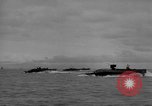
U.S. troops unloading from the LVTs and LCT on the beach as it loads Sherman tanks in Palau island.
The amphibious landing of U.S. troops in Palau during World War II. Four Landing Vehicles Tracked (LVT) heading for the beach. The troops unloading from the LVTs. A wrecked aircraft in the water. The troops unloading from the LVT. The wreckage of the aircraft. A man digging a foxhole. A man getting his knee bandaged. A man jumping over the side of an LCM (Landing Craft Mechanized) into the surf. Men unloading into the surf from an LCVP (Landing Craft, Vehicle, Personnel). A man carrying a stretcher on his shoulder. Two Sherman tanks with snorkels on the beachhead and an LCT (Landing Craft Tank) in the background. Sign: 'Tokyo Bound' on the side of the tank. Snorkel on the port of the tank. LCT 1292 on the beach as it loads Sherman tanks. The tanks load onto LCT on the ramps. Two tanks in the LCT. A soldier wearing foul weather gear and life jacket talks over the radio.
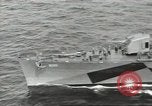
USS Braine transfers men to the USS New Mexico, during the Mariana Islands campaign in World War II
The destroyer USS Braine, DD-630, transfers wounded men, via Stokes stretcher, to the battleship USS New Mexico, BB-40, for medical treatment, during the Marianas campaign of World War 2. (The USS Braine had earlier been hit by a Japanese six-inch shore battery off the shores of Tinian, causing minor damage.)
USNS Rose Knot functioning as a telemetry station for the Mercury-Atlas 6 network off the coast of the Canary Islands in Africa
View of the antennas of USNS Rose Knot (T-AGM-14), operating as USAFS Rose Knot E-45-1850, a missile range instrumentation ship assigned in the Atlantic Ocean off the coast of Africa, to function as Station 3 telemetry station for the Mercury-Atlas 6 network. View of bow of the USAFS Rose Knot E-45-1850 sailing in the Atlantic Ocean, communicating with American astronaut John Glenn on Friendship 7 and monitor its journey. Inside the engine room, a senior sailor operates the ships telegraph engine and speed control back and forth. A sailor seen at helm on the ship’s wheel. The older sailor speaks through an intercom with an Eastern European accent. Telemetry communicators aboard USAFS Rose Knot goes down a spiral stair and submits a paper to a colleague in the control room. The telemetry specialist, wearing headphones, reads the paper given to him by his colleague earlier.

U.S. B-24s and B-17s on bombing mission against Japanese positions on Kiska during World War II
The Aleutian Islands Campaign during World War 2. U.S. Army Air Forces B-24 and B-17 bombers on bombing mission from Adak Island to Kiska, Aleutian Islands. The B-24 aircraft in formation over the Pacific Ocean. Navigator at his position with compasses and chart. Gunners test turrets and guns. Scene shifts to the B-17s flying at low level over water. Small iceberg seen off wing of B-17. One B-17 displays number 19162 on its tail. Kiska volcano seen. Scene shifts again, to B-24 Liberator bombers maneuvering over Kiska, then shifts again, to B-17s on a low altitude bomb run. Bombardier over bomb sight dropping bombs. Views of bombs falling from the higher flying formation of B-24s. Low altitude bomb run by B-17s. Gunners firing at ground targets.Bombs falling. Some black Flak bursts are seen. Flights of B24s and B-17s returning from Kiska, as fires burn at the targets.
U.S. Navy and U.S. Marine forces in Guadalcanal campaign versus Japanese forces during World War II
Map shows Solomon Islands in South Pacific. Truk and Australia are highlighted. Tulagi and Guadalcanal are shown. American Naval task force, including Attack Transports and warships seen underway in stormy Pacific waters. Sailors loading heavy naval guns aboard a U.S. warship. Ship's guns firing. Smoke rising from explosions on island. shows smoke rising. USS Salt Lake City (CA-25) is seen at time 1:34, firing its main battery. Douglas SBD Dauntless aircraft flying low overhead. U.S. Marines land on Guadalcanal. Marines wading ashore. American Douglas SBD lands at Henderson Field on Guadalcanal. B-17s on Henderson Field, including B-17E Serial number 41-9145 of the 26th Bombardment Squadron.Long column of U.S. marines snakes across edge of airfield headed towards interior of Guadalcanal. Scene shifts to jungle interior, where they march two abreast over captured terrain. A building in the background. Marines firing a 105mm Howitzers. A B-25 bomber taking off. B-26 bombers in flight. Closeup of B-26 flying over water. View from cockpit of U.S. aircraft strafing Japanese held island, striking targets at shoreline and aircraft and supplies on a Japanese airfield. Japanese marines taken prisoner on Guadalcanal. Views of groups of Japanese prisoners of war. Japanese soldiers stand in formation and are also seen sitting in confined areas.US marines patrolling shore where numerous Japanese soldiers are seen dead.

U.S. Navy Task Force bombards Saipan during World War II
A U.S. Navy Task Force underway in the Pacific Ocean off the shore of Saipan, Mariana Islands during the Battle of Saipan of World War 2. Closeup of triple gun turrets turned to port on a U.S. warship in the task force. Shells striking at shoreline of the island in distance. View of warship in the distance firing its naval guns to port. A Flush deck destroyer escort firing to port, from close to the island. Sailors in position with a twin Bofors 40mm gun. At TC:00:37 mark is the USS Indianapolis CA 35 heavy cruiser.Landing craft approaching the shore, where smoke is rising. A huge explosion in the water near the shore. Shell bursts in the water short of the island. Landing craft underway.
CRITICALPAST.COM: About Us | Contact Us | FAQs - How to Order | License Agreement | My Account | My Lightboxes | Shopping Cart | Advanced Search | Featured Collections | Website Terms & Conditions | Privacy Policy ©2026 CriticalPast LLC.
License Agreement |
Terms & Conditions |
Privacy Policy
©2026 CriticalPast LLC.