


 Francais
 Deutsch
 Italiano
Refine Your Search
Puerto Princesa Island Philippines 1945 stock footage and images
- Showing 3325 to 3330 of 9920 results more
more Hide
Hide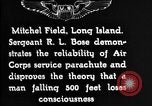
Sergeant R. L. Bose demonstrates reliability of Air Service parachutes at Mitchel Field on Long Island, New York.
Sergeant R. L. Bose demonstrates reliability of Air Service parachutes and disproves a theory that a man falling 500 feet or more loses consciousness. Civilians and military spectators watch the demonstration. Views from the airplane as Sergeant Bose free-falls from 3000 feet, delaying his chute opening until 1500 feet. Some of his free fall in slow motion. He makes a routine parachute landing. Spectators and an ambulance come as a precaution to his landing point.
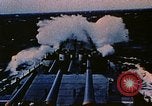
Documentary titled 'To the Shores of Iwo Jima' about the American attack on Iwo Jima in the Pacific campaigns of World War
Documentary titled 'To the Shores of Iwo Jima' about the American attack on Iwo Jima. Map shows location of Iwo Jima Island near Japan, Japanese defense lines and the American front lines. U.S. Navy forces attack on the island. Planes from carriers take off to drop bombs at Japanese targets on the island. Scenes of heavy shelling on enemy's beach installations. U.S. Navy forces head towards the beach in the initial assault. Troops debark from landing craft onto the beach. Soldiers pinned down due to heavy enemy fire. Navy corpsmen carry wounded soldiers on litters.
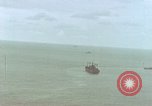
U.S. Navy warships of Task force 51 bombarding Japanese positions on Iwo Jima prior to invasion during World War II
U.S. Navy warships of Task Force 51, Joint Expeditionary Force, commanded by Vice Admiral Richmond Kelly Turner, bombard Japanese positions at the start of the campaign against Japanese-held Iwo Jima, during World War 2. Mount Suribachi visible at end of the island. The Eldorado (AGC-11), Vice Admiral Turner's flagship is seen. At time 00:20 to 1:04, the heavy cruiser USS Chester ( CA-27 ) is seen in camouflage Measure 32, design 9d, following another unidentified heavy cruiser, shelling the island of Iwo Jima. Time codes 1:05 to 1:12 show the battleship USS Tennessee (BB-43). In time codes 1:14 through 1:31 the heavy cruiser USS Salt Lake City ( CA-25) and the USS Vicksburg, CL-86, a Cleveland Class light cruiser, in camouflage (measure 33, design 6D), are seen shelling Japanese anti-aircraft gun emplacements around the east side of Motoyama airfield. The battleship, USS Idaho (BB-42) is seen in time codes 1:32 to 1:53. Other, unidentified U.S. warships are also seen bombarding the Island.

U.S. Marines land and advance near Mount Suribachi amidst enemy fire during the Battle of Iwo Jima in World War II.
'Action on Iwo Jima' depicts the Battle of Iwo Jima or Operation Detachment during World War II. United States Marines Divisions eliminate positions on Mount Suribachi. Mount Siribachi on the island coast. Additional waves of Marines arrive at the island. 3rd Marine Division arrives to enforce the 4th and 5th Divisions. Landing crafts and ships approach the shore amidst enemy fire and explosions. Crouched Marines in a Landing Craft Vehicle Personnel (LCVP). Marines advance inland amidst mortar fire and machine gun fire by the Japanese. They advance across mine fields on the beach. Soldiers unload supplies from landing crafts and ships. They pull a tank across the beach. A view of the battle from inside a tank. Marines battle around Mount Suribachi. Advanced units scale cliffs and take cover against grenades and demolition charges from the Japanese in caves and pill boxes. The Marines use flames to flush Japanese soldiers out of dug in positions. A Japanese soldier takes cover from machine gun fire. Guns fired and explosions on the island.
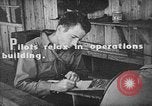
U.S. pilots in 19th Fighter Squadron operations building at Aslito Airfield, Saipan during World War II.
U.S. Army Air Forces 19th Fighter Squadron personnel on the Island of Saipan, Mariana Islands in World War 2. Pilot writing a letter at Aslito Airfield, Saipan Island. Interior operations building showing the men lounging around and relaxing. Barber giving a haircut in outside area, P-47 Thunderbolt planes in background. Airman taking a nap. Bulletin board of the fighter squadron with chalk reference to 19th Bomb Squadron (possibly meaning fighter-bomber Squadron).Contains a note reading: "Minimum buzzing alt 50 ft." Alert duty roster is posted with names of pilots, shifts they will pull, & assigned aircraft numbers. Pilots cleaning and inspecting their sidearms.
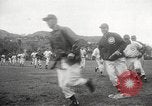
Chicago Cubs get ready for the 1950 baseball season on Catalina Island, California
The Chicago Cubs run onto the field during spring training for the 1950 baseball season. Mountains and tall trees visible in background. General manager Wid Matthews and manager Frankie Frisch confer. Cubs players pose for the camera. Several players warm up throwing arms, including #17 Bob Rush and #53 Johnny Schmitz. More players pose for camera; in shot with three players, man on the left is Hank Sauer, who would win the 1952 National League MVP for the Cubs. Cubs players take practice swings, including outfielders Andy Pafko (#48) and Bill Serena (#6).
CRITICALPAST.COM: About Us | Contact Us | FAQs - How to Order | License Agreement | My Account | My Lightboxes | Shopping Cart | Advanced Search | Featured Collections | Website Terms & Conditions | Privacy Policy ©2026 CriticalPast LLC.
License Agreement |
Terms & Conditions |
Privacy Policy
©2026 CriticalPast LLC.