


 Francais
 Deutsch
 Italiano
Refine Your Search
Puerto Princesa Island Philippines 1945 stock footage and images
- Showing 3355 to 3360 of 9920 results more
more Hide
Hide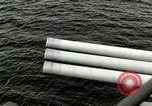
Battleship firing 14-inch guns during U.S. Naval campaign against Saipan in World War II
Bombardment of Saipan in the Mariana Islands during World War 2. Tennessee class battleship fires its triple batteries of 14-inch guns. Cruisers pass in formation. Firing from ships. Soldiers near guns on a ship. Smoke columns rise from the island under bombardment.
USAAF B-29 Superfortress bombers drop bombs over industrial targets in Tokyo, Japan during World War II.
Bombings in Tokyo, Japan during World War II. A bomb truck backs up to a United States Army Air Force ( USAAF ) B-29 Superfortress heavy bomber at an airfield on Saipan, Mariana Islands during the preparations for Tokyo bombing. A soldier writes 'Only the Beginning' on a bomb. The soldier wheeling a bomb cart to the underside of the aircraft. An airman on the top of the aircraft. A Commandant briefing the members of the 21st Bombing Command. Mission leader United States Air Force Brigadier General Emmett O'Donnell and Commanding General of 21st Bombing Command Brigadier General Haywood Hansell, Jr., look at a document and discuss on the airfield. USAAF pilot Robert Morgan, who piloted B-29 Dauntless Dotty, with another crew member. The men beside the B-29 Dauntless Dotty which would lead the team. B-29s lined up on a runway. B-29 Dauntless Dotty takes off. Several men on the airfield watch. A man beside a camera mounted on a tripod takes pictures. The B-29s take off one after the other. They head towards Tokyo. A map shows the flight path from Saipan island to Tokyo, Japan over the Pacific Ocean. Aerial view of Tokyo. The B-29s drop bombs over target areas. Explosions occur in the bombed areas. The B-29s drop more bombs over industrial targets. Explosions occur. The B-29s head back to Saipan after the bombardment. U.S. Army tents in Saipan. Japanese aircraft drop bombs over an airfield in Saipan. Thick clouds of smoke rise from the bombed areas. Wrecked B-29s in view. Flames and smoke rising from the bombed areas. Wreckage of the Japanese aircraft shot down in the raid. Men extinguishing fire. A B-29 taking off from the airfield.
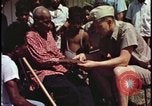
United States Army doctor examines Cold War atom bomb fallout victims near Bikini Atoll
United States Army doctor examine radiation sickness patients for fallout and radiation effects, including hair loss, likely after the disastrous atomic bomb BRAVO test at Bikini Atoll March 1, 1954 during the Cold War. U.S. Army doctor examines the eyes and teeth of an elderly Micronesian man and a little girl, as locals watch the procedure in Marshall Islands, near Bikini atoll. Army doctor examines scalp of a little boy and shows hair that has fallen out during the examination. Army doctor examines the scalp and skin of a Micronesian young woman. Micronesian young woman’s inner elbow show discoloration from radiation due to fallout. Army doctor examines the neck of a Micronesian woman. Likely residents of Rongelap Island or Utrik Atoll, which was engulfed in nuclear fallout after the BRAVO test.
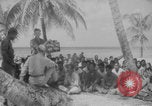
Commodore Ben Wyatt asks Bikini Atoll natives to voluntary relocate before United States testing of atomic bombs
United States Commodore Ben Wyatt, the military governor of the Marshall Islands, sits under a tilted coconut tree as he addresses the natives of Bikini Atoll. James, Commodore Wyatt’s interpreter, speaks to the locals about U.S. planning for nuclear weapon testing in Operation Crossroads. “Alright now James tell them that the United States government now wants to turn this great destructive force into something good for mankind” Commodore Wyatt asks his interpreter. King Juda, the leader of the native tribe, stands up and talks to his people. The interpreter speaks to Wyatt. King Juda gives his answer that his tribe will gladly move to Rongerik Island, as advised by the United States Navy. United States Navy personnel using clapboard before shooting scenes. Children sit near a United States Navy personnel and James the interpreter. A boy sits on top of an oil barrel. King Juda stands and talks to the tribe. The interpreter speaks to Commodore Wyatt. Commodore Wyatt stands and said “Tell him that’s fine, everything being at God’s hands it must be good”. King Juda nods in agreement. Interpreter speaks to the locals. Commodore Wyatt tells his interpreter that they will proceed with the plans for the relocation.
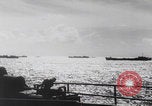
United States Army engineers repair destroyed airfield after the Battle of Saipan (WW2)
United States Army troops landing on beaches in the Pacific during World War II. An LCM (Landing Craft Mechanized) carrying troops approach an island. A tracked vehicle carrying U.S. soldiers and supplies wade towards the beach of Saipan. Injured casualties lie on stretchers on the floor. An injured soldier is being carried to an aircraft for evacuation to Kwajalein, Marshall Islands. Recovered soldiers board an aircraft bound for Saipan. A Curtiss C-46 Commando transport plane takes off from Kwajalein airfield. Saipan airfield and surrounding areas show extensive damage after Japanese surrender. Engineers repair a hangar and airstrip on Saipan. Abandoned and damaged Mitsubishi A6M Zero fighters in Saipan. A pile of destroyed Japanese aircraft in airfield. Damaged engine of a Mitsubishi Zero. Machines and conveyers mixing and transporting cement for airfield repair. A bulldozer clearing debris. A soldier hammering. Marston Mats laid down on newly repaired Saipan airfield. A Boeing B-29 Superfortress aircraft lands in Saipan.
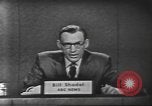
During an election debate in the US, Kennedy and Richard Nixon talk about a hypothetical invasion by the Chinese Communists.
The third Kennedy-Nixon Presidential Debate in the United States. Charles Van Fremd from CBS News asks Republican candidate U.S. Vice President Richard M. Nixon that if he were the president would he launch a war if the Chinese Communists began an invasion of Quemoy (Kinmen) and Matsu Islands and if he would authorize the use of nuclear weapons if regular conventional forces failed to halt the invasion. Nixon answers and states that it is irresponsible for a presidential candidate to indicate the course of action and the weapons he would use in the event of such an attack. He states that he would not say in advance how the U.S. would respond. He states that the Chinese Communists do not want just Quemoy and Matsu or Formosa (Republic of China or Taiwan), but the world. He concludes that defense of the free world territories and not surrender will lead to the path of peace. Democratic candidate Senator John F. Kennedy talks about a treaty to defend Formosa (Taiwan) and the Pescadores Island. He states that the U.S. would meet its commitment to Formosa. He disagrees with Nixon's suggestion that the United States should go to war if Quemoy (Kinmen) and Matsu islands are attacked as the treaty does not include these two islands. He concludes and says that the U.S. would defend if Formosa (Taiwan) or the Pescadores Island is under attack.
CRITICALPAST.COM: About Us | Contact Us | FAQs - How to Order | License Agreement | My Account | My Lightboxes | Shopping Cart | Advanced Search | Featured Collections | Website Terms & Conditions | Privacy Policy ©2026 CriticalPast LLC.
License Agreement |
Terms & Conditions |
Privacy Policy
©2026 CriticalPast LLC.