


 Francais
 Deutsch
 Italiano
Refine Your Search
Puerto Princesa Island Philippines 1945 stock footage and images
- Showing 3391 to 3396 of 9920 results more
more Hide
Hide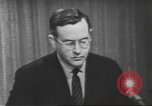
Vice President Nixon and Senator Kennedy debate over Quemoy and Matsu issue prior to presidential elections in the U.S.
The fourth presidential election debate held between Democratic nominee Senator John F. Kennedy and Republican nominee U.S. Vice President Richard Nixon in New York, United States on 21st October 1960. ABC News correspondent Quincy Howe speaks during the debate and allows NBC correspondent John Chancellor to pose a question to Richard Nixon a . Correspondent Chancellor asks a question about Quemoy and Matsu issue. Vice President Nixon points out inconsistency of Senator Kennedy. He further explains it by saying that Senator Kennedy signed a resolution in 1955 which gave the president the power to use United States forces to defend Formosa (Taiwan) and offshore islands. But he also voted for an amendment which was lost, an amendment which would have drawn a line and left out those islands. Vice President Nixon supports President Eisenhower's position. Correspondent Howe asks Senator Kennedy to comment on the topic. He speaks about President Eisenhower sending a mission to persuade Chiang Kai-shek in the spring of 1955 to withdraw from Quemoy and Matsu because they were exposed. The President was unsuccessful. He refers to the fact that in 1958, as a member of the Senate Foreign Relations Committee, he was very familiar with the position that the United States took in negotiating with Communist China (PRC) on these two islands. He further that the U.S. was unable to persuade China's Chiang Kai-Shek to withdraw and thus it was decided by the U.S. to defend the islands.
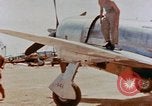
P-47 operations of USAAF 464th Fighter Squadron, 507th Fighter Group,on Ie Shima Airfield in World War II
Armorers work on P-47N Thunderbolts of the 464th Fighter Squadron, 507th Fighter Group, on Ie Shima Airfield, Ryukyu Islands, Japan. The unit was targeting Kyushu, Japan, near end of World War 2. Airmen near P-47s. Airman on the wing of a plane. Another walks nearby. Gun camera footage shot inflight and aerial views of return to Ie Shima, including the landing rollout.
U.S. B-29s bombing Japan mainland from Marianas Bases during Second World War
Numerous B-29 bomber aircraft operating against Japanese targets from Northern Marianas Islands bases during World War II in the Pacific. U.S. Army Air Force bombers are seen from following units: Guam-based 314th Bomb Wing, 39th Bomb Group (Tail Code "P"), 29th Bomb Group (Tail Code "O") and 330th Bomb Group (Tail Code "K"); Tinian-based 313th Bomb Wing, 6th Bomb Group (Tail Code"R"); Saipan-based 73rd Bomb Wing, 497th Bomb Group (Tail Code "A"). Aircraft of these units are all seen taking off on missions. View from inside cockpit of a B-29 aircraft taking off. Pilot calls for and signals "gear up" to copilot. View from nose of the aircraft as it flies low over some ships. On airfield, a ground controller/dispatcher is seen on radio telephone. View aboard a B-29, during mission, as bombardier signals that he has control of the B-29. Large clusters of incendiary bombs dropping from B-29s. Bombs away views of many bombs dropping from open bomb bay doors. Explosions and flashes on ground as bombs impact Japanese enemy targets. Huge clouds of smoke rise and obscure the scene after the strikes. B-29s returning to land after the mission. View from nose as a B-29 touches down and taxis on active runway. Crew members discussing mission in front of parked B-29. Final scene is of formation of B-29s from Saipan-based 73rd Bomb Wing, 499th Bomb Group (Tail Code "T").
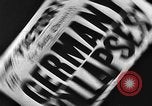
Training and life of a Japanese soldier. Boyhood indoctrination; fighting in Nanking, China. American casualties in Marianas
Life and indoctrination of Japanese troops during World War II. Newspaper headline reads 'Germany Collapses'. People celebrate and have drinks at bar. Table with few glasses and a liquor bottle. A Japanese soldier lay dead. Japanese flag and Koinobori carp windsock on pole. Japanese boys being indoctrinated to militarism, marching, drilling, in organized play, with model artillery pieces. Young Japanese soldiers in regiment commencing Japanese assault on Nanking, China. Scenes of Chinese civilians suffering at hands of Japanese soldiers. Views of Japanese atrocities perpetrated in Nanking. Japanese ships underway to Mariana Islands. Dead Japanese soldier. American troops attacking Japanese soldiers holed up in jungles. Staged enactment of last surviving Japanese soldier in a cave, who, instead of surrendering, seizes pistol of his slain officer and attacks Americans with it. Actual scenes of American wounded soldiers being carried out of jungle on stretchers following a battle with Japanese forces. Vast numbers of Japanese soldiers parading. American military dead being buried at sea, with a scene of many caskets draped in American flags poised for release into the ocean during the ceremony. Clip closes with Anti-Japanese propaganda message on screen "Get the Jap -- And Get it Over" directed at U.S. soldiers viewing the film.
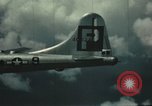
B-29 Superfortress aircraft of the U.S. 314th and 73rd Bomb Wings during World War II
Aerial views of B-29 Superfortress of the 314th Bomb Wing, displaying the Square P tail code of the 39th Bomb Group. It is in flight and flying around the coast of Guam, Marianas Islands, during World War 2. In the far distance, a B-29 is seen taking off from North Field, Guam airstrip. In separate sequence, a B-29 from the the 73rd Bomb Wing, displaying Plain T tail code of the 498th Bomb Group, lands at Isley Field, Saipan, and taxis behind a follow-me jeep. B-29 of the 497th Bomb Group, with tail code Plain A, seen parked on the field.
Crew of grounded Dutch submarine, O-19, being rescued by the U.S. submarine, USS Cod (SS-224) during World War II
A U.S. Navy PB4Y-2 Privateer aircraft flies low over the submarine, USS Cod (SS-224) as 3 of her crew members paddle a yellow inflated rubber raft to the Dutch submarine, O-19, aground on Ladd Reef, in the Spratly islands, South China Sea, during last month of World War 2. Crew members of the O-19 are seen on her deck. Rescued Dutch sailors seen aboard the USS Cod. Light signals being sent from the O-19, but no crew visible on her deck.
CRITICALPAST.COM: About Us | Contact Us | FAQs - How to Order | License Agreement | My Account | My Lightboxes | Shopping Cart | Advanced Search | Featured Collections | Website Terms & Conditions | Privacy Policy ©2026 CriticalPast LLC.
License Agreement |
Terms & Conditions |
Privacy Policy
©2026 CriticalPast LLC.