


 Francais
 Deutsch
 Italiano

Refine Your Search
Qui Nhon Vietnam 1970 stock footage and images
- Showing 763 to 768 of 4260 results more
 Hide

U.S. troops and airmen get off from a TWA jet and sit in a terminal area at Bien Hoa Air Base in Vietnam.
U.S. soldiers seated in a terminal area at Bien Hoa Air Base in Vietnam during the Vietnam War. A TWA (Trans World Airlines) jet taxis to an unloading area at Bien Hoa Air Base. A soldier at the airfield with barracks bags kept near him. The TWA jet is stationary. Ground crewmen push aviation passenger stairs. A sign on the stairs reads 'Welcome Det 5 8 Aerial Port, Bien Hao Air Base, Republic of Vietnam'. A soldier at the air base with 'Concor' written on his helmet. U.S. airmen and soldiers get off from the aircraft. They assemble and sit in the terminal area. A close up of U.S. recruit Richard Gillispie with another soldier seated in chairs. Gillispie smiles.

U.S. soldiers sit on barracks bags and wait for transportation to take them to their assigned units in Vietnam.
U.S. soldiers sit in small groups and wait for transportation in Vietnam during the Vietnam War. Signs of various locations in Vietnam where the soldiers can be shipped. A helicopter in flight and a loudspeaker on a pole in the background. A pile of barracks bags kept on the ground. The soldiers wait for transportation to take them to their assigned units. A sign reads 'Movement Control'. Another sign reads '9th Inf Division'. The soldiers seated on barracks bags in a small group talk. A sign reads 'Pleiku' . Trucks loaded with the soldiers move out. Insignia of the United States on a truck.

USAF Sergeant Gaa speaks about time period of missions and necessary equipment they carry with them in Vietnam.
U.S. Air Force (USAF) Combat Control Team in Vietnam during the Vietnam War. USAF Sergeant Gaa speaks about time period of missions in Vietnam. He also speaks about necessary equipment they carry with them during the missions. He also speaks about kinds of radios they use in operations.

Combat artist Captain John H. Dyer creates artwork in village during Vietnam war.
Artistic depiction of United States Marine Corps (USMC) Marines moving in Vietnamese jungle during Vietnam War. Marines in a rural village. Vietnamese children gather to watch Marine Reserve Captain John T. Dyer creating a ‘Combat Art’ artwork. Captain Dyer sketches as children curiously watch the Marine. Captain Dyer talks about the artistic inspiration he finds during his stay in Vietnam, saying, "I'd like to come back to this country someday when I don't have to wear a 45 on my hip." A Vietnamese boy comes near Dyer to watch him work closely. An old man peers behind Dyer. A ‘Combat Art’ painting of Vietnamese fishermen on boat created by Dyer during his time in the Vietnam War.
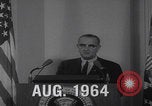
President Johnson addresses the public on United States actions against North Vietnam
During the Vietnam War, President Lyndon B. Johnson addresses the United States public during the “Radio and Television Report to the American People Following Renewed Aggression in the Gulf of Tonkin” from the Fish Room at the White House in August 4, 1964. "Renewed hostile actions against United States ships on the high seas in the Gulf of Tonkin have today required me to order the military forces of the United States to take action in reply,” says President Johnson. The USS Constellation (CV-64) aircraft carrier sailing. Pilots walk away from Douglas EKA-3B Skywarrior fighter jets in the USS Constellation. Aircrafts fire missiles, destroying facilities in North Vietnam. United States Secretary of Defense Robert McNamara addresses the public to explain the direct attack against North Vietnam. “We wish to emphasize we seek no wider war. Our response will depend upon the action of the aggressors, in this case the North Vietnamese. The key to the situation remains the cessation of infiltration from the North into the South,” says Secretary McNamara.

Change of Command I FFV (First Field Force Vietnam)-ARTY (Artillery Men) in Nha Trang, Vietnam
Change of command IFFV (First Field Force Vietnam)-ARTY (Artillery Men) in Nha Trang, Vietnam. Soldiers stand in formation while the leader raises flag at half past. Officers seated on chairs watch the ceremony. Officers and soldiers salute. Soldiers in line raise the flags at half mast. Officers exchange flags. Four officers march with American flag and another flag. Officer speaks on microphone with 5th Special Forces Group written on board in the background. Soldiers stand with rifles in hand (Vietnam War period).