


 Francais
 Deutsch
 Italiano
Refine Your Search
Qui Nhon Vietnam 1970 stock footage and images
- Showing 2743 to 2748 of 4260 results more
more Hide
Hide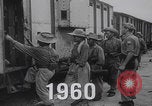
United States Army advisors train South Vietnamese, combat and capture Vietcong before Vietnam War.
South Vietnamese soldiers board an armored rail car in a train in 1960 before the Vietnam War. Close view of steam locomotive wheels and piston as it starts up. A silhouette of a soldier with gun on board a train with tracks in the foreground. An explosion on train tracks ahead. A gun firing from a gun turret. A machine gun firing from a slit. Soldiers running up a hill and field. They shoot with guns in the smoke-covered battlefield. Explosion in the field. South Vietnamese soldiers evacuate wounded and carry equipment out of battle. United States officials disembark from United States aircraft. A United States official, possibly retired General Maxwell Taylor, is interviewed by the media. United States and South Vietnamese soldiers inspect a cutaway of an airplane engine and propeller during training. A United States Air Force instructor shows an aircraft model to South Vietnamese pilots. United States and South Vietnamese pilots shake hands. South Vietnamese pilot sits in fighter plane cockpit. The cockpit canopy closes. A United States Army specialist speaks to South Vietnamese soldiers in Vietnamese during weapons training. United States military adviser talks to some soldiers, pointing to a map. Soldiers carrying ammo boxes and weapons, and wearing foliage for camouflage. An African American soldier holding a 60mm M2 mortar. Soldiers shoot guns, including M1919 Browning machine gun, as Vietcong soldiers run away. Camouflaged U.S. and South Vietnamese soldiers running towards jungle. A U.S. soldier points as a young Vietcong soldier emerges from brush. Captured Vietcong prisoners sit on the ground and are led away. United States medical specialists treat Vietnamese civilians in village. An army doctor uses a stethoscope on a woman’s chest.
Vietnamese soldiers jump out of helicopters and fire at enemy positions (Vietnam War)
United States helicopters on airfield during the Vietnam War. United States Army advisors talk to one another. They share maps, papers and discuss plans. U.S. and South Vietnamese soldiers board United States helicopters...including a CH-21C Shawnee. A Sikorsky UH-34D Seahorse takes off from airfield. South Vietnamese soldiers onboard helicopter holding rifle and machine gun. A group of helicopters in flight. Point of view from helicopter as it flies down a river. Piasecki H-21 helicopter in flight. A South Vietnamese soldier looks out of window. South Vietnamese soldiers jump out of helicopters and cross rice field after landing. Aerial view showing some soldiers using a field telephone in the middle of a dense jungle. Two United States soldiers shout at each other. An injured U.S. soldier lies on a stretcher and loaded on helicopter. A South Vietnamese soldier in helicopter. The helicopter flies away. A South Vietnamese Navy captain shows his United States counterpart enemy positions after looking through binoculars. Swift boats shooting at Vietcong forces. South Vietnamese soldiers carrying weapons and landing on beachhead. A South Vietnamese soldier gives signal to fire. An explosion on beachhead. South Vietnamese soldiers load shells into mortar and fires them. An injured South Vietnamese soldier with saline tube attached to him lying on a stretcher. The injured soldier cries in pain. Vietnamese women watch medics clean another soldier. A Vietnamese soldier prays for the dead, incense burns in front of him.
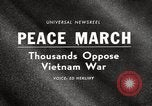
The anti war protests against the United States involvement in the Vietnam War.
Anti-war protests in the United States during the Vietnam War. Protesters march and demonstrate against the United States involvement in the Vietnam War from Central Park to the UN headquarters in New York City. Demonstrators in crowd holding protest signs. A number of African American marchers hold signs that read, "Black men should fight white racism, not Vietnamese freedom fighters." Another sign reads, "They are our brothers whom we kill." Masses of people including doctors, teachers, and businessmen on streets. People dressed in different costumes and 1960s hippie fashion as they protest. Young men participate in burning their draft cards while a crowd gathers around to watch the draft card burning. Pro-war counter protestors (sometimes called "Hawks") also demonstrating and arguing with anti-war activists. Pro-war banner reads, "End Hanoi Sanctuary. Let's bomb Hanoi to win the war and destroy the Communist conspiracy." Another Hawk sign reads, "Anarchy Cannot be Permitted in the USA. Fight Communism and Red Termites." African American civil rights activist Martin Luther King Jr. walks toward the United Nations building with other officials advocating peace. Policemen drag a protester. Scene changes to San Francisco: 50000 people carry banners as they protest the war in Vietnam and march to the Kezar Stadium (670 Kezar Dr, San Francisco, CA 94118, United States) for a mass assembly. People push each other during the protest as pro-war demonstrators clash with anti-war demonstrators and pacifists. A huge crowd gathered at a stadium.
United States President Lyndon Johnson declares that U.S. pilots have resumed bombings over North Vietnam.
United States President Lyndon Johnson addresses the nation. United States resumes bombings over North Vietnam. U.S. aircraft carry out air strikes against Vietnam. President Johnson sits in his office. U.S. pilots inspect their aircraft and work under the wings. Air raids on supply depots and railroad lines. The planes take off from an aircraft carrier. U.S. soldiers in trenches. An aerial view of the land below. Smoke rises up due to explosions. A meeting in the United Nations Headquarters. Dignitaries of various countries seated during the conference. (Vietnam War period).
U.S. Defense Secretary Robert McNamara reports air strikes on oil depots of Hanoi and Haiphong in North Vietnam.
United States Defense Secretary Robert McNamara at a press conference in the United States. He talks about air strikes against North Vietnam targets during the Vietnam War. A map of Haiphong and Hanoi on a wall. Cameramen take photographs. U.S. aircraft carry out bombing air strikes against Haiphong and Hanoi in Vietnam. U.S. troops load bombs onto Thunderchief F-105 aircraft and F-105 aircraft takeoff for bombing run. Air raids on oil depots in Haiphong and Hanoi. U.S. Navy aircraft take off from USS Ranger (CV-4) aircraft carrier. An aerial view of the land below. Smoke rises up due to explosions.
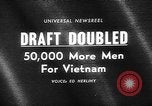
U.S. President Lyndon Johnson's speech on his decision to increase U.S. forces in Vietnam; in Washington DC, United States
U.S. President Lyndon Johnson's Washington Press Conference address on his new policy for Vietnam. President's wife Lady Bird Johnson and daughter Lynda Bird Johnson Robb in attendance. Members of the press seated in the room and take down notes. President Lyndon Johnson addresses the press. The President says that he wishes to convey to Communist powers in Vietnam that the United States cannot be defeated by 'force of arms or by superior power.' The President states that he has spoken to Commanding General Westmoreland has assured him that whatever his needs are, they will be met. He says that U.S. troop numbers in the Vietnam War will be increased from 75,000 to 125,000. Additional forces will be needed later which will be sent. Brief shots of young men recruits in the United States standing in line for the draft, taking tests, and taking the oath as soldiers. The President says that he welcomes the concerns of any nation.