


 Francais
 Deutsch
 Italiano
Refine Your Search
Qui Nhon Vietnam 1970 stock footage and images
- Showing 445 to 450 of 4259 results more
more Hide
Hide
French capitulate to North Vietnamese, and leave Indochina. Geneva Conference divides Vietnam.
Division of Vietnam into North and South Vietnam as Indochina war ends up in Vietnam. Aerial view of cratered battle ground, with smoke rising, at Dien Bien Phu, Vietnam, in March, 1954. A French A-26 Invader aircraft flying above some clouds and pilot in cockpit using radio. French paratroops, dropping from C-47 aircraft, and landing, to reinforce troops dug in at Dien Bien Phu. French artillery firing and rounds exploding in the distance. French troops moving through brush, and carrying wounded back out. Citizens on streets of Hanoi, North Vietnam, scrounging for scraps to eat. An old woman hunkered down in a doorway. A mother with a young boy. French troops crossing a bridge as they surrender following the siege at Dien Bien Phu. North Vietnamese troops entering Hanoi. Delegates at the Geneva conference of 1954, in the Palais des Nations, including representatives of the Soviet Union, the United States, France, the United Kingdom, and the People’s Republic of China, among others. Closeup of Soviet delegation, with Foreign Minister, Vyacheslav Molotov, second from left. View of the North Vietnamese delegation, and delegate Ta Quang Buu, Vice Minister of Defense of the Democratic Republic of Vietnam (North Vietnam), and Head of their Military Delegation, signing the accords. Closeup of one treaty page, with his signature, as Minister of Defense, and that of Henri, Deltiel, Brigadier General, who signed for the Commander in Chief of all French Forces in Indochina. OUtdoors. After the conference, Soviet Foreign Minister, Molotov shakes hands with Chou En-lai, Chinese Foreign Minister. Soviet Deputy Foreign Minister,Andrei Gromyko, wearing a hat, is standing behind Molotov. A long line of refugees fleeing to the South, from North Vietnam. A 1954 map showing the division of North and South Vietnam at the 19th parallel. Mist settled among mountain tops. South Vietnamese people engaged in agricultural pursuits and building new dwellings. South Vietnamese placing ballots in boxes during elections. Brief glimpse of the glamorous Madame Ngo Dinh Nhu, defacto First Lady of South Vietnam, dressed in ao dai and wearing dark glasses, as she leaves a polling place. Farmers dressed in traditional conical hats (non la) working in grain fields, and reaping and carrying cut grain on poles in the South. Beautiful view of fishermen and boats silhouetted against sky, with tall limestone islands in background, at Ha Long Bay, North Vietnam (incorrectly implying it shows South Vietnamese in peaceful pursuits). South Vietnamese at work building structures with concrete blocks. A car with bullet holes in the windshield, draws attention on busy street in South Vietnam. Closeup of murdered man inside on floor of car. Scenes of vandalism at a house. Viet Minh guerillas moving through jungles and setting fires to straw roofed houses. Remains of a destroyed dwelling. Bodies of South Vietnamese killed, according to the narrator, by "Viet Cong pursuasion squads." A framed picture of Ho Chi Minh, over a North Vietnamese star flag.
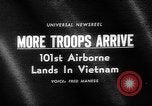
The members of the 101st Airborne Division transported to Cam Ranh Bay in South Vietnam during the Vietnam War.
U.S. military troops being transported to South Vietnam, Vietnam during the Vietnam War. A vessel underway in ocean carrying U.S. soldiers to South Vietnam. Members of the 101st Airborne Division arrive at Cam Ranh Bay. The soldiers are taken in army vehicles to the base. The soldiers at the base. The regimental banner and the U.S. flag. General Taylor who retires as the U.S. Ambassador to Vietnam with the soldiers. The soldiers salute. The men of the Screaming Eagle Division take up their positions at the new base. The U.S. soldiers near army vehicles. A few soldiers on heels. A soldier in position.
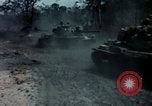
U.S. Army provides aid and assistance to South Vietnamese people in support of Republic of Vietnam Development Program
The U.S. Army providing military security in Vietnam to facilitate the Republic of Vietnam Revolutionary Development Program during the Vietnam War. U.S. Army tanks on the move. Vietnamese village on a river, with small boats at the bank. Irregular volunteer with M-16 walks over small bridge. Republic of Vietnam representatives in a rural village trying to win allegiance of the people with simple social and economic projects. Seen are persons providing health assistance, supervising small construction activities, and teaching school. U.S. Army officers advising Vietnamese officers as they consult a large map in a headquarters. U.S. Army advisory team listens as Vietnamese officer explains an agricultural project in rural Vietnam. District Advisor, a U.S. Army Major, named Taylor, converses with a South Vietnamese officer, during a meeting. South Vietnamese rural townsfolk standing outside a building where American dentist is providing care to local populace. A U.S. Army roadbuilding project in rural South Vietnam. American soldiers handing out candy to Vietnamese children and distributing food and clothing to rural poor. U.S. Army Civil Affairs Companies, engaged in building construction, bridge construction, agriculture improvement, public health medical care and refugee assistance. U.S. Army surgical team providing services to the Vietnamese. Army engineers work on water supply system while small Vietnamese children bathe in the water. Supplies captured from the enemy, including rice, salt, food, clothing and medical supplies, are distributed to the local population.
U.S. Army operations in Vietnam which is at war with Buddhist majority and Viet Cong communists.
Vietnamese government faces Vietnam war on two fronts from Buddhist majority and Viet Cong communists. The war is joined by a large number of students who take to the streets. The capital Saigon tuned into an armed camp. Barricades on roads as the army keeps a vigil among the public. A military tank in the city. A mass meeting called by President Diem's regime on the roads of Saigon. Numerous students and supporters gathered in the streets. Banners and posters in support of President Diem. The President makes a rare and brief appearance at the meeting. He inspects the Honor Guard. Madam Nhu and her husband, head of the secret police seen standing with children. Madam Nhu gives marathon interviews stating her views against the United States and President John F Kennedy. Ton That Dinh, Military Governer of Saigon at a press conference blaming foreign interventionists for the riots in Vietnam. Henry Cabot Lodge takes over as U.S. Ambassador to Vietnam. Ambassador gives a statement to the media. He demands the ousting of President Diem's brother Nhu in order to continue American aid to Vietnam. U.S. soldiers known as advisors stand beside a U.S. Army helicopter as they plan their strategy. U.S. Army helicopters in a marshy swamp. Soldiers board the helicopters as they take off. The helicopters with U.S. and South Vietnam troops approach the Ca Mau Peninsula. A view of the village taken over by the Viet Cong Red Guerilla Band. Damaged houses near the water body. A helicopter down in a rice paddy. U.S. soldiers run to the safety of other helicopters as Communist Vietcong snipers begin shooting. U.S. soldiers take cover behind the crashed helicopter. An American soldier running to safety in the water. A village set on fire by North Vietnamese Communists in the Mekong Delta. View of wiped out villages.

Gulf of Tonkin response: President Johnson announces U.S. action as United States soldiers and aircraft are rushed to Vietnam
United States planes and soldiers are rushed to Vietnam, responding to the Gulf of Tonkin crisis. U.S. Destroyer Maddox seen underway in the gulf of North Vietnam following reported skirmish with North Vietnamese torpedo boats (the "Maddox Incident.") Narrator indicates U.S. war planes from two carriers avenged the unwarranted Red communist assault with 64 sorties against North Vietnam. An airman boards a U.S. aircraft. Night view of the White House in Washington DC. President Lyndon Johnson addresses the American people in a midnight speech on August 4, 1964 describing U.S. actions in response to the Gulf of Tonkin incident. Scenes of South Vietnamese women and children evacuees looking exhausted and scared beside nearby American helicopters. The President's speech continues, including, "We Americans know, although others appear to forget, the risks of spreading conflict. We still seek no wider war." View of the United Nations building in New York and flags of various nations at the UN building. Ambassador Adlai Stevenson is seen making his report of the Gulf of Tonkin attacks to the UN Security Council and affirms U.S. position that it wants the people in Vietnam to be free of North Vietnamese intervention and agression. United States military advisors and U.S. Army soldiers board helicopters. A gunner aims at a target on the ground. Vietnamese troops accompany U.S. soldiers. South Vietnamese forces exit a helicopter and wade through water and rice paddies. U.S. soldiers advance in trucks with artillery. A Douglas TBD Devastator aircraft takes off armed with a torpedo. Another one lands at an airfield. A TBD plane, armed with a torpedo, taxis with wings folded. several TBD aircraft parked on a flight line. The President concludes his remarks referring to "firmness in the right" being indispensible for peace. (Vietnam War period).
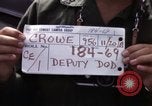
E. R. Zumwalt, Captain Faulk, Commodore Chon and W. R. Flanagan await the arrival of Mr Packard in Vietnam.
Vietnam tour by U.S. Deputy Secretary of Defense David Packard . U.S. Vice Admiral Elmo Russell Zumwalt, Comnavforces, Vietnam talks with Captain Faulk of the U.S. Navy. They await the arrival of U.S. Deputy Secretary of Defense David Packard at Binh Thuy Air Base. Rear Admiral W. R. Flanagan, Deputy Commander Naval Forces, Republic of Vietnam talks with Commodore Tran Van Chon, Chief of Naval Operations,Vietnamese Navy. Rear Admiral W R Flanagan in military clothes. Aide of Commodore Chon stands in the background. W. R. Flanagan, Commodore Chon and an unidentified Republic of Vietnam officer stand. Commodore Chon chats with Captain Faulk, W. R. Flanagan and Elmo Russell Zumwalt while waiting for Mr. Packard. David Packard arrives. He gets off a car. The welcoming committee moves towards the car to greet Mr Packard. Zumwalt, Chon and others welcomes Mr Packard. An unidentified man shakes hands with Mr Packard in the foreground. Aircraft parked in the background. Republic of Vietnam police in a jeep. A motorcade prepares to start up.