


 Francais
 Deutsch
 Italiano

Refine Your Search
Qui Nhon Vietnam 1970 stock footage and images
- Showing 43 to 48 of 4260 results more
 Hide

Scenes of college women in 1970s fashions socializing together at Morton Hall in the University of Alabama in Huntsville
1970s college fashions at the University of Alabama. A young woman, holding a colorful umbrella, calls for her friend, saying "hey c'mon Sherry, hurry up!" Sherry catches up with the young woman to go to class together at Morton Hall in the University of Alabama in Huntsville (301 Sparkman Dr NW #116A, Huntsville, AL 35899). The women are wearing 1970s bell bottom jeans. Women read books together on Morton Hall entrance, one of them holding a macrame handbag and the other wearing white painters overalls. Two women, one wearing a backless dress, sit on stairway and talk together inside Morton Hall.
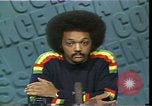
Patrick Borgan questions Jesse Jackson on Civil Rights protests of the 1960s versus 1970s approaches, during a press interview.
Jesse Jackson is interviewed in a press conference. Jesse answers Patrick Borgan of London Times on protesting peacefully with reference to 1968 and its riots and unrest vis-à-vis Civil Rights and racial equality for African Americans. Judith Randal of New York Daily News and Henry McGee of Newsweek Magazine are also present. Bill McCrory of Voice of America is the moderator. Jackson discusses the purposes of the protests of the 1960s, and explains that the vision toward the goal of equality takes time and has curves, rather than being a straight line. He implies that some people because satisfied with the gains from the 1960s, but that there is more to do, and that moral depravity and a lack of good ethics is the current obstacle in the 1970s holding back progress.

Various American activities, lifestyle, and industries as seen in the early 1970s.
Children at school cafeteria lunchroom in a school. A boy selects food from the lunch line offerings and puts it on his tray. Building of the Department of Housing and Urban Development. A few POV views of buildings and homes of a small town along a rural road, as seen from a moving car or vehicle. A small power plant. Sign announcing future home of Loudoun County campus of the Northern Virginia Community College. A Childrens Hospital under construction. A new campus under construction for the Mercer County Community College. A mother and baby. A newborn baby being brought to car from hospital, by a nurse. Area of heavy industry. Contaminated beach in Mendocino County California with warning sign, "Raw sewage. This beach quarantined." A working cowboy with rope lariat. A golfer on golf links. A farmer plowing behind a mule. A large piece of farm equipment in operation. A small ferry moving several cars across a river. Low aerial view of late 1960s and early 1970s cars on a network of highways.
Man smoking at night, woman getting on bus, women driving and at gas station, girls at roller rink 1970s.
View of a dark, secluded street at night. A soldier holds a lighted cigarette, with cigarette butts littered on the ground. Close up car headlight turning off. Woman's feet stepping out of car. Young female sergeant walks alone in secluded street at night. Soldier throws cigarette butt on the ground at night. Bus pulling up to bus stop in Alabama. Young woman wearing 1970s fashions, with blue boho head scarf steps onto bus as doors open. Blond woman holding groceries unlocks car door. Young woman sitting in driver’s seat as gas station attendant at Gulf gas station cleans windshield of her sports car. Car drives down street at night while 1969 Mustang GT car pulls away. African American girl and her friend in pigtails approaches the African American girl’s father in a roller skating rink. The African American girl tells her father that her friend needs a ride home. Man looking through binoculars at night. Views of several apartment windows at night with curtains drawn. Man putting down binoculars and closing curtains at night. A soldier greets a young female sergeant. Female sergeant asks the soldier to hold her handbag for her while she plays billiards with them. After the soldier asks if it was an order, the female sergeant hands over her handbag to him, explaining “… it’s called being a good sport.”

View of the Erie Canal in New York; 1800s and 1970s views of the Eric Canal
Television program host, Lee Marvin talks about the Erie Canal in New York. Historic still images from 1800s showing the Erie Canal and surroundings. View of the Erie Canal that connects Great lakes with the Atlantic Ocean. Modern moving images of a steamer on the Erie canal.

President Nixon presides over the 1970 Christmas tree lighting ceremony, in Washington, DC
Opening scene shows a large crowd in a rain storm, gathering on the Ellipse near the White House in Washington, DC. Almost all carry or share colorful umbrellas. Scene shifts to s choir on a covered stage and President Richard Nixon standing at a podium on an adjacent stage. The gathered audience is unprotected except by their umbrellas. On the stage with the President are Mrs. Nixon and daughters Tricia Nixon and Julie Eisenhower. In his preliminary remarks, the President mentions the weather, saying, "I know we want to express our very grateful appreciation to the Mormon Choir and to the Friends University Symphonic Choir for their participation and particularly under the rather adverse weather conditions which I know are very hard for those of you here in the audience." Camera focuses on the choir members. Next, a Girl Scout, in uniform, speaks at the podium. She is followed by a boy scout who also makes some remarks. President Nixon then delivers a Christmas message, saying that the nation could look forward to the end of the war. The President then steps down from the stage, to where several children have their hands raised in hopes of being selected to assist in the tree lighting. Nixon reaches down and picks up five-year-old Andre Proctor of Washington, D.C., saying, "he's the smallest child here." The President speaks with the boy about what they are going to do, as members of the audience watch from under their umbrellas. Next, the Christmas tree lights are seen, from a distance as they turn on, illuminating the area. Camera focuses and pans over the many lights on the tree. The President and his family are seen on the stage, as the camera pans over the choirs, audience, and the Christmas tree.