


 Francais
 Deutsch
 Italiano
Refine Your Search
Rio de Janeiro Brazil 1946 stock footage and images
- Showing 163 to 168 of 2632 results more
more Hide
Hide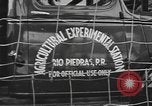
Puerto Rican men drain mosquito infected ditches to fight malaria under National Youth Administration
Men transplant seedlings at the agricultural experimental station under National Youth Administration in Rio Piedras, Puerto Rico. A tree grown from a seedling. Men drain mosquito infested ditches to fight against malaria. Girls march to create awareness against malaria. Ditches cleaned up. (World War II period).
Launching of NATIV missile under Project MX770 in California United States.
A scientist makes a presentation of Project MX770 showing coverage of model and various phases of missile development from 1946-1951. Development of NATIV (NORTH AMERICAN TEST INSTRUMENTATION VEHICLE) missile is between 1946-47 while NAVAHO is developed between 1948-49.The presentation shows the pulling of test vehicle under launching tower and its vertical position. A technician ties guide wires near the top of the missile.The missile is fired. Graphical presentation shows the parabolic pathway of missile showing altitude of 400mt and speed of mach8 (2722.32m/s). The firing range of Navaho is 3000mt from surface to surface.The missile uses Ramjet engines. Models of three missiles are also shown.
United States aircraft carrier USS Independence (CVL-22) damaged in Operation Crossroad "Test Able," risk in daily lives and discussion of radioactivity.
'Radioactive contamination' about the hazards posed by the sinking of a United States aircraft carrier and the methods to control radioactivity. United States Navy F6F-3 Hellcat aircraft taking off from United States aircraft carrier USS Independence (CVL-22) in the Pacific Ocean during World War II. F6F-3 Hellcat firing rockets in air. Landing signal operator LSO using flags while guiding plane for landing on USS Independence. Kamikaze attacks at Tarawa. Anti aircraft guns on carrier cut down kamikaze planes as they attack. USS Independence flying USA flag at Tokyo Bay. Scene of surrender of Japanese at Tokyo Bay aboard the USS Missouri. Aerial view of atomic bomb blast at Bikini in 1946. The wrecked carrier Independence being towed away after it was used as a target for an atomic bomb test in 1946 as part of Operation Crossroads. Men at a construction site talk about contamination caused in sea water due to sinking of Independence containing radioactive waste. They comment, "she's all full of that radioactive poison" and with respect to eating fish in water near the ship, "would you eat fish again?" Two women dressed in furs, in a car, also discuss radioactivity. One woman says, "from what I've heard it's very dangerous. " View of 1940s car backing into oncoming traffic and almost causing an accident. An aerial view of atomic explosion at Bikini. Damaged USS Independence ship after TEST ABLE. Signs on board warn of radioactivity with words, "Keep Clear, Danger! Very Radio-Active" and "Radioactivity. Do not remain more than 2 hours." Men in small boat near USS Independence examine damage to the ship. Parts of the USS Independence being tested for radioactive contamination at the Naval Radiological Defense Laboratory NRDL, Hunter's Point Naval Shipyard in San Francisco, California. The USS Independence being sunk in 1951. View of Bikini atomic bomb blast within a bay surrounded by ships. Simulation shows the effect a similar blast would have on a coastal city as a radioactive cloud covers the city. Officers holding handkerchiefs to their mouths as they enter an office building from outside. Firemen climb ladders while putting out a large fire. A house wife working in a kitchen and responding to a pot boiling over on the stove burns her hand. A man slips on a bar of soap in the shower while singing. An officer honking at an oncoming car as he is run off the road. Woman driver dressed in furs exclaims to her friend about the bad driving of men. Officer just run off the road by woman driver exclaims, "Women !" with frustration. Aerial view of test nuclear explosion at Bikini Atoll.
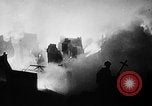
Germany bombs London during Blitz, and United States sends Lend-Lease war materiel to England (WW2)
The London Blitz. Sections of London ablaze from German bombing during Battle of Britain. US President Franklin Roosevelt signing H.R. 1946, Lend-Lease legislation in World War II. View of last page of H.R.1946, signed by Sam Rayburn, Speaker of the U.S. House of Representatives, and by President Roosevelt. United States sends war material to England. 'USA' written on Lend-Lease boxes being loaded on lorry after arrival in Britain. Huge crates of Lend-Lease war materiel on railroad flat cars pulled by locomotive. Smoke rises up from the engine. 'Machine tools, BULLARD, Bridgeport Conn.' written on crate in transit.
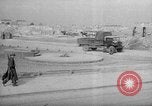
Ruined buildings outside Warsaw, and the first memorial to the Warsaw Ghetto uprising in Poland
Scenes shortly after the end of World War 2. View of the mostly cleared rubble and ruins in Warsaw, Poland, near the intersection of Anielewicza Street, Karmelicka Street, Lewartowskiego Street and Zamenhofa Street in the devastated Warsaw Ghetto district of Muranów, near where the first armed clash of the uprising occurred. Two soldiers walk by on a sidewalk beside the round memorial on the street corner. A truck is parked on an intersecting street. There are mostly open sight lines into the distance with all buildings having been destroyed. A horse cart moves along the road. A jeep with soldiers pass along the road. Closer views of the first memorial to the Warsaw Ghetto Uprising (also later called the Monument to the Ghetto Heroes), designed by Leon Suzin. Views of the inscription on the stone memorial, dated April 19,1946, and commemorating Polish Jews who fought against German military forces in World War 2. Translated, it reads, "To those who fell in an unprecedented and heroic struggle for the dignity and freedom of the Jewish people, for a free Poland, and for the liberation of mankind. Polish Jews." Some flowers laying at the memorial site. (The round 1946 memorial tablet, with its shape symbolizing the underground manholes used during the uprising, was later incorporated into the larger Monument to the Ghetto Heroes, sculpted by Nathan Rapoport and unveiled in 1948.)
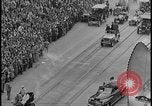
Hundreds of thousands watch Auto Industry Golden Jubilee Parade in Detroit Michigan
The 1946 Golden Jubilee Parade celebrating the auto industry, in Detroit Michigan. A large crowd of approximately 750 thousand people watches from sidelines as antique automobiles drive past in the parade, along Woodward Avenue. The parade features a wide variety of antique and classic cars dating from as far back as the 19th century. Several jeeps carry persons, standing, who seem to be supervising the event. On a couple of occasions, cars stall and drivers must get out and hand crank them to restart, or push to get them running again. Some occupants are in costumes dating to the time of their cars. A Ford tractor pulls a float containing a Ford Fordson tractor. Another drives behind them. That is followed by a float showing the world and a message, "More food for a hungry world." The float also carries three men shoveling in a bread basket and a Ford tractor. A float carries the 999 race car built by Henry Ford, that set world speed records when driven by race driver Barney Oldfield. A 1946 Lincoln Continental that is possibly carrying Henry Ford, is followed by a large brass band, and more antique cars. A small brick building is seen on a float with a sign reading: "1896, The Original Ford car in First Workshop, 58 Bagley Avenue." The next float carries a 1940 Ford Station wagon, and a 1903 model Ford. Behind it are more antique cars. One stalls and need a push to restart. Scene changes to new perspective offering wider view of Woodward avenue, which is lined with tall Golden Jubilee signs. A pause in the parade allows spectators to spill into the street and some buses to pass. Closeups of more antique cars and their occupants. Closeups of the 1896 Ford workshop, showing the original Ford car inside, through a cutaway in the brick side.