


 Francais
 Deutsch
 Italiano
Refine Your Search
Rio de Janeiro Brazil 1946 stock footage and images
- Showing 1831 to 1836 of 2633 results more
more Hide
Hide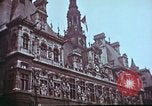
Civic reception for President John F. Kennedy and First Lady Jackie Kennedy in Paris, France
U.S. President John F. Kennedy and First Lady Jackie Kennedy ride in an open car for a civic reception at the Hotel de Ville (Paris City Hall, Pl. de l'Hôtel de Ville, 75004 Paris, France) during their State visit to Paris, France, in June, 1961. A contingent of French Republican Guards form an honor guard at the entrance as the President and first Lady Jacqueline Kennedy step from their car to enter. Crowds of Parisians cheer and wave enthusiastically from the sidewalks as they enter the Hall to be greeted by the President of the Paris Municipal Council. After speaking in the City Hall, the President and Mrs. Kennedy are seen being escorted by the Council President as they leave the building and mingle with Parisians. Next, Mrs. Kennedy and Madame Yvonne de Gaulle are seen arriving at a French Public School, where the American flag is displayed. Mrs. Kennedy is surrounded by enthusiastic Parisians. Final scenes show the Kennedys leaving the terminal building at Paris Orly Airport, accompanied by French Premier Michel Debre and Foreign Minister Maurice Couve de Murville. The President's airplane is parked at the end of a red carpet and is next seen in flight. Views of Paris and of the Air Force One engines from inside the aircraft.
Aerial view of Mont-Saint-Michel and Rennes, France (WW2)
Aerial view of the Abbey of Mont-Saint-Michel (50170 Mont-Saint-Michel) during World War II. View of the tower of the Mont-Saint-Michel Abbey. The coast of Mont-Saint-Michel and some buildings, with some damage from bombing. Aerial view of bombed railroad yards at Gare de Rennes (Place de la Gare, 35000 Rennes, France) in Rennes, Brittany. Aerial view of the Rennes Opera House (1 Place de la Mairie, 35000 Rennes) and the Place de la Mairie town square (Place de la Mairie, Rennes, Brittany 35000). Aerial view of railway yards with damage.
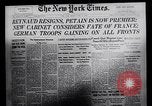
France surrenders to Germany during World War 2
French Marshal Petain, now Premier, following Battle of France, walks to a car and seen later at conference table with Pierre Laval and other national leaders. View of Adolf Hitler, with close associates, expressing delight after signing of the second armistice at Compiegne,ending resistance by France, on June 22, 1940. German honor guard marching near Marshal Foch's railroad car where the 1918 armistice was signed. Monument of Marshal Foch. Hitler, Hermann Goering, and Admiral Raeder, head of the Kriegsmarine, review the honor guard. German stand at steps of the rail car. Raeder, and Goering, both carrying Marshal's batons, flank Hitler. French Army General Charles Huntziger, accompanied by General Jean Bergeret,Air Minister, Vice Admiral Le Luc, Commander of Maritime Forces, and Ambassador Leon Noel, are escorted by two German officers. They enter the railroad carriage. View inside, as Hitler, Goering and German representatives stand when they enter. Newspaper headline describes tax on France for German occupation. French prisoners of war in an outdoor yard and being moved to Germany. French prisoners in bucket brigade and carrying construction materials. French workers engaged in labor to support German war effort. Unhappy French children. Public funerals for persons executed by the Germans. German flag draped over the Foch statue. Hitler's touring motorcade passes Arc de Triomphe in Paris in early morning when streets are empty. Parisians gather on streets to hear German orders broadcast. Many express distress. In Southern France, Military units carry their colors as they depart for North Africa. General Charles de Gaulle is among the marchers. De Gaulle seen reviewing contingents of French military. Free French soldiers parading in London, England. Military officers salute as the ship carrying Regimental colors departs. French colors carried beside unit with American flag. General Charles de Gaulle and General Henri Giraud at 1943 Casablanca Conference (Roosevelt and Churchill seated).
Huge crowd assembled at Concorde square as President Wilson and other American Officials pass through.
Aerials of Paris, France shortly after end of World War I. President Wilson and other American VIPs arrive at Place de la Concorde. Crowd cheering. Behind the crowd is the Rue Royale and the Church of the Madeleine (Pl. de la Madeleine, 75008 Paris, France). On the left is the Hotel de Crillon (10 Pl. de la Concorde, 75008 Paris, France). A large crowd at Concorde square. View of Obelisk and fountain. A procession of horse-drawn carriages, cars, and troops on horseback pass through road and crowd lined up on sidewalks.
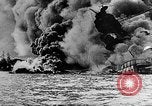
Japan extends its empire into Manchuria, Mongolia, and China in 1931 and 1932
Brief opening scenes show ships being engulfed in flames and smoke from Japanese attack on Pearl Harbor, December 7, 1941 in World War 2. Focus is primarily on the USS Arizona. Scene shifts to Japanese troops assembling on a pier and boarding troop transport ships bound for Manchuria and China, following the Mukden Incident of September, 1931. Japanese troops are then seen marching into Manchuria on September 18, 1931. A formation of Japanese soldiers presents arms. In another formation, they shoulder swords. Closeup of a Japanese soldier in a steel helmet with chin strap in place. A steam locomotive pulls a train into the Chin Hsien station on the South Manchurian Railway. A Japanese train on that line had been dynamited, triggering a Japanese push into Mukden. View from behind a train leaving Chin Hsien on the South Manchurian Railway. Japanese battalions place bundles of straw across a stream to facilitate troop crossing. A column of Japanese troops is seen crossing the water on the makeshift straw crossing. Japanese troops advancing along with supplies carried by pack animals. Troops traverse a sandy berm past an abandoned two-wheel cart. A formation of 12 Japanese G3M bombers flies overhead in a "V" formation en route to bomb Mukden. View of Chinese population running for shelter from the bombing. Chinese walk past some civilian casualties lying in a street. The League of Nations headquarters in Palais Wilson, Geneva, Switzerland. A memorial to Woodrow Wilson at the Palais Wilson reads: "A La Memoire De Woodrow Wilson President des Etats-Vnis,Fondatevr DL La Societe Des Nations, La Ville de Geneve." A car driving away from the entrance of the League Headquarters. Closeup of doorway with sign identifying it as the entrance for delegates and members of the Press. League delegates are seen inside its meeting hall. Japanese warships are seen next, attacking 15 miles from Shanghai with naval gunfire.Three Mitsubishi 2MR4 (Type 10)Reconnaissance biplanes are seen in flight above the barrel of a large naval gun. Japanese troops marching into Shanghai, as people on the roadside wave Japanese flags. Next, they are seen marching out of Shanghai at the insistence of the League of Nations. After signing a truce with China, on May 4, 1932, Japanese troops are seen entering Mongolia, in September, 1932, which they reconstituted as the Puppet State of Manchuko. A Japanese soldier standing atop a building waving a Japanese flag. Japanese statesmen resigning and leaving the League of Nations in protest after it labeled Japan an aggressor. Japanese forces fire a long barrel Type 89 cannon (150mm) as they push into China proper. Group of Japanese artillerymen use range finders, Periscopic viewers and binoculars to guide the gunners. Shell explodes raising large amount of earth. More views of artillery firing and infantry advancing. Infantry crossing a bridge and raising siege ladders to scale a fortress. Engines running on Japanese Ki 30 Type 97 airplanes, as pilots get final briefing and orders. They salute, board their aircraft, and are seen in formation aloft, dropping bombs. View from the air of bombs striking below. View from a bomber of its bombs dropping from the aircraft (bombs away view) and exploding on the ground. A column of Chinese soldiers moves along a section of the Great Wall of China heading into the interior of China. Civilians moving all manner of equipment and machinery into the interior.
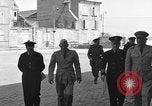
U.S. Vice Admiral John Wilkes and British Admiral Bertram Ramsay in Cherbourg, France near the Place Napoléon.
Allied occupation of Cherbourg, France during World War II. British Admiral Bertram Ramsay and U.S. Navy Vice Admiral Wilkes with other officers walking on town streets of Cherbourg and they arrive at the Hôtel de ville de Cherbourg for a conference. French, British and American flags on the Hotel de ville de Cherbourg. U.S. Army trucks loaded with men and towing covered trailers seen moving on roads and partially destroyed ferry terminal seen in the background. Admiral Wilkes and Admiral Ramsay at the town center with the equestrian statue of Napoleon mounted on a horse (the Place Napolean) designed by Armand The Véel. A bunker fortification is seen beside the statue, and the Place Napoléon statue is surrounded by a decorated iron gate. The partially bombed ferry terminal can be seen behind the Place Napoléon. Vide Admiral Wilkes and Admiral Ramsay stand in a building balcony and look at a map while in discussion. Admirals along with other officers in an amphibious jeep.