


 Francais
 Deutsch
 Italiano
Refine Your Search
Rio de Janeiro Brazil 1946 stock footage and images
- Showing 2149 to 2154 of 2633 results more
more Hide
Hide
Natural wealth, people, rural and city views in Arizona, United States.
Natural wealth of Arizona is shown. Canyon and desert with huge sonoran cactus in Arizona are seen. Mining operations with digger loading rail cars. Huge explosion from dynamite blasting in a mine. Men examine ancient petrified wood trees. Logging, timber, and lumber operations: Two workers operate a two man manual saw and cut a large Ponderosa Pine tree into sections. Dry desert area shown, and then contrasted with irrigated lands as men package harvested carrots. Oranges shown up close growing on citrus orange trees. Mountain peaks shown covered with snow. Two young boys in cowboy clothing sit on a fence and smile. Cowboys graze their cattle animals. Cowboy crosses a field on horseback silhouetted by a bright sunny sky background. City buildings and automobile traffic on the roads of an Arizona city contrasts with rural native American Indian tribal life. A native American Indian woman stands with a baby outside of a traditional hut build with mud and logs. An orange and silver colored modern locomotive races toward the camera position and passes by showing various train cars. Reenanctor playing part dressed as a Spanish conquistador. Spanish mission San Jose de Tumacacori is shown -- a historical monument of Arizona. A man prospecting walks amid rocks with his burro. He picks up a rock and hits on it with a hammer or chisel. Camera shows a vulture flying ominously overhead with a bright blue sky behind. A rattlesnake slithers across the desert ground. Bones of a dead human lying on desert floor. Sign for Tombstone Arizona, and actors portray residents of Tombstone, talking on town streets and fighting cowboys in a pistol firefight. A cowboy (actor) falls, show under a covered wagon. Views of gate at Boothill Graveyard with tombstones. Cross bearing text "Alfred Cantrell. Shot 1881." Another says "Ernest Brodines. Murdered 1882." And a third "M.E. Kellogg. 1882. Died natural death." Next grave crosses are: "Holderman Brothers. Hanged" also "Dan Kelly - hanged" and others.
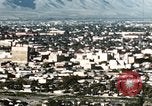
Landmarks and construction in growing Tucson Arizona; scenes from parades and rodeos in Arizona.
Scenes of the town Tucson in Arizona, United States. Old houses and buildings in the town. Late 1930s cars driving on a road in Tucson and parked outside a building. The Mission San Xavier de Bac is shown. The Pima County Courthouse with old cars parked in front. Views of campus buildings at the University of Arizona. Students on the campus of the university. Construction workers building new brick buildings in Tucson. This is constrasted with view of a Mexican worker mixing clay and straw to make Adobe bricks. The man presses the mixture into forms to make large bricks or blocks. Mexican American children sit by the side and watch him work. 1930s era cars drive on the streets of Douglas Arizona. Mexican mariachi street musicians wearing sombreros play guitars and sing. A city parade (possibly in Phoenix) heads down a street with a marching band and men on horses. Women and children watch the parade. A rodeo event in Phoenix is shown with men on bucking broncos and bucking horses.
French Army artillery during World War I.
French troops moving a large gun barrel on a small gauge railway during World War 1. Men ride in open cars behind train engine. Troops assembling a 370mm railroad howitzer and then raising and lowering its camouflage-painted barrel. Railroad trains passing through woods. A French 320mm railroad gun covered by camouflage netting. Gun crew members clamber aboard. Army gunners rapid-firing a French 75 artillery field piece covered by camouflage net. French soldiers passing spent 75mm shells from a wagon and tossing them into a huge pile. View of the pile and of the larger munitions depot in which it sits. A small gauge rail is seen along the ground in the depot. French artillery and caissons being pulled by horses, past the pile of spent shells. Turret of a railway howitzer turning. Exploding shell from the howitzer. French gunners firing a 155mm field howitzer (Canon de 155 Mle 1917 Schneider C). Views of a French 400mm railway howitzer firing. What looks like a small old navy cannon firing in the field. French coastal batteries firing. A 320mm rail gun firing. No man's land and shells exploding in distance. A rail gun at the rear of a freight train, firing. Numerous scenes of French rail guns of various types and sizes firing. (WWI. WW1)
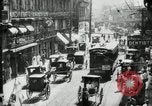
People walk and school children march on street in Manila, Philippines.
Lifestyle of Filipinos during the American period in Manila, Philippines. Horse-carts and trams (tranvía) on the street. People walk on the street. They walk over a bridge on a waterway. Houses and trees in the background. Horse-carts with luggage on the street. Vehicles crossing the Puente de España over Pasig River. Filipino school girls march in uniforms on the street. School building in the background. School boys march in uniforms on ground.
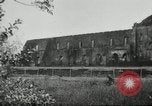
Ruins of Guadalupe Church in Makati, Philippines
Ruins of the Nuestra Señora de Gracia Church or Guadalupe Church (7440 Bernardino Street, Guadalupe Viejo, Makati, Metro Manila) in San Pedro Makati, outside of Manila, Philippines. The church and monastery complex were ruined in the Filipino - American War at the turn of the century. A flag on the top of the building. Trees in the foreground.
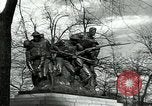
History and contributions of the U.S. Army infantryman to development of the United States of America
Memorial statue in Central Park, New York, to the 7th U.S. Army Regiment of World War I (World War 1, WWI, First World War). American infantrymen run with rifles from C-47 transport planes. U.S. soldiers in battlefield in Europe, and parading in tanks and marching,along the Champs Elysee,in Paris, France, with the Arc de Triomphe behind them. Soldiers march with flags. People watch. Korean War era U.S. soldiers march with rifles. West Point cadets march in New York City. Houses and buildings along the sides of the street. U.S. Army soldiers in various modes of operation: riflemen, artillerymen, paratroopers,ski troops, and Army engineers building bridges. One scene shows a woman soldier working as a mechanic. Soldiers training on an obstacle course, traversing a polar region with dog sleds. A gun emplacement in Hawaii and U.S.troops parading in the Philippines. A ship traversing the Panama Canal. View of U.S. Army tent Camp in Puerto Rico. A U.S. soldier sentry standing guard beside the ocean, in summer, in Iceland. An American soldier poses on a hill in New Jersey, silhouetted against backdrop of the Manhattan skyline with tall skyscrapers of New York City seen behind him. Sergeant James Mansfield talks about Colonel William Wilson Quinn. Colonel William Wilson Quinn on the show discusses the blue badge of the combat infantryman. The badge framed on a wall. He says that the badge has a blue background which is the color of the infantry. Copy of a rifle on the badge is surrounded by a circle with a star.