


 Francais
 Deutsch
 Italiano
Refine Your Search
Rio de Janeiro Brazil 1946 stock footage and images
- Showing 253 to 258 of 2632 results more
more Hide
Hide
Montage of World War II scenes, encompassing the allied Pacific campaigns and Big Three wartime meetings.
Allied campaigns against Imperial Japan during World War II. Animated map depicts Allied victories in various Pacific islands like Guadalcanal, Palau, and the Mariana Islands. A map of the Philippines. United States troops invade the Philippines. Naval guns fire at a shore and flak bursts are seen. Dramatic shot of a Japanese Zero aircraft approaching United States Navy ships that are firing guns. The Japanese aircraft is hit at close range to the ship, a wing ruptures, it is consumed in fire and crashes with explosion in the sea beside the ship. Many landing craft with U.S. Army forces landing at beach on Leyte. Soldiers land and advance inland. United States Army General Douglas MacArthur and President Sergio Osmeña of the Philippines wade ashore. Filipino women and children on the island are assisted by U.S. forces and provided with food and protection. Following are meetings of wartime Allied leaders, shown briefly in the ending of the film: Prime Minister Winston Churchill meeting President Franklin D. Roosevelt on the battleship, USS Augusta, at Newfoundland, during the Atlantic Conference, 1941. Roosevelt stands at the railing, assisted by his son, Army Captain Elliot Roosevelt. Roosevelt and Churchill meeting with Generalissimo Chiang Kai-Shek, at the Cairo conference, in 1943. Joseph Stalin, Roosevelt, and Churchill pose outside the Livadia Palace (Baturyna St, 44-а, Livadiya, 98655) during the Yalta conference in 1945. Soviet Foreign Minister Molotov, American Ambassador Harriman, British Foreign Minister, Anthony Eden, and Churchill's daughter, Sarah, in uniform, are among those standing behind the seated Big Three. Delegates from 51 Nations gathered for the first meeting of the UN General Assembly, in Westminster Central Hall, London, England, in 1946.

Robert Templer visiting in 1953, and Robert Thompson being interviewed in Malaysia during the Malayan Emergency
Film about guerrilla war for independence fought between Commonwealth armed forces and Malayan Communist Party in Malaysia. View of a steam locomotive train in 1953 pulling in to a station. Sign on side of railroad train shows a picture of a British royal crown and below it reads, "Coronation - North British Locomotive Company - 1946 - Glasgow. No. 25767". British Field Marshal Sir Gerald Walter Robert Templer in train. General Gerald Templer meets people. People read a notice in the state of Malacca. Policemen carry a stand board. A troop carries a farm equipment into a house. People walk on road and work on fields. Interviewer seen with former Secretary of Defense for Malaya Sir Robert Thompson (Robert Grainger Ker Thompson). He asks what was the communist answer to the new the villages program. The two discuss communist work in villages, race problem, and related issues.
Some U.S. Army soldiers focusing on leisure after World War 2, and some attend Army extension classes in the United States.
A post-war U.S. Army film (after World War 2) in 1945-1946 contrasts dice and pool playing soldiers with the soldiers who take Army extension classes to prepare for jobs in civilian life following demobilization and discharge from the Army. Group of U.S. Army soldiers in a room as they play pool at a billiards table. Soldiers in a barracks room seated on a bed and on the floor throwing dice in a game of craps. The soldiers play cards and smoke. Contrast is shown with U.S. Army students seated in a class. An officer takes lessons. A soldier takes notes. A young teacher or professor explains a concept with the help of a blackboard. View of the Hôtel Miramar in Biarritz, France (built in 1927 and demolished in 1978). Aerial view of a building with interconnected corridors. Street level view of the University of Calcutta Senate Hall in Calcutta (Kolkata), India (hall designed by Walter Granville; one time home to the Asutosh Museum of Indian Art; demolished in 1960). People walking in front of the Senate Hall as a car and a pulled rickshaw go by. In next scene, a sign reads 'Fox-Hole Campus'. An officer holds a mechanical model and explains a concept to students. A soldier works with equipment and an African American soldier stitches clothes at a sewing machine. A sign "Learn today; Earn tomorrow" as soldiers learn skills to help them in the civilian sector after separation from the armed forces. A solder works on a model. Pamphlets on a desk with the names of different subjects written on them that U.S. Army students can study to learn skills and jobs, including Automobile Repair Shop, Retail Bakery, Service Station, Grocery Store, Metal Working Shop, Shoe Repair Business, Small Sawmill Business, Beauty Shop.
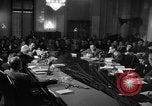
Howard Robard Hughes, Jr. testifies about profits on war contracts during Senate Hearings,1947 in Washington DC.
Senate Hearings,1947 in Washington DC. Officials and dignitaries seated for Senate Hearings, 1947. Howard Hughes, Jr. is questioned. He testifies about profits made on war contracts by him before Senate War Investigating Committee. He says that he has not made any profits on war contracts in year 1946. He asserts that any profits he made came from selling oil well tools and Grand Prize Beer (of Gulf Brewing Company) which are not the subject of the investigation. He further comments, "if I didn't make a little money somewhere, how could I put 9 million dollars into the Flying Boat?" Views of Hughes and other dignitaries sitting during the hearings.
Sailors are released on point system, workers leave war plants and line up for new jobs in Long Beach, New York.
U.S. Navy sailors return to civil life in Long Beach, New York after as soldiers and sailors are discharged at end of World War II. The sailors are among the first groups to be released in Long Beach on a point system. Sailors at a separation center stand in line a pay windows to receive paychecks and then attend group ceremonies to receive honorable discharge papers. Workers leave war production plants at the end of a shift. Civilians line up in cities for new jobs in post-war industries. Clothes iron presses, washing machines, and new 1946 Ford cars on assembly lines being built in peacetime economy.
Joseph T McNarney,Georgy K Zhukov and Alphonse P Juin attend the Joint Allied Control Commission conference in Germany.
Joint Allied Control Commission Conference in Berlin,Germany. Joint Allied Control Commission Conference in session to resolve the conflicting economic and political policy. Members of board and representatives of four nations General of the United States Air Force Joseph T. McNarney,Marshal of the Soviet Union Georgy Konstantinovich Zhukov and Marshal of France Alphonse Pierre Juin attend conference. United States Secretary of State James Francis Byrnes addresses German civilians on Vital policy at Stuttgart in 1946. U.S. Ambassador Robert P. Murphy,Senators Arthur Hendrick Vandenberg,Matthew Connelly and General Joseph T. McNarney seated at speaker's stand.