


 Francais
 Deutsch
 Italiano
Refine Your Search
Rome Italy 1944 stock footage and images
- Showing 2395 to 2400 of 7988 results more
more Hide
Hide
Opening statement of the prosecution at the Nuremberg Trials; flashback scenes of Nazi crimes and starving civilians in 1945
Events related the Nuremberg Trials held at the Palace of Justice in Nuremberg, Germany. Flashbacks of a variety of Nazi crimes against humanity during World War II. Europe during 1945. War devastation: buildings and cities laid in waste, people in hunger and despair emerge from shelters searching for the causes of the war and of the immediate human suffering. Deprived children and adults weep, starve and beg on the streets. November 21, 1945, Nuremberg, Palace of Justice, seat of the International Military Tribunal. List shows the names of the convicted Nazi criminals. Chief prosecutor from the United States, Robert Houghwout Jackson, makes the opening statement of the prosecution. He presents Count 1 of the indictment a conspiracy to commit war crimes and crimes against peace and humanity. He makes the statement that criminals who have done injustice to the laws of humanity must be brought to justice. Stenographers wearing headphones take down notes. Defendants stand in their dock including Herman Goring, Rudolf Hess, Joachim von Ribbentrop, Wilhelm Keitel, Karl Donitz, Erich Raeder, Baldur von Schirach and Fritz Sauckel. Faces of the convicted criminals. Scenes from mass burial of victims from German bombing of Coventry, England. Scenes from the end of World War 2, with women weeping and civilian victims of war in Europe, including Germany, seen scavenging on streets for food. Women and hungry children scrape out trash cans and metal lids for bites of food. Desperate civilians cut down remaining tree stumps from formerly tree-lined streets to use for fuel. A group of men and women struggle in a food relief line in Italy.
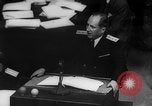
View of the Nazi Concentration Camps and its victims, and other atrocities committed by Nazi forces in World War 2.
Images and testimony related to the Nuremberg Trials held at the Palace of Justice in Nuremberg, Germany in October 1946. Flashbacks of a variety of Nazi crimes against humanity during the years of World War II. Reference to testimony of Kenaris and Hans Frank in describing Nazi policies and methods for exterminating Poles and others. Pictures recording the implementation and results of Nazi policies; atrocities and murder of victims in Ouradour Sur Glane in France, in Bande in Belgium, in the Catacombe of San Callisto in Italy and in Czechoslovakia. Nazi German soldiers seen leveling and destroying the town of Lidice in Czechoslovakia in 1942, after massacre of many residents, in retaliation for the assassination of SS Reich Protector Reinhard Heydrich. Corpses of the victims of the Nazi concentration camps, including Auschwitz, in 1945. Bones of humans in crematory ovens. Cramped starved women camp victims inside barracks. Stacks of luggage and suitcases of victims at a concentration camp, along with locks of hair, stacks of toothbrushes. Shaving cream brushes, shoes, clothing, and finally, piles of bones of camp victims. Testimony of Rudolf Franz Ferdinand Höss (sometimes spelled Höß or Hoess or Hess) describes concentration camps at Auschwitz in Poland. As scenes of victims in hospitals are shown, testimony of Rudolf Hoess is read, describing medical experiments include lowering the body temperature, injecting the body with poisons and infectious diseases and subjecting the body to high altitude pressure chambers. Shows pile of mutilated corpses.The "Arbeit Macht Frei" sign over the camp entrance of Auschwitz. Scenes of dead victims of Nazi brutality in the concentration camps.
Oil production of the U.S. and other countries is compared and evolution of internal combustion engine is depicted.
The world struggle for oil is depicted. Oil production of the United States is compared with that of other countries. Relative production in 1900 is shown. A political map of the United States. A dot in some states represents 1 % of the world's production whereas a cross in other states represents less than 1 % of the world production. A map shows Russia, Germany, Italy, Galicia, Roumania and other neighboring countries. A box on the map shows Japan with a cross. Another map shows India, Tibet, Afghanistan and their neighboring countries. Still another map shows countries of South America. Evolution of internal combustion engines, whereby gasoline is used, is shown using diagrams.
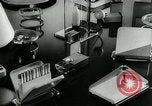
The challenges of reconstruction and rise of communism in Europe after World War II
Reconstruction problems in Europe in the aftermath of World War II. Examples of prewar Germany's industrial and commercial prowess, showing its consumer products and famous cameras. A German coal-burning power plant and miners extracting coal from Germany's vast natural supplies. Coal being transported by conveyer belt. Open rail cars loaded to capacity with German coal. A German iron and steel plant dependent on coal. Shift to postwar destruction including destroyed: German factory; locomotive; rail yards; trucks; farm machinery; fertilizer plant; farm fields lacking crops. Shift to prewar era with view of British coal cars getting ready to be emptied for export to Europe. Current postwar view of British coal cars and coal, that narrator says are barely enough for her own needs. View of prewar German coke being loaded onto conveyers. Coal miners receiving food ration cards. Animated map showing "Iron Curtain," of Soviet occupation, separating traditional German regions of agriculture from those of industry. British Foreign Secretary, Ernest Bevin; French Foreign Minister, Georges Bidault; Soviet Foreign Minister Vyacheslav Molotov; and U.S. Secretary of State, George Marshall; are seen at the Paris Conference in 1946 where they negotiated the postwar future of Germany. Reminder footage of Hitler with brownshirts in 1930s. Italian police coping with communist inspired unrest in Italy. Bombed out buildings in snow. Europeans literally scratching for bits of food from pavement and trash heaps. Two women fighting with each other during time of shortages and ration. Dejected woman. French Communist party leader, Maurice Thorez, speaking to a large crowd. Party flag with hammer and sickle behind him.
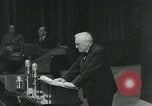
Illustration and comments about post--World War II spread of communism driven by policy and actions of the Soviet Union
Soviet Deputy Minister of Foreign Affairs, Andrey Vyshinsky (aka Andrei Vishinsky), making an impassioned speech, in 1948. Adolf Hitler making one of his bombastic speeches, during World War II. Animated map of Europe, showing countries becoming puppet states under post-World War 2 expansionism by the Soviet Union. It also highlights unrelenting Soviet hold over postwar zones of occupation in Austria and East Germany. The map goes on to illustrate expanding communist reflected in politics of Italy, France, Greece, and Finland.
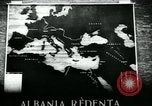
Italian soldiers land in Albania and are welcomed by the people during World War II.
Italian troops occupy Albania during World War II. A map on a wall. A map of Italy. An Italian ship underway at sea. A flight of aircraft. A ship loaded with Italian troops. The soldiers wave. Italian troops land in Albania. Italian soldiers in trucks move through the streets. People welcome the soldiers. Soil is dug and is put in wheel barrows. A building under construction. A gathering in a square. The soldiers march. Aircraft in flight.
CRITICALPAST.COM: About Us | Contact Us | FAQs - How to Order | License Agreement | My Account | My Lightboxes | Shopping Cart | Advanced Search | Featured Collections | Website Terms & Conditions | Privacy Policy ©2026 CriticalPast LLC.
License Agreement |
Terms & Conditions |
Privacy Policy
©2026 CriticalPast LLC.