


 Francais
 Deutsch
 Italiano
Refine Your Search
Rome Italy 1944 stock footage and images
- Showing 301 to 306 of 7988 results more
more Hide
Hide
Joseph Stalin, Franklin Roosevelt and Winston Churchill at Tehran conference; also Yugoslavian and French resistance fighters.
General Secretary of the Communist Party Joseph Stalin, President Franklin D Roosevelt of the U.S. and Prime Minister Winston Churchill of the UK seated on porch of Soviet Embassy building in Tehran, Iran, 28 November 1943, during World War 2. Scene shifts to group of Yugoslav Partisans and closeup of their leader, Marshal Tito, at their mountain headquarters. Yugoslavian Marshal Tito smoking a pipe while standing on the porch of his headquarters with American Office of Strategic Services (OSS) Officer, Army Major Linn M. Farish, U.S. Liaison to the Partisans, and British Brigadier General Fitzroy Maclean, Winston Churchill's special envoy to the Yugoslavia leader. Next scene shows French resistance fighters with their flag on a mountaineer's pick. It reads,""Vaincre ou Mourir"" and displays a cross of Lorraine. Closeups of French resistance fighters at attention and also relaxed, smiling, and singing. Scenes of various such groups joining in the June 6, 1944 Allied invasion at Normandy, France. Aerial glimpse of D-day task force crossing the English Channel. Animated map shows Germany being attacked by Russian forces from the East, by the other allies from Britain in the West and from Italy, in the South. Allied forces moving across a pontoon bridge and engaging German forces in France. A U.S. M3 Gun Motor Carriage firing its 75mm gun. American troops firing machine guns, carrying wounded on stretchers and using flame throwers. Troops, including ambulatory wounded moving under enemy fire. Paratroopers of the 101st Airborne Division in France. One carries a wounded buddy. American troops firing a variety of artillery from under camouflage netting. French underground forces engaged in Paris. Closeup of one wearing a French Adrian helmet firing a rifle. Another throws a grenade out an apartment window. An American tank moving under the base of the Eiffel Tower as French Resistance fighters run across the area. French citizens celebrating the liberation of Paris. View from an American jeep as French people cheer. Closeups of French people. A bombed out bridge. A battlefield cemetery. Destruction and death in the wake of combat. Fallen French civilians lying on pavement. A U.S. tank slowly driving through a masonry wall. Soviet forces advancing through destroyed buildings. Chinese troops marching along the Great Wall. British troops on parade in tropics. Asian ally troops marching. Huge formation of marching U.S. soldiers. United Nations flags in the breeze.

U.S. film designed to boost national morale during World War II. Numerous scenes of American forces engaged in combat.
Several American school children, including one in a Boy Scouts of America uniform, recite the pledge of allegiance during World War 2. Scene broadens to encompass a school yard filled with elementary school students reciting the pledge in front of an American flag flying high on a pole. As scene fades images appear of battleships firing guns; an F4F airplane taking off from an aircraft carrier; landing craft approaching a beach; American soldiers fighting with small arms and a flame thrower, in jungles of New Guinea; a U.S. gun crew firing heavy artillery; and a U.S. P-38 aircraft on a rainy runway, spraying water as it takes off, in the Aleutian Islands. U.S. troops firing automatic weapons on a Pacific Island. A B-17 pilot wearing an oxygen mask in his cockpit, flying in a formation creating contrails at high altitude over Germany. Waist gunner firing at an attacking German fighter plane that explodes in air. U.S. troops in jeeps moving over jungle road. U.S. ski troops on snow in Iceland heading downhill toward their tents in the snow. American troops during amphibious landing in the Philippines. U.S. troops aboard army halftracks on desert in Iran. American paratroopers dropping from C-47 aircraft over France. U.S. soldiers marching through two large gates with cadre of Chinese soldiers in China. American troops fighting in Italy and firing a 155mm howitzer. U.S. infantry following a sherman tank over a war-torn landscape with shells bursting nearby. Crowded, busy street scenes of traffic and pedestrians in Manhattan, New York City, and Chicago, Illinois. Army tanks being manufactured by war production workers in a Detroit war production plant or factory. A Los Angeles shipyard filled with workers at shift change. Closeups of individual American soldiers in combat helmets. U.S. troops descending rope nets from transport ships to board landing craft, and approaching the beaches of Normandy, France, under fire, on D-day, June 6, 1944. Views of the Statue of Liberty, including closeups.
Nazi leaders congratulate Hitler after he survived a bomb attack in Germany during World War II.
Conferences after Hitler's Escape from Bombing Plot on 20 July 1944. Prime Minister of Italy Benito Mussolini arrives by train at Fuhrer Headquarters (FHQ). German Fuhrer Adolf Hitler greets him with a left-handed handshake. Nazi Party member Hermann Goering also present. At Hitler's Wolf's Lair compound near Rastenburg, East Prussia, Nazi leaders greet the Fuhrer to congratulate him on surviving the attack, including Foreign Minister of Germany Joachim von Ribbentrop, head of the Party Chancellery Martin Bormann, German Reich Minister of the Interior Heinrich Himmler, SS-Obergruppenfuhrer Hermann Fegelein, Member of the Nazi party Hermann Goering. Lined up to greet Hitler and show loyalty are Saukel, German Minister of Armaments and War Production Albert Speer, Dr. Sauer, Head of the Reich Chancellery Hans Lammers, Himmler, Goering, Joseph Goebbels.
Navy film about amphibious assaults. German films about the building of the German coastal defenses known as the "Atlantic Wall."
U.S. Navy film entitled, "the Battle for the Beaches." Several Higgins boat landing craft arrive at a shore and U.S. soldiers leave them to run ashore. Scene is then overlayed by the title slate. View of the White Cliffs of Dover, England. British civilians preparing defenses during World War 2. Civil Youth loading sand bags and erecting sand bag parapets around buildings. Home guard troops march up a road carrying rifles. British defenders occupying fortified positions They stand along a coastline looking out at sea. Street scene in an English village. Guards walking up along a barbed wire fence erected on the outskirts of the village. Film shifts to the German coastal Atlantic Wall defenses. German troops march along sandy shores containing all manner of obstacles at the water's edge. German officers stand on an overlooking cliff, and peer through binoculars. German sentry and large coastal gun barrel under camouflage net are silhouetted against light sky. Three German officers confer over plans for coastal defenses. View from above of slave laborers working and shoveling sand as they build defenses. German soldiers dismantling wooden forms around completed concrete fortifications. Glimpse of a huge German coastal gun being raised by a crane with heavy steel cables, as it is steadied by dozens of workers with hands on its barrel. German troops manning a machine gun in coastal defense position where a twin mounted antiaircraft gun is also seen. Momentary view of two German soldiers walk past rotating barrel of a huge coastal defense gun under a camouflage net. Workers, with shovels, placing fresh concrete to build up a section of concrete barriers along the coast. Allied troops storming a sandy shore from landing craft, as shells explode near them; possibly related to 1944 D-Day. One contingent are British soldiers. American troops landing at a beach from landing craft. Dead allied soldiers lying in the surf. Film shifts abruptly to U.S. Lieutenant General Mark Clark with some officers in Italy. In another switch of war theaters, General Douglas MacArthur is seen congratulating crew of a B-25 named "Smiling Jack." U.S. troops, in a training exercise, storming ashore from Higgins boats directly and closeup at the camera. They take up defensive positions in the sand, and move a jeep towing a field artillery piece.
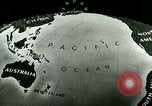
African American soldiers engaged on all fronts in World War 2
Film opens with map of the world showing the various theaters of operation in World War II. Narrator refers to Allies liberating town after town, as they advance. View of American troops being welcomed in a European town during an advance (probably Italy in 1944). Next, African American troops are seen boarding troop transport ships. A huge convoy of ships is seen from the air. Huge piles of war materiel on a dock. Ammunition being delivered by landing craft from the transport ship USS Hunter Liggett (APA-14) to American troops at a beachhead in the Pacific. An African American sailors directs the lowering of a piece of artillery from a ship into a landing craft. Construction equipment being used to clear the way for a new landing field. Docks, roads, and bridges being built as the Allies advance. American troops in the swamps of the South Pacific. American Army engineers clearing trees to build the Alaska Highway (ALCAN Highway) in 1942. Corps of Engineers building the Ledo Road (from India to China) during the war. African American soldiers building a bridge across a river in Europe. A U.S. Army truck under fire, driving along a dirt road in Europe as shells burst all around it. U.S. troops firing various kinds of field artillery and tank guns. U.S. infantryman using a flame thrower. Closeup of African American soldier using a bayonet and others firing small arms. A tank being blown up by artillery fire. A Japanese Mitsubishi A6M3 Zero aircraft maneuvers overhead in the Pacific theater. An African American soldier runs to man his Browning .50-caliber, water-cooled antiaircraft machine gun, and begins firing as the Zero fighter plane strafes his position. Closeup of Japanese pilot in his cockpit and his machine guns firing from leading edges of his plane. His rounds strike all around the U.S. gunner, who turns and follows him with more fire. His tracers show behind the plane. Closeup of the African American gunner as he continues firing. View of the Japanese airplane rolling over and diving. Next the Japanese plane, aflame, crashes on a tropical island and explodes. (Note: It is apparent that some of these combat scenes have been made up of clips from other sources, edited into this film.) (World War II; WW II; World War 2; World War Two)
Training film for U.S. troops with the Army of occupation in Germany after world War II
Opens with bell tolling Victory against Germany in World War II. Next, a slate reads: "Victory Leads to Peace," and a farmer is seen with cattle pulling a plow. But narrator says "the problem now is future peace," and a map of Germany is shown overlaid with "Your Job in Germany." A cartoon of a soldier is superimposed on the map, along with one of a World War 1 American soldier and a figure of possible future soldier with similar mission. Camera focuses on parts of German aircraft in a jumbled heap. Closeups of weary defeated German soldiers at end ot World War II. Glimpse of Adolf Hitler speaking and haranguing an audience from a podium in an animated and forceful way. Swastika flags displayed from houses in a quaint German town. Joseph Goebbels, Nazi Reich Minister of Propaganda, at a microphone. Glimpse of a German concentration camp. But as they appear, each of the Nazi elements promptly disappears, showing the scenes without such Nazi symbols and persons. Skeleton remains of bombed buildings. Flower displays. Bucolic German rural countryside and quaint old villages in peaceful settings. Camera focuses on a book titled "German History." Chapter I, titled "Blood and Iron," shows Image of Otto von Bismarck. German troops march in a parade. Narrator states that "under Bismarck, the German empire was built." (He formed the German Empire in 1871, unifying Germany with himself as Imperial Chancellor, while retaining control of Prussia at the same time.) The film shows mounted German lancers as it alludes to Bismarck's campaigns against Denmark in 1867; Austria in 1866; and France, in 1870. Germany's leaders celebrating its status, in 1871, as the mightiest power in Europe. Troops marching and girls dancing nearby. Farmers plowing field with a horse and cow. Classic peaceful rural alpine scenes with local people in agricultural pursuits. A group of local German musicians playing folk music as village people dance outdoors. Back to the book, Kaiser Wilhelm II is shown on Chapter 2, entitled: "Deutschland über Alles." Gathering of German soldiers in Pickelhaube (spiked helmets). A German Big Bertha howitzer firing. German troops marching against Serbia; Russia; and France (with view of war damaged French cathedral). German invasion of Belgium in 1940 (with view of clock tower resting in rubble). German troops seen in Italy, walking past battle-damaged buildings. German Zeppelin dropping bombs on British targets and view of bombed out London neighborhood. Next scene shows a capsized ship with survivors running across its hull. Film slate labels the scene as United States, as if it is a U.S. ship attacked by Germany. (Actually, it is the Austro-Hungarian Battleship, SMS Szent Istvan, torpedoed, by Italian torpedo boats, during World War I.) Next, American soldiers in trench are seen going "over the top" and into "no man's land" on the western front of World War 1. Glimpse through a window of Kaiser Wilhelm II, after defeat of Germany, in 1918. View of Germans in a Beer Garden. Picturesque view of German town. A German orchestra performing. American soldiers marching out of Germany, with flags waving. Back to the history book,as chapter III is revealed, entitled "Today Germany, tomorrow, the world," and featuring Adolf Hitler. German troops invading Austria (where a civilian lies dead on the ground). German troops entering Czechoslovakia (where local people in tears render the Nazi salute). They march into Poland (where a girl weeps over someone, not seen, on the ground). They march into France (where a wounded, bandaged child cries in a bed). Next, is a scene from England, where a British child victim of bombing lies dead in the remains of a shelter. German troops invading Norway, Holland, Denmark, Belgium, Luxembourg and Russia (where a woman tries to rouse a dead woman). They invade Yugoslavia (where women sit near coffins of children) and Greece (where a woman rescues a naked child). A U.S. merchant ship explodes after being torpedoed by a German submarine (unseen). Scenes of destruction with people plucking dead victims from rubble of buildings. American troops invading Normandy, France on D-day, June 6, 1944. Several American soldiers fall to German gunfire on the beach. Wounded American soldiers being transported in jeeps on the battlefield and being placed on landing craft for evacuation. Americans walking past huge piles of destroyed aircraft parts. A landing craft filled with wounded American soldiers. American wounded and dead on a battlefield. Sailors abandoning a burning American ship by jumping into the sea. A sailor picked up in a life boat. A wounded American soldier being dragged from the beachhead at Normandy. Various wounds being treated by U.S. Medical Corps personnel. More scenes of American wounded being moved on stretchers. Scene shifts abruptly to German people folk dancing. Film concludes with question marks about the future.