


 Francais
 Deutsch
 Italiano
Refine Your Search
Rome Italy 1944 stock footage and images
- Showing 385 to 390 of 7988 results more
more Hide
Hide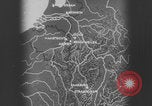
German forces launch a counter offensive after the Allied 1944 invasion at Normandy during World War II
Film shows map of the Ardennes region of Germany and Belgium. In the dark of night, German artillery and rockets are seen being launched against Allied forces in a counter offensive in the Ardennes during World War 2. In daylight, clouds of dark smoke lay across the horizon partially obscuring the rising sun. A German officer signals for artillery to fire, and a heavy gun barrel is seen recoiling as it fires. Shells exploding in the distance. German gunners firing an LeFH 18 howitzer hidden under branches of foliage. Rockets launchers (Nebelwerfers) firing. Explosions in the distance. German troops in trenches. Several views of howitzers firing. American prisoners marching past Dragons Teeth antitank barriers at the Ziegfried line (Western Wall). German soldiers riding on Stug III Ausf. F tank destroyers. A half track (Sd.Kfz.251) passing a line of American prisoners walking in the opposite direction at side of muddy road with their hands over their heads. View from the rear of the U.S. soldiers escorted by German soldiers. German infantry advancing single file along the side of a road. Some carry panzerfaust anti tank weapons. Others carry MG 42 machine guns and belt ammunition. View from rear of the German infantry entering woods. Dead American soldiers lying in a group in bluff overlooking a body of water. American steel helmets scattered on the ground. More views of dead U.S. soldiers.
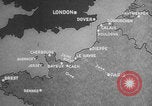
German troops reinforce defenses in Southern France after Allied 1944 invasion of Normandy in World War II
Film opens with map of western coast and towns in France. Camouflaged trucks filled with German infantry drive along rural French road in World War 2. Closeup of smiling soldiers in one truck. A makeshift sign reads (in German) "One-way street to the front." A soldier passes out newspapers to other soldiers riding bicycles. Closeup of a soldier reading the newspaper. Closeup of the paper has headline reading (in German) "Eisenhower has not surprised us." Troops on bicycles ride through a village. Large wooden sign warns (in German) that the enemy understands things you might say about military activities. Camouflaged vehicles drive along a road, passing overturned civilian vehicles at the sides of the road. View from rear of German soldier on motorcycle, with foliage on his helmet, looking skyward for aircraft. Formations of Allied aircraft are seen overhead, and German troops seek protection in ditches at side of the road. Scene shifts to German troops firing anti-aircraft guns at the planes. Black flak clouds are seen near the Allied airplanes. A lone B-17 bomber is seen overhead. Next, burning wreckage of an aircraft is seen strewn across a field. No markings are visible on the wreckage. A sign identifies the town of Avranches in Southern France. German infantry enter the war-torn town on civilian cars and other vehicles of opportunity and motorcycles. A German half track personnel carrier tows an artillery field piece.
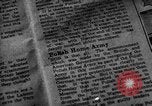
Warsaw bombed by Germans in retaliation to 1944 uprising, various scenes of Warsaw before WW2
Newspapers around the world reporting on the bombing of Warsaw by Nazi Germany as retaliation for the Warsaw Uprising during World War 2. Newspaper headlines read, "Poles Fighting Inside Warsaw," and "Warsaw Being Razed by Hitler's Order," and "Warsaw's Plight" and "Warsaw Poles Fight Tanks in Streets." Scenes of Warsaw in flames as buildings are being bombed by German forces. Montage depicting Warsaw on fire. Scenes of Warsaw before WWII, including scenes such as the Warsaw Old Town Market Square (rynek Starego Miasta, 00-279 Warszawa, Poland), the column of Sigismund III Vasa (plac Zamkowy, 00-001 Warszawa, Poland), the Royal Palace (plac Zamkowy 4, 00-277 Warszawa, Poland) and the Lazienki Park, before World War 2. Statue of King Jan III Sobieski in Lazienki Park. Men strolling near a palace. Baroque gates in park.
Newly naturalized Americans recite the Pledge of Allegiance during the 1944 “I Am An American Day” (WWII)
More than a million people attend the “I Am An American Day” citizenship ceremony in Central Park in New York City, during World War 2. Over 150,000 people attended the ceremony as newly naturalized American citizens. Native American Indians in traditional dress and women and men in military uniform attend the ceremony. Flags of various nations are flown. Wounded Army soldiers and wounded Navy sailors arrive as guests of honor. New York City Mayor Fiorello LaGuardia shakes hands with servicemen, giving tribute to their heroism during World War II. Immigrants stand up to recite the Pledge of Allegiance to the United States of America as part of the naturalization ceremony. Speaker recites the Pledge of Allegiance, which predates the inclusion of "under God" which was added later in the 1950s.

Lucky Hofmaier walks on his hands from Rosenberg to Rome
Lucky Hofmaier walks on his hands in Germany as people look on. He is on his way from Rosenberg to Rome and aims to reach Rome in 38 days.
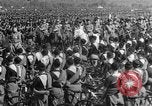
Benito Mussolini parading and speaking in Rome and other famous persons of the time.
Opening scene shows Italian Leader, Benito Mussolini on horseback wearing a military uniform and accompanied by followers in military uniforms. They are riding into the center of a gathering of thousands of Italian youth (Boy Scouts, or Guides) wearing uniforms and bedrolls draped over their shoulders. The youth all stand by bicycles. Scene changes to a race track where a large group of the Italian youth ride bicycles on the track while others with their bicycles watch. There are many ordinary people in normal dress also watching the cyclists on the track. Next, Mussolini and his mounted military entourage are seen riding on the racetrack. Closeup of several in his entourage on a city street. Next, Mussolini and his entourage are seen riding triumphantly along the Via triumphalis, with the Arch of Constantine behind them and the Colosseum at their left rear. Spectators line the sidelines, including a group of youth holding flags. Mussolini raises his arm straight upward in salute and the youth do the same, as he rides past them. View of King Vittorio Emanuele III in a reviewing stand with Italian Generals and Admirals. Closeup of some civilian officials, including a woman standing near Field Marshal Luigi Cadorna as they listen to a speech by Mussolini. Complete change of scene shows an Australian pioneer in radio telephony and associate of David Sarnoff. He stands aboard the deck of a ship just arrived in America, next to his friend, Sarnoff, as he makes some remarks about his visit and recalls receiving the first radio telephone call in Australia, from Sarnoff in Italy. Scene shifts back, again, to Vittorio Emanuele III and others in reviewing stand, and then to Mussolini standing on a balcony giving a speech. Glimpse of Mussolini on horseback. Pope Pius XI making some remarks. .
CRITICALPAST.COM: About Us | Contact Us | FAQs - How to Order | License Agreement | My Account | My Lightboxes | Shopping Cart | Advanced Search | Featured Collections | Website Terms & Conditions | Privacy Policy ©2026 CriticalPast LLC.
License Agreement |
Terms & Conditions |
Privacy Policy
©2026 CriticalPast LLC.