


 Francais
 Deutsch
 Italiano
Refine Your Search
Rome Italy 1944 stock footage and images
- Showing 409 to 414 of 7988 results more
more Hide
Hide
First Session of the twenty-first Ecumenical Council of the Catholic Church meeting at St. Peter's Basilica in the Vatican City
Pope John XXIII presides over final meeting of the First Session of the twenty-first Ecumenical Council of the Catholic Church at St. Peter's Basilica (Piazza San Pietro, 00120 Città del Vaticano, Vatican City) in the Vatican City. Two thousand cardinals, bishops, and other prelates of the Roman Catholic Church are in attendance. The altar with Bernini's baldacchino stands in the middle of the meeting. The Council granted Bishops more authority regarding the use of modern languages in the liturgy of the church. The Pope is quoted as saying He has "heard the voice of the whole Catholic World." Attendees are seen leaving St. Peter's after the end of the session. (Note: This was one of the activities undertaken during The Second Vatican Council, also known as “Vatican II," which focused on relations between the Roman Catholic Church and the modern world.)
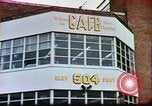
U.S. Air Force Air Weather Service. Improved radars and radar network expanded for observation and reporting of weather data
Sign reads "Welcome to GAFB, elevation 504 feet" on the Base Operations Building at Griffiss Air Force Base in Rome, New York. View of exterior or Operations Building. View of a radar screen is shown as narrator discusses expansion of radar network for gathering data. Improved radars are shown being used for routine observing and reporting. A Vertical Viewing Radar unit is shown at the air base. An Air Force weather technician records readings.
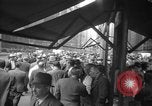
People in New York City learn of Allied invasion of France from newspapers and New York Times building display
At start, film shows crowd (mainly men) gathered on sidewalks in New York City during World War II. Focus shifts to myriad newspapers on a stand, all showing headlines about Allied D-Day invasion of Normandy in Nazi German-occupied France. Men purchase the papers. Glimpse of men moving shoulder to shoulder. The New York Times building at Times Square is seen with latest news being displayed in lights. News messages seen include: "President Roosevelt in Radio talk..." "Rome declares victory at time when Allies invade Europe." "American British and Canadian troops swarm ashore on Northern coast..." American paratroops land behind the Atlantic Wall to deal first invasion blow to Nazi communications." "...The Allies will accept nothing but full victory." View of passengers in a bus reading the Times news as their bus passes the building.

Allied assaults against the German Gustav Line at Monte Cassino, Italy during World War II
Opening scene shows peaceful Italian mountains, including one snow-capped, in Spring, 1944, during World War 2. Camera focuses on the town of Monte Cassino and its historic Monastery, on a mountain above the town. (German forces held the Rapido-Gari, Liri and Garigliano valleys and some of the surrounding peaks and ridges that formed the heavily defended Gustav Line.) Animated relief map shows where, by mid January, 1944, American, Polish, and British forces had cleared the enemy from mountains east of Cassino and drawn up on the east side of the Rapido valley. Map shows progress of subsequent Allied attacks that finally reached Mount Castellone and then up Abbey Hill at Monte cassino, itself. Image of German soldier is superimposed on the scene, using binoculars on Abbey hilltop to observe Allied forces. (Narrator states: On February 9th, 75 yards from the abbey, we were stuck.") U.S. Army Air Forces Douglas A-20 Havoc aircraft are seen starting engines. Closeup of Fifth Army leaflet warning the local people to leave the Monte Cassino Abbey to avoid shelling and bombing. View of U.S. troops packing the leaflets into thin-skinned shells to deliver the warning by artillery fire. Next, 105 howitzer guns are seen under camouflage netting, firing bombardments of warning shells. Formation of A-20 aircraft taking off. Aerial view from high above, of B-25 bomber formation in flight. Formations of B-17s, B-24s, B-26s in flight enroute to bomb Monte Cassino. Bombs dropping from B-25 Mitchell bombers. Bombs exploding on Monte Cassino and the Abbey. Batteries of 155 mm guns firing. Formation of 6 B-25 bombers in formation. More bombs bursting on Monte Cassino. Animated map shows German forces taking up their earlier defenses again following the Allied artillery and air attacks. It also shows supplies streaming in to the German Green Devils Parachute Division (Luftwaffe’s 1st Fallschirmjaeger [Parachute-Hunter] division.) The map illustrates all the locations in the town that they occupied and would defend to the last man. Map also illustrates circling positions of Allied artillery batteries. Camera focuses on Polish troops and M4 Sherman tanks moving forward in an offensive. Glimpse of U.S. Army Air Forces mechanics working on a Douglas bomber engine. M4 prime movers towing 155mm howitzer guns. Gun crews camouflaging their positions with netting. Various views of A 240mm howitzer being put in place by a crane. Soldiers deploy detector microphones to locate enemy gunfire sources. They test them, and then enclose them in water-proof containers, bury and cover them. Sound from the microphones being recorded on film at a machine in the Command Post. The data being plotted on a map and corresponding grid locations phoned to Battalion headquarters. View of bombers resuming attacks again, on March 15, 1944. Formations of Douglas bombers, followed by B-25s, seen dropping bombs that explode in the town of Monte Cassino. Artillery firing. Formation of B-24 Liberator bombers in flight. Formation of B-17s dropping bombs. String of bombs exploding in a line on the town. More views of artillery barrages. More lines of bombs exploding. Allied forces storming the shattered town found German soldiers using destroyed structures as shelters to fire from and rubble obstructing the movements of Allied tanks, so the Allied advance was again stopped. Later, a newspaper headline reports resumption of Allied offensive.
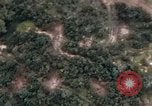
Cleared and uncleared forest area in Bein Hoa, South Vietnam.
U.S. tanks, APCs and troops downhill from a vegetation clearing operation in Bein Hoa. Bulldozers and Rome plows removing vegetation. Work performed by the U.S. Army 27th Land Clearing Team of the 168th Engr. Bn, supporting the 2nd Bde, 1st Inf Div. (Vietnam War period).
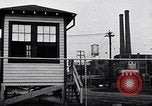
Textile workers on strike attend meeting, receive supplies in Georgia with Union support.
Textile workers go on strike in Georgia, United States. Textile workers (possibly from Celanese Corporation in Rome, Georgia) carrying placards outside a factory. Smokestacks are seen in the background. Placards say 'Textile Workers on Strike' and 'Give us real Senority'. Textile workers on strike stand near factory fence. A worker lights his cigarette. Strike committee made up of union members and representatives from the locality and national union convene for a meeting. An African American worker speaks with the strike committee. A man takes the minutes of the meeting. A telegraph is sent through Western Union. Telephone operator transfers a call. Close up views of men and women talking on telephones. Publicity department gets the details from a typewriter. A woman mails a pamphlet “This is your fight”. A man signs a Textile Workers Union of America check made out to the Northwest Georgia Joint Board, TWUA. Man signs an official paper of 'Textile Worker Union of America'. Workers on strike line up outside the TWUA Local 689 commissary. The union commissary replenishes their stocks of food and supplies for the workers to carry them through the time without pay. Workers receive their supplies and food. A man leads the union workers to sing "We shall overcome." The worker takes his supply to his car. Interior of a house, a woman (mother, housewife) gives a glass of milk to a boy, man seated on chair in living room reading newspaper and his family with boy on sofa, and wife joins him.
CRITICALPAST.COM: About Us | Contact Us | FAQs - How to Order | License Agreement | My Account | My Lightboxes | Shopping Cart | Advanced Search | Featured Collections | Website Terms & Conditions | Privacy Policy ©2026 CriticalPast LLC.
License Agreement |
Terms & Conditions |
Privacy Policy
©2026 CriticalPast LLC.