


 Francais
 Deutsch
 Italiano
Refine Your Search
Romorantin France 1918 stock footage and images
- Showing 205 to 210 of 6001 results more
more Hide
Hide
Newly drafted American Army soldiers undergo medical examination in United States.
Draft and mobilization activities for U.S. Army soldiers during World War I in 1917-1918. American World War 1 military recruits take a shower and undergo medical examination. Recruits lined up as doctors with stethoscopes perform physical examination. Those who pass the examination are injected by doctors "with 6 million germs" and their finger prints taken. Men and women at Adjutant General's office maintain the records of the recruits. Recruits in new uniforms lined up as officers go through their records to make registration card, qualification card and various other documents. (World War I; World War 1; WWI; WW1)
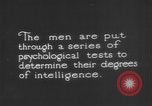
American military recruits for World War I undergo psychological tests in United States.
Draft and mobilization activities for U.S. Army soldiers of World War 1 in 1917-1918. American military recruits undergo psychological and mental acuity tests to determine their intelligence and ability to serve as soldiers. They undergo attention and observation tests. Figures drawn on a board as an instructor guides them, and Army recruits write on papers. Recruits must rapidly pick up their pencils on cue in a test of alertness. Rejected recruits discharged with payment and a discharge letter. The discharged soldiers stand in line at pay window. Close-up view of U.S. Army honorable discharge certificate. Slates indicate that most soldiers participated in the life insurance plan that was offered. Scene of soldiers seated at tables as they write letters home.
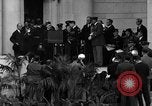
In an Armistice Day speech in 1935, President Roosevelt reflects upon World War I and the perils still threatening world peace
President Roosevelt delivers a speech reflecting the failure of World War 1 to be the "war to end war." He addresses a crowd at the Arlington National Cemetery Amphitheater in Arlington, Virginia, gathered for Armistice Day, commemorating the 1918 armistice ending World War I. Roosevelt reflects upon the role of United States in the world (as seeds of World War 2 are being sown). He upholds the ideals of peace and importance of being a good neighbor. He declares that the aim must be to avoid war and to remove the causes of war.
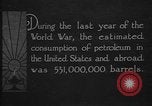
Water flows over the Niagara Falls and a globe with nine circular parallel lines along the equator rotates in the U.S.
The total consumption of petroleum of the U.S. and the world outside of the United States for the year 1918 is compared. Animation is used for this. Per capita consumption is also compared. Water flows over the Niagara Falls. A globe with nine circular parallel lines along the equator rotates. The 9 circular lines denote that if the per capita consumption of petroleum had increased as rapidly abroad as in the U.S. the world's petroleum requirement in 1922 would have been 10 times the actual requirement and if this volume had been loaded into tank cars of the capacity of 10,000 gallons each it would have made a solid train extending around the world at the equator 9 times.
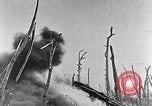
Extract from film "The Somme" depicts German troops in trench warfare against South African Brigade in Battle of the Somme, World War I.
Scenes from British feature film "The Somme" made in 1927, about the Battle of the Somme in World War 1. Part of it depicts events involving the South African Brigade in the battle. The extract opens with shells bursting all along No Man's Land among fragments of trees. Explosions and smoke everywhere. On July 18, 1916, Nine German Battalions deploy to drive the South African Brigade from the Delville Wood. Several soldiers of the Brigade seen entrenched in a sand-bagged position as a German shell explodes only yards from them. German soldiers advance through the broken trees and brush, while under fire by British gunners using Vickers machine guns. Some German soldiers falling and others seeking cover in abandoned trench. A line of South African troops firing their rifles from a trench, as several German soldiers reach them and are shot dead just feet away. A British soldier is shot while climbing out of a trench containing several fallen comrades. Other British (or South African) troops scrambling to find a safer place. One crawling across the ground. A British gunner firing a Lewis gun. German troops starting to go over-the-top, from their trench. British soldiers advancing. German gunner firing Maxim gun from fortified position, as shells burst in the distant background. A horizontal line of British troops advancing toward the German position. Some are cut down by the machine gun fire. German gunner firing a captured British Vickers machine gun. British soldiers hunkered down in a deep shell hole behind a ridge. They use their trenching tools to dig in deeper. Several German shells burst in the air. Two British soldiers watch as a tank approaches through the smoke. Large numbers of British troops attack downhill through smoke and haze. German soldiers preparing to defend an occupied structure, as more British troops charge forward. Post-battle view of the area, with fallen soldiers marked by rifles stuck in the ground with helmets on them. (Note: The tanks shown in this film are models Mark V which did not enter service until 1918.)
Emperor Hirohito watches maneuvers performed by soldiers in Japan.
Conditions in Japan in 1927-1928. An animated map of the Pacific Ocean depicts the growth of Japanese military might since 1894. The map depicts areas under Japanese empire in 1894, the Chinese Japanese War of 1894-1895, the Russian Japanese War Of 1904-1905 (Russo-Japanese War), the territory under Japanese influence and World War I from 1914-1918. Officers watch as Japanese soldiers march. Japanese cavalry units. Soldiers run forward. Japanese Emperor Hirohito looks at the maneuvers at the Imperial Japanese Military Academy in Tokyo. He salutes standing at a dais. The soldiers parade. A naval smoke screen is laid to shield the army at a river crossing. The Emperor looks on as soldiers in a barge land at a shore. Two vessels in a water body. Japanese sailors march. Emperor Hirohito in conversation with military officials. From the deck of his flagship 'Katori', he watches as naval guns are fired.
CRITICALPAST.COM: About Us | Contact Us | FAQs - How to Order | License Agreement | My Account | My Lightboxes | Shopping Cart | Advanced Search | Featured Collections | Website Terms & Conditions | Privacy Policy ©2026 CriticalPast LLC.
License Agreement |
Terms & Conditions |
Privacy Policy
©2026 CriticalPast LLC.