


 Francais
 Deutsch
 Italiano
Refine Your Search
Romorantin France 1918 stock footage and images
- Showing 229 to 234 of 6001 results more
more Hide
Hide
U.S. 105th Field Artillery and 2nd Battalion Pioneers aboard USS Madawaska wave and leave from Newport News, Virginia.
U.S. 105th Field Artillery and 2nd Battalion Pioneers aboard USS America and USS Madawaska in Newport News, Virginia leave for Europe in 1918 during World War I. U.S. troops aboard USS America. The ship leaves from the Newport News. The troops of 2nd Battalion Pioneers and 105th Field Artillery aboard USS Madawaska. The troops on the deck wave.
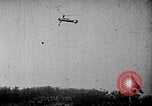
Kellett KD-1 autogiro hovers above U.S. troops on maneuvers, moving on horse drawn vehicles in the United States.
Kellett KD-1 autogyro (rotary wing aircraft) in flight over U.S. Army maneuvers in the United States. Mounted troops and a horse drawn caisson move across open terrain. Troops in 1918-style uniforms move on horse drawn vehicles. Kellett autogiro in flight. View of military maneuvers. Troops load and fire French 75 artillery pieces. Shells burst in area near damaged farm building.
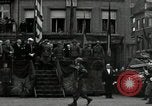
U.S. troops of 2nd Armored Division parade in Belgian town of Hasselt, during World War II
Troops of the 82nd Reconnaissance Battalion, U.S. 2nd Armored Division, pass in review before their Commanding General, Brigadier General Isaac White, who stands on a stage with Belgian officials, in the town of Hasselt, Belgium during World War 2. The troops are led by the 66th Armored Regiment military band. A contingent of the marchers carries numerous American flags. Civilian spectators line the sidewalks, and Belgian officials in formal dress with medals, watch the parade which ends at a World War I memorial monument in the square. General White carries wreath of flowers and places them at the foot of the memorial, which is inscribed: "1914 - 1918." The U.S. troops parade from the scene. Group of children applaud. Camera focuses on young woman, in crowd, smiling and applauding. View of flag bearing inscription: "Hasselt Liberators."
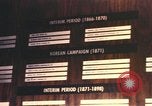
Hall of Heroes at the Pentagon showing hero names from Korean Campaign to the Vietnam War
View of the Hall of Heroes at the Pentagon, in the United States, during the Vietnam War. Names of the war heroes in the hall. Nameplates of the war heroes of each historical conflict on the wall. Names of the soldiers and officers who served the best in the wars. Names under the nameplates reading: 'Interim Period (1866-1870)', 'Korean Campaign (1871)', 'Interim Period (1871-1898)'. Other nameplates read: 'War with Spain (1898)', 'Philippine insurrection (1899-1913)', 'China Relief Expedition-Boxer Rebellion (1900)'. Several other conflicts mentioned in the hall. Other nameplates read: 'World War I (1917-1918)', 'Haitian Campaign (1919-1920), 'Second Nicaraguan Campaign (1925)', 'Word War II (1941-1945) and 'Vietnam (1964-Present).
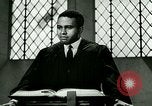
African American soldiers serving in various combat positions during World War II
At the beginning an African American pastor is seen speaking to his congregation during World War II. Scene shifts to Morton Field,where the "Tuskegee Airmen" were trained. They are seen receiving their pilot's wings in a graduation ceremony. A band plays. North American T-6 training aircraft are parked in the background. Next, the pilots in flight gear, and wearing seat-pack parachutes, walk toward Curtiss P-40 fighter airplanes parked on a flight line. A pair of P-40s take off. Two groups of four planes, each, is seen in formation high above. Closeup of a Tuskagee Airman pilot at the controls of his airplane, in flight. Several views of their P-40 aircraft in various formations flying above clouds. Scene shifts to a snowy Northern location where Army troops board jeeps and trucks and maneuver through the snow. A large battery of M1918 155mm howitzers is lined up in the snow. The soldiers fire them simultaneously on an officer's command. Scene shifts to a desert setting, where African American soldiers are seen closeup, in turrets of tanks. Others who are gathered on a field run to their respective tanks, that begin moving out. Views of M3 Stuart Light Tanks in training maneuvers over terrain where explosives are being detonated. African American Army engineers building a pontoon bridge across a river. Army quartermaster vehicles moving troops and supplies along dirt roads. A soldier silhouetted against light sky signals to others who are installing telephone and telegraph lines on poles. Mounted cavalrymen on maneuvers. Half track M3 Gun Motor Carriage tank destroyers operating on a snowy field. Closeup of one with an African American Officer manning a heavy machine gun. Numerous M3 tank destroyers firing their guns as they move across a training field. Anti-aircraft gun crews racing to their respective gun emplacements, in the snow, as a large barrage balloon is sent aloft behind them. An African American crew manning a 37mm anti-aircraft gun. The gun sight is raised in front of the primary gunner. The position is sandbagged. Infantrymen, crawling through sandy terrain in a training course as live machine gun fire is directed above them. Glimpse of troops running through water and starting to scale a bluff. (World War II; WW II; World War 2; World War Two)
United States Army Infantry troops attack in Beffe, Belgium in winter snow during the Battle of the Bulge (WW2)
United States Army Infantry engage in attack against German snipers in Beffe, Belgium during the Battle of the Bulge (World War II). A platoon of the 200th Infantry, 4th Cavalry Reconnaissance Squadron advances along snow covered field in attempt to wipe out German snipers during winter. Soldiers with M-1 rifles assume prone position in the snow. A soldier shoots with a M1918 Browning Automatic Rifle (BAR). Soldiers shoot with their M-1 rifles before crouching. A soldier aims and shoots with his rifle. View of soldiers shooting with their rifles (one of them is holding a .45 caliber Thompson submachine gun) from a distance. Some crouch shortly to reload their rifles. Some soldiers carefully sneak up in the snow while holding shells and rocket launcher. Soldiers advance in the snow against enemy fire. A soldier firing with rifle from behind barbed wire fences. A wounded soldier crawls back to safety. The mustached soldier smiles upon his return. Two soldiers fire bazooka (2.46 rocket launcher) near barbed fence. Two soldiers crawl in the snow, attempting to rescue another wounded soldier. The soldiers are forced to withdraw because of German sniper action.
CRITICALPAST.COM: About Us | Contact Us | FAQs - How to Order | License Agreement | My Account | My Lightboxes | Shopping Cart | Advanced Search | Featured Collections | Website Terms & Conditions | Privacy Policy ©2026 CriticalPast LLC.
License Agreement |
Terms & Conditions |
Privacy Policy
©2026 CriticalPast LLC.