


 Francais
 Deutsch
 Italiano
Refine Your Search
Romorantin France 1918 stock footage and images
- Showing 4537 to 4542 of 6011 results more
more Hide
Hide
French capitulate to North Vietnamese, and leave Indochina. Geneva Conference divides Vietnam.
Division of Vietnam into North and South Vietnam as Indochina war ends up in Vietnam. Aerial view of cratered battle ground, with smoke rising, at Dien Bien Phu, Vietnam, in March, 1954. A French A-26 Invader aircraft flying above some clouds and pilot in cockpit using radio. French paratroops, dropping from C-47 aircraft, and landing, to reinforce troops dug in at Dien Bien Phu. French artillery firing and rounds exploding in the distance. French troops moving through brush, and carrying wounded back out. Citizens on streets of Hanoi, North Vietnam, scrounging for scraps to eat. An old woman hunkered down in a doorway. A mother with a young boy. French troops crossing a bridge as they surrender following the siege at Dien Bien Phu. North Vietnamese troops entering Hanoi. Delegates at the Geneva conference of 1954, in the Palais des Nations, including representatives of the Soviet Union, the United States, France, the United Kingdom, and the People’s Republic of China, among others. Closeup of Soviet delegation, with Foreign Minister, Vyacheslav Molotov, second from left. View of the North Vietnamese delegation, and delegate Ta Quang Buu, Vice Minister of Defense of the Democratic Republic of Vietnam (North Vietnam), and Head of their Military Delegation, signing the accords. Closeup of one treaty page, with his signature, as Minister of Defense, and that of Henri, Deltiel, Brigadier General, who signed for the Commander in Chief of all French Forces in Indochina. OUtdoors. After the conference, Soviet Foreign Minister, Molotov shakes hands with Chou En-lai, Chinese Foreign Minister. Soviet Deputy Foreign Minister,Andrei Gromyko, wearing a hat, is standing behind Molotov. A long line of refugees fleeing to the South, from North Vietnam. A 1954 map showing the division of North and South Vietnam at the 19th parallel. Mist settled among mountain tops. South Vietnamese people engaged in agricultural pursuits and building new dwellings. South Vietnamese placing ballots in boxes during elections. Brief glimpse of the glamorous Madame Ngo Dinh Nhu, defacto First Lady of South Vietnam, dressed in ao dai and wearing dark glasses, as she leaves a polling place. Farmers dressed in traditional conical hats (non la) working in grain fields, and reaping and carrying cut grain on poles in the South. Beautiful view of fishermen and boats silhouetted against sky, with tall limestone islands in background, at Ha Long Bay, North Vietnam (incorrectly implying it shows South Vietnamese in peaceful pursuits). South Vietnamese at work building structures with concrete blocks. A car with bullet holes in the windshield, draws attention on busy street in South Vietnam. Closeup of murdered man inside on floor of car. Scenes of vandalism at a house. Viet Minh guerillas moving through jungles and setting fires to straw roofed houses. Remains of a destroyed dwelling. Bodies of South Vietnamese killed, according to the narrator, by "Viet Cong pursuasion squads." A framed picture of Ho Chi Minh, over a North Vietnamese star flag.
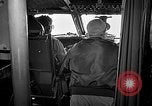
U.S. Air Force airlifts French paratroopers to Indochina.
Film opens showing entrance to cockpit of a U.S. Air Force Troop Carrier Douglas C-124 Globemaster aircraft en route from France to Indochina. A pilot is seen at the controls in the left seat, and the Aircraft Commander is observing from behind and between the pilots' seats. Close-up of number 3 and 4 engines with propellers turning as viewed from copilot's window. Two crew members are seen asleep on bunks in rear of flight deck compartment. Another is napping in a bulkhead seat. More views of engines running and propellers turning. Glimpse downward of land and clouds below. Close-up of Copilot in right seat of cockpit, wearing headset and making an announcement through his microphone. View of French paratroopers seated in cargo compartment, listening to the announcement from loudspeaker above them. Next, a French paratrooper passenger is seen opening contents of a flight lunch package. He uses the tiny can opener included in the package to open a can (with some difficulty). Paratroopers eating flight lunches.Two of the passengers playing chess on a miniature board with plug-in chessmen. Close-up of the chessboard. Co-pilot speaking on intercom again and a French paratrooper, wearing headset and microphone, speaking as well (likely translating). Glimpse of engine running on left wing. A different person (not in flight suit) at the controls in copilot's seat. The crew's Flight Engineer making throttle adjustments at his panel. View on the ground of French greeting party on the destination airfield to meet the arriving aircraft. Arriving C-124 aircraft taxiing on inboard engines only, as it proceeds along layers of pierced steel plank (Marsden matting) comprising the surface of airfield ramp. Views of French military waiting to greet arriving paratroopers. The aircrew's loadmaster lowering one of the aircraft's front loading ramps. French paratrooper passengers use it to leave the aircraft. (The other ramp is partially down and contains cartons and boxes.) Close-up of a French major in the greeting party. A woman greeting troopers, individually, as come down the ramp from the aircraft. Some French aircraft lined up on ramp, in background. (They appear to be Grumman F8F Bearcat aircraft.) Glimpse of an armed French Colonial (Tirailleurs Sénégalais) sentry standing near the aircraft. Troopers carrying cartons of rations from the aircraft and joining others preparing to board trucks for a ride to their quarters. Uniformed French soldiers in the greeting party help load heavy crate into an Army truck. Some troopers leave on trucks.
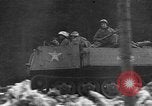
United States troops advance through the Siegfried Line and enter a German village and town during World War II.
Film opens showing American soldiers riding in an open tracked personnel carrier, along a road in France, during World War 2. They pass a burning destroyed German tank at the roadside. A U.S. Army truck full of troops and a jeep follow the personnel carrier. Next dragon's teeth tank traps are seen in the snow. A U.S. M10 tank destroyer and a truck are parked near the dragon's teeth. A gunner atop the M10 fires his M2 Browning heavy machine gun. The M10 continues to move past the dragon's teeth. Infantry are seen accompanied by a whitewashed M4A3(76) Sherman tank. Other troops are settled into positions in the snow beside the narrow road. View from behind advancing troops. Explosions in a hillside as shells strike from an M4A3(105) firing rounds. White smoke rising from phosphorous shells fired into a German village. An M4A3(76) tank firing rounds in the village. Sherman medium tanks moving through rubble and then on a town street. Two M4A3(75) tanks parked side-by-side in the town. Tank commander in one points down the street, as hatch in the nearest one begins to open. U.S. infantry moving through the town accompanied by these tanks. Armored infantry hunker down behind a tank as it passes a church building. Some soldiers scamper down a hill toward village wooden buildings. Two are seen escorting a German prisoner, who collapses and has to be helped to his feet. Three other U.S. soldiers are approached by a surrendering German soldier with his hands in the air. Next American soldiers are seen taking several surrendering German soldiers into custody.
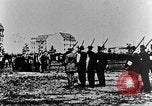
The German volunteers gather and practice drills; and cattle confiscated for the army in Europe during World War 1.
German volunteer soldiers demonstrate rising man power in Europe during World War I. The German volunteers gather and practice in drills for marksmanship and shooting. The German volunteers carrying rifles, practice for firing. An officer reviews troops. The troops learn to march. The German military personnel herd cattle through the streets of a town, for use to feed soldiers. Sides of beef and large wheels of cheese are distributed to soldiers. The soldiers eat the beef. Some German soldiers in France or Belgium distribute food and drink to hungry children of the enemy who gather near them.
Eisenhower, Tedder and Montgomery view the tons of supplies and join the troops engaged in mass maneuvers in Great Britain.
Preview of pre-invasion maneuvers in Great Britain during World War II, less than 2 months before the D-Day invasion of France by Allied forces. Men accumulate tons of supplies and motor cars are lined up. U.S. General Dwight D. Eisenhower, Marshal of the Royal air Force Arthur William Tedder and British Army Field Marshal Bernard Law Montgomery view the tons of supplies which have been accumulated. Photographers take photos. They join the troops who engage in mass maneuvers. View of a British soldier loading and firing a British spigot mortar type 35 pound anti tank PIAT gun (Projector, Infantry, Anti tank), new machine guns spit into action from tanks and masses of tanks give off salvos of artillery fire. A huge formations of transport planes in flight as hundreds of paratroopers descend on ground.
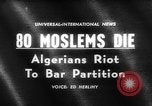
Soldiers fire artillery and move into action in streets of city as Muslims protest in Algeria.
80 die in Algeria in Moslem protest. Views of city and closely packed houses. Vehicles on a road. Police standing in two lines beside the road. A street in the city. Soldiers fire artillery as Moslems protest against France's plan to isolate the natives if peace talks did not lead to a close association after independence. The soldiers move into action in the streets of city. Rioters carried by soldiers. Soldiers standing in a group, show Algerian flag.
CRITICALPAST.COM: About Us | Contact Us | FAQs - How to Order | License Agreement | My Account | My Lightboxes | Shopping Cart | Advanced Search | Featured Collections | Website Terms & Conditions | Privacy Policy ©2026 CriticalPast LLC.
License Agreement |
Terms & Conditions |
Privacy Policy
©2026 CriticalPast LLC.