


 Francais
 Deutsch
 Italiano
Refine Your Search
Romorantin France 1918 stock footage and images
- Showing 5965 to 5970 of 6000 results more
more Hide
Hide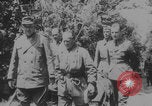
German paratroops, mechanized troops and infantry near Saint-Lo (WW2)
German paratroops prepare to aid mechanized troops and infantry moving up near Saint-Lo during the Allied invasion of Normandy in World War II. Luftwaffe General der Fallschirmtruppe (Paratroop General) Eugen Meindl meets the paratroopers of the 3rd Division of the 2nd Parachute Corps. General Eugen Meindl talks to German officials. Troops perform the Nazi Salute as General Meindl on a camouflaged vehicle drives away. German infantry and mechanize troops deliberate on plan and prepare for mobilization. Road sign reads “N174 Saint-Lo”. Camouflaged German tanks, one a Panzer IV, taking the N174 highway to Saint-Lo. Close up of German officer with soldiers in tank. German troops smiling while marching on foot. German soldier in camouflage holding a Panzerschreck (German bazooka gun) grabs a trench shovel from a comrade and runs to his position. German troops use trench shovels to dig in. German soldier uses binoculars. Two soldiers fire a mortar. German soldier sits under a tree. A German soldier uses a field telephone. A German soldier wears a “Backpack” infantry radio behind his back. A group of German soldiers sitting. A German soldier communicates through morse code in the field. German troops reading a map. Medics carry an injured German soldier. German SS (Schutzstaffel) soldier with a limp leg speaking to other soldiers. Close-up views of SS insignia on uniform.
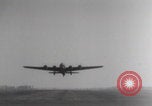
Operation Cobra bombardment and attack begins in Normandy (WW2)
A bomber takes off from an airfield for Normandy during World War 2. A group of bombers in flight. Free French 2nd Armored Division soldier looking up the sky. B-17 bombers flying. A German soldier looks up to see bombers. Bomber dropping bombs. German troops get out of a camouflaged truck. Close up of bomber pilot flying. Bomber cockpit with view of bomb sight. Bombs falling. A B-17 bomber dropping multiple bombs from its bomb bay. Anti-aircraft guns firing at bombers. A bomb lands on a factory. Aerial view of bombs landing onto crossroads. More B-17 bomber planes dropping bombs simultaneously. Consolidated B-24 Liberator bombers dropping bombs over Normandy. Multiple bombs fall on Normandy, creating clouds of explosion. United States General J. Lawton Collins and General Omar Bradley (wearing glasses) ascend stairs. United States troops remove camouflage branches from a Jeep. An M4 Sherman tank moves. Soldiers began moving as Operation Cobra has begun. “Marigny” and “St. Gilles” are highlighted from a map of Normandy. United States soldiers moving through a village with destroyed houses. A German soldier in foxhole aims his rifle. United States M4 Sherman tank passing stone house on road. German soldier with deep scar on his face. German soldier fires a rocket launcher (Raketenpanzerbüchse 54). Multiple explosions on field. German troops fire artillery at United States soldiers. German commander observes field using binoculars. German soldiers prepare to attack Allied troops. German soldiers running. A German soldier fires a Maschinengewehr 34, also known as the MG 34, machine gun. A German soldier throws a hand grenade. A Panzer IV firing at Allied positions. Explosions and thick smoke. United States soldiers crouch beside a hedgerow for cover. Soldiers carry supplies after fighting ceased for the day. Soldier sitting while holding a pistol. Soldiers moving and running with rifles. Tank artillery firing. An M4 Sherman tank drives through a forested road. United States soldier climbs a hedgerow. Soldiers firing artillery from under camouflage nets. A group of United States soldiers climb a hedgerow. Soldiers on top of a moving M4 Sherman tank. Two soldiers fire a mortar from a foxhole. An M4 Sherman tank moves across a field. American commander directs troops to climb over hedgerows. United States soldiers firing at Germans from behind a hedgerow. Soldier firing an M9 Bazooka. A soldier firing with an anti-tank rifle grenade launcher (M7 grenade launcher). Soldiers firing with an M1919 Browning machine gun. An M4 Sherman tank pass by a house. An Armored Column with M4 Sherman tanks enters the town of Saint-Gilles. Most houses in Saint-Gilles are damaged. Piles of rubble in Saint-Gilles. United States 7th Corps soldiers engage in street fighting with German troops in Saint-Gilles. Destroyed houses in Saint-Gilles. Tank firing at a house. Soldiers running far. United States soldier firing with machine gun behind bushes. A tank climbs up a hedgerow. United States soldiers climbing hedgerows. Soldier puts more shell into an artillery. Map of Normandy showing the town of Avranches.
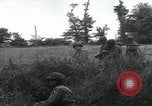
101st Airborne Paratroopers liberate Saint Marcouf, Normandy on D-Day (WW2)
United States 101st Airborne Division paratrooper in a field outside the town of St. Marcouf on D-Day in World War II. Soldiers drawing sniper fire. Paratroopers rounding up and interrogate German prisoner of war. An injured German prisoner of war speaks to the paratroopers. A pile of helmets and equipment confiscated from German prisoners. A German prisoner talks while raising both his hands. Paratroopers of the 502nd Infantry Regiment in St. Marcouf. A heart-shaped symbol stenciled on a paratrooper’s helmet. A paratrooper chewing. Paratroopers look out for snipers during a mop up operation. They inspect the cemetery. U.S. troopers are seen riding captured German Panzer I Ausf.A Sd.Ktz.101 light tanks. One is pulling a field piece trooper riding on the barrel. 82nd Airborne Division soldiers walk past a sign 'St. Marcouf'. A soldier walks past a statue of the Virgin Mary. French civilians provide paratroopers information on German movements. One of the paratroopers smoke a cigarette behind a French civilian. A paratrooper speaks with French children. Paratroopers resting on the side of the road. Airborne and seaborne units make contact. A German tracked motorcycle parked on pavement, surrounded by 101st Airborne Paratroopers. 101st Airborne Paratroopers smile and hold a captured Nazi flag.
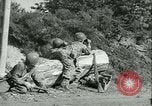
U.S. troops advance towards Cherence Le Roussel.
U.S. troops advance towards Cherence Le Roussel. SOldiers fire at the enemy. A soldier scouts for enemy soldiers through binoculars. Smoke from artillery fire. Explosions across the terrain. Soldiers stand on a camouflaged tank. Barrel of a tank jutting out of the bushes. Soldiers load and fire artillery. Soldiers march on the road and through fields. A sign board for 'Cherence Le Roussel' amid ruins and destroyed buildings. (World War II period).
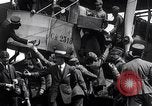
Aerial views of Verdun and Fort Douaumont during World War I
French soldiers and airmen gather around a Caproni Ca.3 bomber preparing for an aerial photography mission in World War 1. The identification number "Ca 2318" is stenciled on the airplane fuselage. The men load camera cases and equipment for the motion picture photographer, as officers watch. The Pilot takes his position in the front of the open cockpit as the photographer and second crewman sit side-by-side behind him. The pilot waves as they taxi out for takeoff. The next sequence contains views from the aircraft as it flies among clouds, and then shows Fort Douaumont clearly below, followed by the city of Verdun-sur-Meuse, and environs, including the Meuse River, bridges, buildings, and roads, without noticeable signs of any battles or damage, since the German offensive would not begin until the following year (1916).
Competitor of Wright brothers, Henry Farmen, and his airplane.
Development of early airplane. The most successful competitor of Wright brothers Henry Farmen and his airplane, in 1908. Men working on it. Farmen fills gas tank of hi s plane while other persons on ground watch. Farmen flying machine takes off in a ground.
CRITICALPAST.COM: About Us | Contact Us | FAQs - How to Order | License Agreement | My Account | My Lightboxes | Shopping Cart | Advanced Search | Featured Collections | Website Terms & Conditions | Privacy Policy ©2026 CriticalPast LLC.
License Agreement |
Terms & Conditions |
Privacy Policy
©2026 CriticalPast LLC.