


 Francais
 Deutsch
 Italiano
Refine Your Search
Rouen Normandy France 1944 stock footage and images
- Showing 841 to 846 of 9958 results more
more Hide
Hide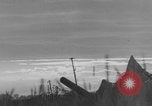
Canadian Army attack Carpiquet airfield in Normandy during Operation Windsor (WW2)
Various field artillery firing under camouflage nets during Operation Windsor, part of the Battle of Caen during World War 2. Royal Canadian forces advance on Carpiquet airfield. Canadian soldiers crouch for cover. Canadian soldiers firing with mortar field artillery. Carpiquet airfield in smoke as seen from the fields. A camouflaged soldier aims his rifle and shoots. Soldiers in a tank. Close up of tank firing its machine gun. Canadian soldiers firing with machine gun behind hedgerows. A soldier uses binoculars, pointing at a direction, while standing on a tank. Carpiquet airfield buildings destroyed after Canadian shelling. The attack was conducted by the 3rd Canadian Infantry Division, 8th Canadian Infantry Brigade, and 2nd Canadian Armoured Brigade.
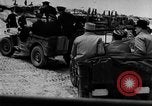
General Charles De Gaulle and officers arrive in a village and the General speaks to the people during WW II in France.
The Normandy beachhead. General Charles De Gaulle and other Free French officers and officials, in jeeps, make their way into village of Courseulles-sur-Mer. Barrage balloons seen in sky. Allied troops move along roads in military vehicles, and some soldiers are on foot. A French Catholic priest, on a bicycle, recognizes General de Gaulle and his party, stops his bicycle in amazement and doffs his hat. A Frenchman, gardening, waves. Man, on horse-drawn cart, stops to look. Women on the side of the road greet and wave to the jeeps. People on either side of the road. General Charles De Gaulle arrives with other officers in the village. Children offer flowers to th General. Several people look on. The General and officers walk through the streets of the village. The General meets the villagers. A French sailor kisses a woman. General De Gaulle speaks from a platform,under a Free French Cross of Lorraine flag, and flanked by British and American flags. A huge crowd gathered to listen to the General. Several women and children look on. General Henri Giraud, stands nearby. The audience sings La Marseillaise. The General amidst the villagers.He kisses a small child. Buildings in view behind. The General proceeds to the vehicle. (World War II period).
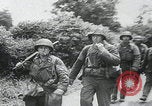
French civilians cheer the arrival of soldiers and armored vehicles in Sainte-Mere-Eglise, France (WW2)
French civilians cheer the arrival of Allied infantry soldiers and armored vehicles in Normandy after the D-Day landings in World War II. French men and women waving to the soldiers and a boy flashed the “V” or “Victory sign”. Smiling French children waving to the soldiers. Soldiers and a 105 mm Howitzer Motor Carriage M7 enter a village. Sign reads “Sainte-Mere-Eglise”. Civilians welcome troops on top of an M4 Sherman tank entering the commune. A Military Police directs traffic in Sainte-Mere-Eglise. French civilian men pushing wheelbarrows with supplies. A soldier speaks to locals. Civilians clapping at the Military Police. Faces of smiling French civilians.
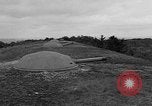
Americans capture Fort Obergentringen and turn its guns on Germans in Thionville, France, during World War II
American soldiers of the U.S. 90th Infantry Division, walking atop captured Fort Obergentringen, Near Thionville, on the west side of the Moselle River, in World War 2. Next, the Fort's German Krupp 105mm guns are seen firing numerous shells at German positions in Thionville, east of the river. American soldiers with binoculars observe the shell strikes from the fort. Smoke rising from the shelling. [Note: A September 17, 1944 wireless report about the fort's capture , to the New York Times, by Frederick Grahamby, stated that "The fort's name is Gingringen and from 1870 to 1919 it belonged to Germany." However, it is actually Fort Obergentringen (Fort Guentrange) on the hills of Guentrange, overlooking Thionville, and built in 1899.]
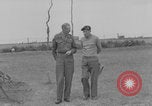
British Army General Montgomery in Normandy, British soldiers attacking Caen (WW2)
British Army General Bernard Montgomery with his staff during the Battle of Caen in World War 2. General Montgomery speaks with a Naval Liaison Officer. General Montgomery and British soldiers meeting in a forest. Soldiers refer to a map during the meeting. British Army soldiers in tanks (likely Mk IV Churchill tanks) approach Caen. A British Army tank covered in foliage moves towards Caen. British soldiers move towards Caen. A tank fires in the darkness. Silhouettes of German soldiers raising their hands to surrender. British soldiers moving though the fields. Captured German soldiers raise their hands.

United States soldiers bombard La Haye du Puits to capture the town from German forces (WW2)
The capture of La Haye du Puits by United States First Army troops under General Omar Bradley in Normandy (World War 2). An M4 81 mm Mortar Carrier Halftrack vehicle and jeep of the United States First Army driving to La Haye du Puits in Normandy. United States infantry troops travel on foot to capture La Haye du Puits. United States First Army soldiers traversing a meadow, crossing a puddle. United States First Army troops fire artillery under camouflage nets. Soldiers load shells into artillery and fire. United States soldiers fire mortar in a forest outside La Haye du Puits. A soldier fires his rifle through a hedgerow. Soldiers duck while firing mortars. Distant Haye du Puits covered in smoke. A soldier fires a rifle grenade launcher (probably an M7) into the air.
CRITICALPAST.COM: About Us | Contact Us | FAQs - How to Order | License Agreement | My Account | My Lightboxes | Shopping Cart | Advanced Search | Featured Collections | Website Terms & Conditions | Privacy Policy ©2026 CriticalPast LLC.
License Agreement |
Terms & Conditions |
Privacy Policy
©2026 CriticalPast LLC.