


 Francais
 Deutsch
 Italiano
Refine Your Search
Rouen Normandy France 1944 stock footage and images
- Showing 955 to 960 of 9958 results more
more Hide
Hide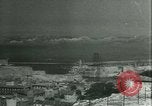
Liberation of several French cities from German Nazi troops in World War II.
Marseilles: View of the French port. British, French and American Naval officers examine German demolition of the port town. Officers survey unfinished U-Boat pens. Toulon: Destroyed German ships in the harbor. Bologne: German coastal guns in ruins. Destroyed artillery. Le Havre: Destroyed buildings and ruins in the town. Unfinished German U-Boat pens. Destroyed artillery. Brest: Destroyed buildings and ruins. German soldiers wave a white flag of surrender on September 18, 1944. U.S, Army Major General. W.M. Robertson , 2nd Infantry Division discusses the surrender with German Colonel E. Pietzonka of the 7th German Parachute Regiment. German soldiers assemble in the main square of the city during the surrender operation.
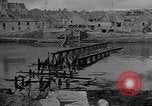
U.S. Army XX Corps units crossing pontoon bridge across Marne River, during World War II
View of bridge across the Marne River destroyed by retreating German soldiers. View shifts to U.S. Army XX Corps troops, trucks, jeeps, halftracks and tank destroyers crossing a pontoon bridge erected by Army Engineers nearby, at the bridgehead captured on 27 August 1944, during World War 2. French civilians watch from the bank of the river and wave as troops pass through their village. Using this crossing, the XX Corps continued its advance on Rheims.
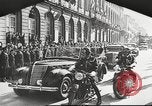
French Marshal Philippe Petain addresses a crowd from the balcony of a building in a French town during World War II.
French Marshal Philippe Petain in a French town in 1944 during World War II. Philippe Petain walks along a street with other officials. A crowd cheers. Petain addresses from the balcony of a building. Petain and staff stand at attention saluting as the crowd sings the national anthem.
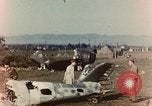
U.S. flyers who escaped from internment in Switzerland examine destroyed German warplanes in World War II
U.S. flyers, who escaped from Swiss internment, examine remains of destroyed German warplanes at a French airfield. A swastika seen on the tail of an airplane and a German cross on the wing of another. Men stand on the tail of a Nazi airplane. A group stands near the wrecked tail of a large German airplane. A U.S. P-47 aircraft is parked in the background. It has a red cowling, identifying it as belonging to the 56th Fighter Group (likely to the 63rd Fighter Squadron, which in Spring of 1944, showed no squadron color on the tail). .Army Air Force L-5 Sentinel aircraft in flight over a field.
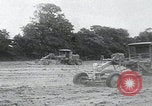
A road grader levels an airstrip before a P-38 fighter landing (WW2)
A road grader levels an airstrip in Normandy after the D-Day landings in World War II. A P-38 fighter aircraft lands on the newly built runway.
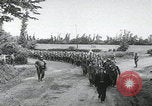
German prisoners after D-Day (WW2)
German prisoners captured by Allied forces marching on highway in Normandy after the D-Day landings in World War II. Allied soldiers watch over them. They march on the side of the road, marching past a DUKW. Prisoners marching towards a compound area with barrage balloons overhead. The prisoners receive food and drinks upon their arrival. German prisoners wading through water to board an LCT (Landing craft tank) on beachhead.
CRITICALPAST.COM: About Us | Contact Us | FAQs - How to Order | License Agreement | My Account | My Lightboxes | Shopping Cart | Advanced Search | Featured Collections | Website Terms & Conditions | Privacy Policy ©2026 CriticalPast LLC.
License Agreement |
Terms & Conditions |
Privacy Policy
©2026 CriticalPast LLC.