


 Francais
 Deutsch
 Italiano
Refine Your Search
Rouen Normandy France 1944 stock footage and images
- Showing 973 to 978 of 9958 results more
more Hide
Hide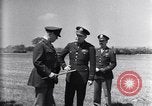
General George S Patton visits Commander and Staff of XIX Tactical Air Command during World War II
Lieutenant General George S Patton talking with Brigadier General Otto P. Weyland and officers of the XIX Tactical Air Command staff, at an airfield in England, prior to the Normandy invasion, in World War 2. He is seen walking across the airfield; standing beside cars; looking at propeller and engine of P-51 aircraft, and watching P-51 aircraft landing.

Allied soldiers rescued from invasion boats sunk on D-Day are brought to England during World War II
The HMS Nightingale, a British Mining Tender, flying the Royal Naval Ensign, approaches a pier in Plymouth England. Several Royal Navy officers and sailors are aboard along with a number of Allied soldiers who were rescued after their ships were sunk during the D-Day invasion of Normandy. Most of the rescued soldiers appear relatively unhurt. However, some are ambulatory wounded and others, more seriously injured, are carried off the boat on stretchers, by British sailors. All proceed up a gangway to a processing center. (Note:The soldier seen at 2 minute mark, fiddling with his gloves, is Private 1st class Paul Knor of E company, U.S. 2nd Ranger Battalion, whose boat was sunk while headed for Pointe Du Hoc. He rejoined his Battalion, soon afterwards.)
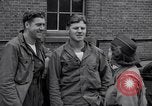
British sailors tell stories of their rescue to Women's Army Corps Captain in England (WW2)
Two British seamen recount their D-Day Normandy invasion rescue to a Women's Army Corps (WAC) Captain in Plymouth, England in World War II. Seaman on the left tells how after a British carrier hit a mine and the American soldiers had to swim to the shore. Seaman on the right tells that the carrier, on which he was there, was hit at the beach broadside and the men had to swim through rough seas. Most of the men were picked up by a United States landing ship and returned to England.
Various U.S. tanks used in World War 2, from film titled 'Tank Mission, World War II'
From a film titled 'Tank Mission World War II'. Eiffel tower in Paris and scenes on quiet streets of Paris during German occupation. German troops in Paris in 1941. United States tanks maneuver during planning phases and drills for invasion of Europe. Tank fires flamethrower. Various U.S. tanks fitted with different attachment for bulldozing practice demolishing beach blockades and erecting landing areas. Infantry troops practice maneuvering behind tanks. German bunkers and fortifications on the French coast. United States infantry and tank units land at Normandy on D-Day and the days following. U.S. troops fire. Smoke rises due to explosion. Many hedges in the way. Tanks fitted with hedgerow cutters (the idea of a Sergeant) for cutting through the hedges. Tank fitted with hedge row cutter cuts through a hedge.
Worldwide operations of United States Coast Guard in World War 2
Overseas activities of United States Coast Guard in World War II. U.S. Landing Craft Infantry, LCI(L) 617, part of LCI Flotilla 22 in World War 2. She is seen underway in rough waters of the Pacific ocean during 1945. Coast Guardsman ordered to Battle stations. A Coast Guardsman observes approaching enemy aircraft through binoculars. Coast guard gunner fires Antiaircraft guns using foot trigger. Enemy aircraft crashes in ocean. A Coast Guardsman signals using semaphore flags. Beachhead supply operations. Coast Guard Picket Boat, CG-42022, seen patrolling around U.S. transport ships in a Persian port, while they carry lend lease supplies to the Soviet Union. Coast Guard combat patrol in jungle using canines (dogs). The Cactus (A) Class 180 foot buoy tender, USCGC Tupelo placing a buoy at sea. Releasing a weather balloon. A Coast Guard wooden 83 foot cutter ("83 footer"). Loading a Coast Guard B-24 aircraft on Guam. The plane takes off. Invasion task force of U.S. warships underway. Coast Guard crews at various duty stations aboard their ships during the war. The former luxury ocean liner, SS Manhattan underway, her decks crowded with troops, following her conversion into the U.S.Coast Guard-manned USS Wakefield (AP-21). U.S. Navy attack transport USS Arthur Middleton (APA-25) at sea in the Pacific. Coast Guard operating transport ships unloading cargo for Allied invasion forces and running inter-island shipping service in the Pacific, during World War II.Landing Ship Tank (LST-788) arriving at the beach next to Landing Ship Medium, LSM-242, on Iwo Jima. A Landing Vehicle Tracked (LVT) being driven off LST-760. USS LCI(L)-87, Flagship of LCI Flotilla 10. Her Captain, M. E. Imlay, USCG, is seen on her bridge, before departing from England for the Normandy invasion. U.S. Landing Craft Infantry, LCI(L)-668 at beach and troops wading ashore.
A damaged LCT and other landing craft vehicles underway during D-Day invasion
Off the coast of Normandy on D-Day. A Landing Craft Tank (LCT) damaged by a mine. A ship underway in the background. PT (Patrol Torpedo) boat and loaded LCTs sail towards a beach.
CRITICALPAST.COM: About Us | Contact Us | FAQs - How to Order | License Agreement | My Account | My Lightboxes | Shopping Cart | Advanced Search | Featured Collections | Website Terms & Conditions | Privacy Policy ©2026 CriticalPast LLC.
License Agreement |
Terms & Conditions |
Privacy Policy
©2026 CriticalPast LLC.