


 Francais
 Deutsch
 Italiano
Refine Your Search
Rouen Normandy France 1944 stock footage and images
- Showing 1327 to 1332 of 9958 results more
more Hide
Hide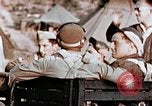
USAAF pilots are briefed and crew members inspect a map in France during the Battle of France of World War II.
United States Army Air Force ( USAAF ) B-25 Mitchell aircraft crew members in France during the Battle of France of World War II. The crew members sitting on a bench. Tents in the background. USAAF pilots leaving the door of a briefing room. The crew members getting into army vehicles. The vehicles moving on a path. The crew members inspect a map standing in front of a USAAF B-25 Mitchell medium bomber. A soldier walks holding the leash of a dog. View of a B-25 Mitchell aircraft in flight.
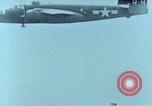
A USAAF B-25 Mitchell bombs a bridge resulting in an explosion in France during the Battle of France of World War II.
United States Army Air Force ( USAAF ) aircraft in France during the Battle of France of World War II. A USAAF B-25 Mitchell medium bomber in flight. The aircraft in flight over fields and wooded areas. The aircraft in flight over target areas. The aircraft drops bombs over a bridge which explodes. Thick smoke rises from the explosion. The smoke spreads over the area. The surrounding wooded region in view. Few B-25 Mitchells in formation flight. The tail section of a B-25 in view. The B-25s in formation flight over a coastline.
Father Farley reading service in front of an altar in a U.S. Army tent in France during the Battle of France of World War II.
A church service in a U.S. Army tent in France during the Battle of France of World War II. A Jewish flag hoisted on a pole flutters in wind. Father Farley reads service in front of an altar inside the tent. The U.S. flag and a cross behind the Father. Several views of the Father reading. Father Farley standing in front of the altar.
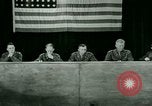
German civilian Pusch testifies in trial of Franz Strasser for shooting of American aviator prisoners; scenes from tribunal in Dachau (WW2)
Excerpts from 24 August, 1945 (World War II) military commission tribunal in Dachau. Swearing in of translator and charges read against Franz Strasser for: "Violation of the Laws and Usages of War. In that on or about 9 December 1944, FRANZ STRASSER, Kreisleiter of Kreis Kaplitz, an Austrian National, did at or near Kaplitz, Czechoslovakia, wrongfully and unlawfully kill an American airman, whose name, rank and serial number are unknown, [by shooting him with a machine pistol]. Strasser replies with a plea of not guilty. Next scene shows entry of German civilian truck driver, Josef Pusch, who is sworn in and provides testimony about the incident. Pusch describes the events of the shooting of the American prisoners by Strasser. United States flag and judges on raised platform. U.S. officials, defendants and civilians in the court room. Shows hearing as it begins. The Nazi commandant seated with other officials. The German civilian is questioned by an interpreter. German civilian Pusch identifies Strasser. Pusch gives his account to the tribunal about the shooting of the American flyers.
Witness gives testimony in trial of Nazi Kreisleiter Franz Strasser, during a War Crimes Trial in Dachau, Germany (WW2)
Scenes from Military Commission trial held by United Stated 3rd Army in Dachau, Germany during World War II. Scenes from courtroom during trial of Franz Strasser for his shooting of prisoner American flyers on December 9, 1944. Soldiers seated in the court room look at the camera as it pans across the room. A German witness to the killing gives his account of the shooting of the American aviators with a machine gun by Strasser and by Lindemeyer (dead - suicide). The Nazi Kreisleiter Strasser is sworn in near the end of the clip.
U.S. Signal Corps officers and soldiers use mine detectors, modern radars, and meteorological equipment during World War II.
The role and contribution of the U.S. Army Signal Corps in combat and war. U.S. shuttle ships loaded with signal communication supplies for U.S. and Allied troops in the European Theater make their way in the Atlantic ocean. The Squier Laboratory at Camp Alfred Vail in Fort Monmouth, New Jersey. A technician works on signal communication equipment in the laboratory. U.S. soldiers use mine detectors in the European Theater during World War II. The mine detectors detect metallic, non-metallic mines, wooden box mines, and mines in glass containers. Artillery soldiers bury large microphones into the ground in advance zones. The microphones relay back information on enemy artillery. Soldiers receive the information on radio sets. U.S. aircraft on a training flight simulating real combat situation: The aircraft lost in heavy rain and rough weather, looking for the location of Boston. The pilot switches on a modern advanced radar. The radar waves pierce thick clouds, are reflected by Earth's surface and display an image on the scope. The image shows the clear location of Boston harbor directly under the aircraft. U.S. bombers attack over the Channel coast on D-Day (6 June, 1944). U.S. soldiers employ meteorological equipment for long range weather forecast in the European Theater during World War II. Soldiers release a hydrogen balloon into the sky. Another soldier uses an apparatus to take readings of atmospheric conditions behind enemy lines. An aircraft drops an automatic weather station called SCM-18-TI by parachute into enemy territory. The timed mechanism sends out weather data in codes. The interior of the automatic weather station lying open in a field.
CRITICALPAST.COM: About Us | Contact Us | FAQs - How to Order | License Agreement | My Account | My Lightboxes | Shopping Cart | Advanced Search | Featured Collections | Website Terms & Conditions | Privacy Policy ©2026 CriticalPast LLC.
License Agreement |
Terms & Conditions |
Privacy Policy
©2026 CriticalPast LLC.