


 Francais
 Deutsch
 Italiano
Refine Your Search
Rouen Normandy France 1944 stock footage and images
- Showing 445 to 450 of 9958 results more
more Hide
Hide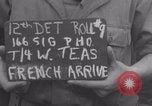
French soldiers with civilians after landing at Utah Beach, Normandy (WW2)
French locals in Foucarville welcome the arrival of the Free French 2nd Armored Division troops after landing in Utah Beach, Normandy during World War 2. Soldiers of the Free French 2nd Armored Division smoking cigarettes in Foucarville, France. French soldiers holding small children on their shoulders. French soldier affectionately holding child points to the camera. A French mother, holding her child, talking with French soldiers. French soldier wraps his arm around the smiling old woman’s shoulder. French soldiers with a woman and some children. Child takes off the beret of the French soldier and throws it to the ground. A boy speaks to a French soldier as his mother looks on.
Free French 2nd Armored Division convoy enters Ducey (Normandy), Philippe de Gaulle reads a map (WW2)
Free French 2nd Armored Division convoy enters Ducey, Normandy during World War 2. French men and women cheering as Free French troops enter Ducey. French women raising their hands while cheering. Sign reads “Centre d’ Accueil” (“Reception center” in English). Lieutenant Philippe de Gaulle, the son of Free France leader General Charles de Gaulle, checking a map in Ducey.
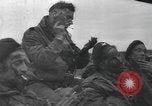
U.S. paratroopers board aircraft and take off from England for the D day invasion during World War II.
Allied invasion of Normandy, France during World War II. United States paratroopers from different professions with camouflage make up on their faces they prepare to leave England for the invasion of Normandy. The paratroopers being briefed before the take off. They put on their combat gear. U.S. General of the 9th Air Force Brereton shakes hands with the paratroopers. The paratroopers board an aircraft and take off. U.S. Army Air Forces C-47 aircraft take off from different airfields in England to bombard Normandy, France. Aircraft in flight. A gunner aboard an airborne aircraft. Bombs being released. The bombs explode causing a pillar of smoke to rise up. German coastal defenses being bombed.

Robot bomb damage in England; launching sites and wide gauge tracks for transporting bombs in Cherbourg, France (WWII)
U.S. Army 9th Air Force North American P-51 Mustang fighters in flight and tracking a V-1 Flying bomb to shoot it down over Southern England, United Kingdom, during World War II. Crowds inspect damage caused by V1 flying bombs and V2 rockets, also known as “robot bombs.” A crater formed by a German robot bomb. A U.S. Army soldier collects fragments while inspecting the bottom of the bomb crater. British and American soldiers and British civilians inspect the damage. Aerial and ground views of an unfinished German V-1 and V-2 launch site on the Cherbourg Peninsula in Normandy, France after its capture by Allied forces. The main rocket ramp is seen on the launch site. A crane at the unfinished launch site. A concrete strip under construction. An unfinished section at the Cherbourg rocket launch site. The rich concrete mixture used in the construction of the massive installation is reinforced by lattice-type steel rods (half inch thick woven in squares). Unfinished and destroyed platforms from 29 rocket launch installations made by German forces at Cherbourg before the Normandy landings. Large solid underground structures intended as showrooms for shells and equipment. Unfinished or damaged narrow-gauge railroad used for supplies and construction. Carts are seen on the railroad. Netting laced with metal leaves to prevent fading is used for camouflage. A soldier arranges green coverings outside a bunker. A man stands on a crater. Wide gauge tracks to bring bombs to the platform. Some parts of the installation are bombed by Allied bombers.
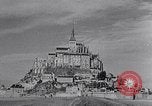
Views of Mont-Saint-Michel island at the mouth of the Couesnon River in France.
Mont-Saint-Michel island at the mouth of the Couesnon River in Normandy, France. Views of the tidal island from afar and on the island itself. Houses and buildings in the village. The abbey of Norman architecture style located near a garden. Arches and pillars. Pillars in the passageway. The spire of Saint-Michel and Gothic details. A glass window in the arched hallway.
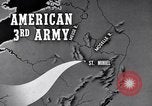
U.S. 3rd Army crosses Meuse River, advances through St.Mihiel, and crosses Moselle River in France, in World War II
Animated map showing American 3rd Army advance toward St. Mihiel, France, during World War 2. Advance elements of General Patton's U.S. 3rd Army cross Meuse River in a French civilian's barge and proceed through town of St. Mihiel. A U.S. Army combat photographer is seen taking pictures at bank of river. U.S. Infantrymen make their way through virtually deserted town of St Mihiel. U.S. field artillery fire on German positions along the Meuse. U.S. infantrymen lying prone beside a large barn.US soldier photographing others as they rest on a sidewalk.Two U.S. soldiers running up and over a wooden bridge.American forces driven back by heavy German resistance and then resume advance after U.S. artillery fire neutralizes defending German forces. However, still under heavy fire, American infantrymen carry small boats to cross the Moselle River. U.S. troops paddle across the river in a boat at Dornot, France, September 1944. Railroad pedestrian crossover bridge visible. (Note: Unit making the river crossing was 5th Division, 11th Infantry Regiment, 2nd Battalion, E and F company.Lieutenant Colonel Kelly B, Lemmon Jr. was battalion commander.)
CRITICALPAST.COM: About Us | Contact Us | FAQs - How to Order | License Agreement | My Account | My Lightboxes | Shopping Cart | Advanced Search | Featured Collections | Website Terms & Conditions | Privacy Policy ©2026 CriticalPast LLC.
License Agreement |
Terms & Conditions |
Privacy Policy
©2026 CriticalPast LLC.