


 Francais
 Deutsch
 Italiano
Refine Your Search
Rouen Normandy France 1944 stock footage and images
- Showing 469 to 474 of 9958 results more
more Hide
Hide
American aircraft bomb German targets in France during World War II.
Allied aircraft bombard German targets in France before the invasion of Normandy during World War 2. A formation of U.S. B-24 Liberator bombers is silhouetted against the sky,. Next is a view from a bomber as its bombs fall away towards targets below. Flashes of bombs exploding in a row on the ground causing smoke to rise upwards rapidly. Glimpse of a U.S. B-17 bomber in flight. A descending trail of white smoke is seen behind the B-17. More views from an airplane of bombs falling from it through contrails below. Views from above of the bombs striking and raising smoke below.
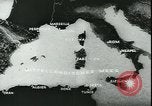
Views of Southern France, under German occupation in World War 2
Film opens with map showing lower France and Mediterranean areas. However, it shows images covering primarily the French Riviera (or Côte d'Azur) under German occupation during World War II, in 1943 or 1944. German infantry march along a road. A flight of German FW-190 Fighter airplanes flies inland from the Mediterranean Sea and crosses low above a harbor. Change of scene shows a single fighter plane buzzing the Marseille Port. (It looks like a P-47 with invasion stripes. But It does not draw any anti-aircraft fire.) Camera tracks it from vantage point at the Marseille Basilica, high above the harbor. Brief view of the Basilica as the aircraft passes. A glimpse of the Marseille Port below from the Basilica. View of the Marseille Transporter Bridge designed by Ferdinand Arnodin and built in 1905. (It was destroyed after these films were made, in 1944.) A German soldier peering through binoculars in front of a 2 cm Flak 30/38/Flakvierling, quad anti-aircraft gun position. Another one is seen in the background. Several more views of German anti-aircraft and other gun emplacements protecting the Marseille Port, including 88mm guns, heavy machine guns, and Atlantic Wall coastal defense guns. Scene shifts to German soldiers marching near the French Riviera beach and palm trees. Italian cavalry are seen riding in formation, ostensibly from Nice. Italian soldiers in trucks are being transported along the Riviera waterfront. A road sign points toward Toulon at 6.3 kilometers away. (So this location is probably near Sanary-sur-Mer.) View of the Toulon harbor, where the French battleship Provence, scuttled in 1942, is seen settled low in the water at a pier.
The first U.S. C-47 aircraft (and its crew) to drop Pathfinder Paratroopers on D-day eve in World War II.
U.S. Army Air Forces C-47aircraft , number 42-93098, of the 9th Troop Carrier Command Pathfinder Group, and its crew. This is the first aircraft and crew to drop American paratroopers (pathfinders) over France during the Allied invasion, in World War 2. The aircraft taxis on a British airfield. Crew of the aircraft are seen in front of it, including pilot, Lieutenant Colonel Joel Crouch, Copilot, Captain Vito Pedone, Navigator, Captain William Culp, Radio Operator, Harold Coonrod, along with two crew chiefs. Crew members shake hands and board the aircraft. Colonel Crouch waves from the cockpit of the C-47 (but has not started engines). Major J.L. Sweetman boards another aircraft. Colonel Crouche's C-47 taxis to where the Pathfinders will load up. View of Control Tower at RAF North Witham, with ambulance parked outside it. Three hours before takeoff.Colonel Crouch, is seen on a path near the airfield, with a Pathfinder Captain and Lieutenant, who will be aboard his aircraft and be the first to jump into France. They kid around. The Pathfinder officers note that Colonel Crouch wears paratroop wings. Later, two Pathfinders, of the 101st Airborne Division , with camouflaged faces and American flag insignia on their right shoulders, step from woods and pose momentarily. Pathfinder Paratroopers line up to board C-47 aircraft as Lt. Col. Crouch rides a scooter at the airfield. Aircrews and Pathfinders pose for photographs before taking off. The lead aircraft, number 42-93098, with Lieutenant Colonel Crouch at the controls, takes off from RAF Station North Witham at 9:54 PM, on June 5, 1944. to begin the invasion of France. (Note: This C-47 was shot down on September 18, 1944, during Operation Market Garden, and crash landed on Haamstede Airbase, Netherlands. Although shot at by German troops on the ground, pilot, Maj Joseph A. Beck, and Navigator Lt. Vincent J. Paterno, survived as prisoners of war. Copilot Capt Fred O. Lorimer and another crew member were fatally shot.)
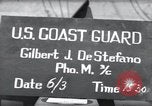
U.S. Military Chaplain (Roman Catholic) conducts mass on pier in Weymouth harbor, England, 3 days before D-Day
U.S. troops and Coast Guardsmen assemble for religious service on a pier in the port of Weymouth, England, three days before the invasion of Normandy, France, in World War 2. A Roman Catholic Military Chaplain conducts the mass. Landing Craft Infantry LCI(L) numbers 89 and 93 are tied up at the dock in the background. (These craft are part of LCI(L) Floltilla 10, operated by the United States Coast Guard.) A small dog stands at the feet of the Chaplain, as he conducts the mass. The service finishes as the Chaplain administers the sacrament of Holy Communion (Eucharist) to the troops. In concluding scenes, U.S. Landing Craft Infantry are seen underway from England, to join Assault Groups for the invasion of Normandy, France. One of the craft is seen to be Number 87 and another number 495.
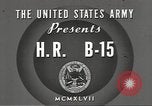
Preparation and planning of D-Day invasion of Normandy by Allied Forces during World War II.
Film titled ‘D-Day Convoy’ based on invasion of Normandy (D-Day) by Allied Forces during World War II. Soviet Leader Joseph Stalin, U.S. President Franklin Roosevelt, and Prime Minister of UK Winston Churchill seated at Tehran Conference in December 1943. Other officials stand behind the big three. U.S. General George Marshall, Supreme Commander of Allied Forces in Europe Dwight Eisenhower and other officials seated at a conference table. Map of France details cross channel assault of France by Allied Forces. Map shows coastal locations to be attacked by Allies. Weapons and equipment from America pouring into England. U.S. soldiers arrive in England and train, for the invasion, on southern coast of England. U.S. B-26 bombers hitting German targets and smoke billowing up from exploding bombs. B-17 bomber in flight and bombs falling on German industrial targets. Gunners on B-17s defend against German fighter aircraft. American bomber explodes in flight after attack by German fighter airplane. German Messerschmitt fighter is destroyed. From edited film produced in 1947.
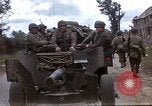
Allied troops advance through the city of Valognes, France, in World War II
Allied troops in France, during World War 2. Troops advance to attack at the St. Lo line. Soldiers seated on artillery and some on foot. They go through the city of Valognes. Military vehicles cross destroyed buildings. A man walks past ruins. A war correspondent walks on a Normandy beach. Many triangular beach obstacles with mines attached to them placed there by German forces and slave laborers.
CRITICALPAST.COM: About Us | Contact Us | FAQs - How to Order | License Agreement | My Account | My Lightboxes | Shopping Cart | Advanced Search | Featured Collections | Website Terms & Conditions | Privacy Policy ©2026 CriticalPast LLC.
License Agreement |
Terms & Conditions |
Privacy Policy
©2026 CriticalPast LLC.