


 Francais
 Deutsch
 Italiano
Refine Your Search
Rouen Normandy France 1944 stock footage and images
- Showing 541 to 546 of 9958 results more
more Hide
Hide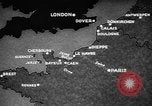
German Army fights Allied infantry and tanks while retreating from the Western Front in Europe, during World War II.
German Army fights with the Allied infantry and tanks on the Western Front in France and England, during the summer of 1944 in World War 2. Animated maps show English and French invasion coastlines. During Battle of Caen, German soldiers load ammunition on a camouflaged truck. The truck driven on roads. A German soldier on truck observes American bombers in sky overhead. Truck parks to the side and German antiaircraft guns fired. Night view from ground of bombs being dropped and buildings burning in the distance in Caen, France. German military trucks move at night on roads passing by burning fires. View from inside cabs of moving German vehicles. Daytime view of heavily bombed and destroyed city of Caen with ruins of houses and shops; German infantry walk through the streets of the destroyed and empty city. German soldiers fully loaded with their weapons ready for a battle. Close views of their faces with determined expressions. German tanks, armored vehicles, and infantry move on roads. Among them are two Borgward IV remote-controlled demolition vehicles (Schwerer Ladungsträger Borgward B IV, or heavy explosive carrier Borgward B IV) each driven by one man. Soldiers of German Army observe approach of U.S. Army forces. A German soldier arranges shells for artillery to fire as they fire on Allied positions. Wehrmacht infantry soldiers advance cautiously along roads. German soldiers take cover and prepare to attack as American tanks pass through a village. German soldiers fire on U.S. Army tanks. German soldiers direct an unmanned, remote-controlled small armored vehicle laden with explosives across a field and detonate it near U.S. Army vehicles (it is known as a Goliath Tracked Mine, or Leichter Ladungsträger Goliath (Sd.Kfz. 302/303a/303b); also known as a "beetle tank" to Allied forces, or a German robot tank). Large explosion as the remote-controlled demolition vehicle is detonated. Dead U.S. Army soldier along a road side, and injured German soldiers are aided by other German soldier
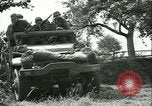
U.S. troops advance through Mayenne and Laval in France (WW2)
6 August 1944: A U.S. armored column on the outskirts of Mayenne on their way to Paris, France in World War II. Soldiers in trucks, jeeps and half tracks. Soldiers prepare to fight, push artillery across a field. Troops march into Mayenne. Civilians welcome and greet the soldiers. U.S. troops and a van on the road. The troops and tanks enter Laval. Civilians greet the soldiers. Civilians on bicycles wave to soldiers in a truck. Soldiers and civilians at a bombed bridge. Soldiers fire at Nazis across the river from behind a wall. Civilians with French flags on the streets. A woman collaborationist surrounded by French men, holds pictures and has a Swastika on her dress front. A woman holds a broken picture of German leader Adolf Hitler. People with US, British, and French flags in a building window.
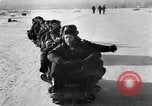
U.S. Army Air Forces operations at Juvincourt Airfield, France, during World War II.
Operations of the U.S. Army Air Forces 394th Fighter Squadron, 367th Fighter Group, at Juvincourt Airfield (Advanced Landing Ground A-68) in France, during Winter of 1944, World War 2. The entire field is covered in snow. Pilots ride to their P-38 aircraft on a train of sleds, pulled by a Carl Eliason Motor Toboggan (Made by Four Wheel Drive Auto Company of Clintonville, Wisconsin). Pilots playfully brush some snow toward the camera as they pass. They stop to let a pilot off at his P-38 (reportedly the pilot is Jack Hallett). Next, P-38 aircraft are seen taxiing for takeoff over the snow, and then, flying very low over the field. The sound of gunfire is heard in the background. An abandoned (crash-landed) RAF Avro Lancaster bomber is seen collapsed on its left wing and elevator, in the snow. (It has been suggested that this might be Lancaster serial no ME850 LS-D of XV squadron RAF that crash landed on January 1st, 1945 or Lancaster VN-G of 50 SQN that crashed there on the same day.)
Signal Corps weekly film reports sent to Photographic Center and used in training films for U.S. troops during World War II.
The role and contribution of the U.S. Army Signal Corps in combat and war. Amphibious landings of the first wave of Allied troops including Signal Corps Units in Normandy, France on D Day during World War 2. The Joint Assault Signal Companies (a Signal Corps Unit that accompanies the soldiers on every beach landing) go ashore in Normandy. Soldiers in landing crafts approach the beach. Landing crafts anchored along the shore line. A U.S. flag on the beach. Crafts approach the beach. U.S. Army Signal Corps combat photographers using motion picture cameras to film the battle that ensues on the beach and in the fields. Gun fire and explosions in the battlefield, filmed by combat cameraman. Allied aircraft in flight. Airmen load weekly film reports of the war in all Theaters made by Signal Corps officers from a van into an aircraft. The films are sent to the Photographic Center in New York. A soldier assembles the films. Technicians organize and arrange the films. They place the film reels onto racks. The film content is used to make training and orientation films for the U.S. troops. Troops watch the films in order to cut down the training period, and stay informed about the order of event in other Theaters of Operation. The films include 'Why We Fight' and 'The Fighting Men' series. Clips and recordings from these films.
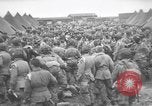
American troops invasion force aboard LST, landing on D-Day, and formation of B-17s Flying Fortress in flight in Europe.
American troops invasion force group in large numbers in tent area. General Dwight D. Eisenhower walks and talks among the paratroopers and soldiers on the evening before the D-Day invasion of France in World War 2. Allied Invasion troops march onto landing craft. LST (Landing Ship Tank) loaded with soldiers. Normandy beaches: fires are burning and smoke is seen along coastline. Troops walk down gangplank into water of Normandy beaches on D-Day. Formation of USAF Boeing B-17s Flying Fortress in flight. Top turret of B-17, large formation of B-17s in the background. German Me 262 aircraft in flight, plane descends toward earth. B-17 bomber going down, engines on fire.
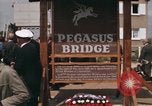
Ceremony at Pegasus Bridge on the 25th anniversary of D-Day
Ceremony at Pegasus Bridge, a bascule bridge over the Caen Canal, at Ouistreham, France. Commemorating the 25th anniversary of the D-Day invasion at Normandy, a group of civilians and British Military and political leaders gather to lay wreaths and honor those who died. The bridge, also known as the Bénouville Bridge, is seen along with crowds gathered. High-ranking British Military figure (possibly Bernard Montgomery?) and a political figure lay wreaths at the bridge. Uniformed musicians play bag pipes and bugles. Children lined up to participate in the ceremony. Canadian, British,American and French flags fly near the memorial on Pegasus Bridge.
CRITICALPAST.COM: About Us | Contact Us | FAQs - How to Order | License Agreement | My Account | My Lightboxes | Shopping Cart | Advanced Search | Featured Collections | Website Terms & Conditions | Privacy Policy ©2026 CriticalPast LLC.
License Agreement |
Terms & Conditions |
Privacy Policy
©2026 CriticalPast LLC.