


 Francais
 Deutsch
 Italiano
Refine Your Search
Rouen Normandy France 1944 stock footage and images
- Showing 565 to 570 of 9958 results more
more Hide
Hide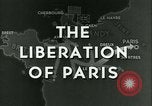
French Forces of the Interior (FFI) clear the way for Allied troops in Paris.
August 1944: French patriots clear the way for Allied troops approaching to liberate Paris. A map shows entry of Allied troops into France. French patriots draw and distribute hidden arms. French men march towards Paris. Demolition fires set by the retreating Germans occupiers throughout the city. Quiet streets and areas of the city before the August uprising. French Forces of the Interior (FFI) Headquarters. FFI men in hideouts. A FFI command post in the city. The members map strategy and prepare arms and ammunition. A woman with a sleeve band with the letters FFI and the Free French Cross of Lorraine insignia. FFI men and women erect barricades throughout the city. Men load rifles. German tanks advance. FFI men in a street fight. A wounded African French man is helped to safety. French patriots behind barricades. A burning vehicle on the road. Smoke from explosions. A man near a wounded on the street. French man and woman disarm a German soldier. German Panther tanks flee. The French take German soldiers prisoners. (World War II period).

Scenes from 1929 Geneva Convention; surrender of 20,000 Germans to U.S. General Macon by German Major General Elster near Loire
A U.S. Army Signal Corps training film on Rules for controlling German prisoners of war in World War 2. International conference 1929 in Geneva, Switzerland. Various officers and dignitaries in the conference where the Geneva Convention was agreed-upon by many nations. Image of Field Manual 27-10 states the Rules of Land Warfare based on the Geneva Conventions and describes standard procedures for handling Prisoners of War. Scene of 20,000 Prisoners of War who surrender under Nazi Major General Eric Elster at Loire, France September 16, 1944 to the United States 3rd Army, 83rd Division, under General Macon. General Elster salutes General Macon, then approaches the microphones in the middle of a roadway and delivers a surrender speech. General Macon then replies accepting the surrender on behalf of General Simpson. General Macon states that the men will be treated according to the rules made during the conference in Geneva.
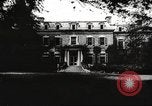
Allied leaders meet in Quebec, Canada and the Germans launch an attack in Bulge, Belgium during World War II.
Allied campaign against the Axis in 1944 during World War II. Exteriors of Dumbarton Oaks in Washington DC. Representatives of the United Nations at a meeting inside the mansion. A railroad train arrives and British Prime Minister Winston Churchill gets off the train in Quebec, Canada for the Quebec Conference. Churchill confers with U.S. President Franklin D. Roosevelt about Allied plans during the war. French FFI or Maquis groups in France. President Roosevelt, seated in front of a large celebrating crowd of people in the U.S., acknowledges them after being reelected President for a third term. People celebrate his victory and hold election victory signs as they cheer. American Civilians (mostly women war production workers) work in war production factories to produce aircraft, tanks and other equipment in the United States. Rows of aircraft engines, cockpits, and gun turrets being produced. On December 16, 1944, German forces launch a major-counter attack through the Ardennes forests, resulting in the "Battle of the Bulge" in Belgium. View of German soldiers and a German Jagdpanzer IV tank destroyer rolling by. German soldiers advance past destroyed Allied tanks and trucks.
Events of World War 2, and creation of United Nations Organization following the surrender of Germany and Japan
Summary of World War II events and formation of the United Nations Organization. Soviet troops on Eastern Front of Europe fire artillery on German positions in 1944. Russian troops advance. German soldiers come out of buildings and surrender. Allied Forces land in France on D-Day. Allied troops and tanks fight Germans on streets in towns and villages of France. U.S. Army tanks fire at German positions. Various groups of German prisoners of war march along roads and are herded into prison camps operated by American and British forces. In 1945, the Allied leaders meet at Yalta on the Crimean Peninsula to discuss Allied military strategy in the final months of WWII. Leaders included British PM Winston Churchill, U.S. President Franklin D Roosevelt and Soviet Premier Joseph Stalin. The meeting of U.S. and Soviet Russian troops at the Elbe River. German Nazi Swastika symbol blown up in explosion atop Zeppelinfeld Nazi party rally grounds in Nuremberg. Aerial view of Berlin in ruins, as seen from low-flying aircraft flying directly over the Unter den Linden boulevard and the Brandenburg Gate. Wrecked and bombed German buildings seen everywhere. German officials signing surrender instrument at Rheims. U.S. President Harry S Truman, Winston Churchill and Joseph Stalin at Potsdam Conference. U.S. Marines battling on beaches of Pacific Islands. Iconic shot of U.S. Marines raising the American flag on Mount Suribachi at Iwo Jima. Aerial view of bombed and ruined city of Tokyo, Japan. The Japanese surrender to MacArthur aboard the battleship USS Missouri. General MacArthur speaks aboard Missouri. Victory celebrations all across the world, with some scenes from earlier V-E Day (Victory in Europe) day in May 1945, including crowds celebrating in Paris, France, and some scenes on V-J Day (Victory over Japan day) in August 1945. Crowds on streets celebrate. Happy crowds jam streets. Delegates of Nations, among them Andrei Gromyko and Vyascheslav Molotov meet in San Francisco and create a United Nations organization. Truman arrives at signing of UN charter. Various delegates sign charter. U.S. troops disembark troop carrier ships at U.S. ports and are discharged after completing military service in World War 2. Group of U.S. Army soldiers exits a church (the Chapel at Fort Dix, New Jersey), waving their discharge papers in hand.
Eisenhower as the Supreme Commander of the North Atlantic Treaty Organization (NATO) and as the President of the Columbia University
Highlights the military career of U.S. General Dwight D Eisenhower from 1945 to 1952. Depicts notable World War II scenes and events starting on D-Day as Allied Forces invade France. Allied planes drop bombs on the enemy positions. Allied troops in Higgins boats land on the beaches of Normandy France. U.S. tanks move forward. Allied soldiers advance towards Saint Lo. Battle in St Lo area. General Patton Forces move forward. French troops and the soldiers of the U.S. 5th Corps march through Paris. The civilians cheer. Allied soldiers move towards the German border fighting on their way. Battle of the Bulge - when the Germans turned counter offensive. The bridge at Remagen on the river Rhine. Allied troops cross the bridge. Allied troops on the offensive, west of the Rhine. The enemy surrenders. Rubble on the streets. General Eisenhower with the troops. Military officers sign documents of German surrender on May 7 1945 in Reims at SHAEF headquarters. Eisenhower makes a speech at the end of the war. Eisenhower, in Paris, waves at the people from an open carriage. People welcome him in his homeland with a ticker tape parade in New York City. Eisenhower waves at the people gathered at the side of the streets from an open car of a motorcade. Eisenhower swears in as the 1st post war Chief of Staff of the U.S. Army. He visited troops in various parts of the world. He salutes and moves towards a car with his wife as he leaves active military life. Pictures of Eisenhower as he becomes the president of the Columbia University. He reviews the troops as he becomes the Supreme Commander of the North Atlantic Treaty Organization (NATO). Eisenhower on European soil. He enters a car. He assumes supreme command of the land, the sea and the air force. Against the threat from the USSR he prepares the European Armies. Soldiers enter into a train. He reviews troops. General Eisenhower and General Matthew Ridgway salute. He enters into a plane with his wife. Painting of Eisenhower being sworn in as President of the United States. Eisenhower Library in Abilene, Kansas, two boys leaving the Library.
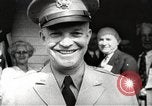
The early life and the activities of U.S. Army General Dwight D Eisenhower in Europe.
The life and career of U.S. Army General Dwight D Eisenhower up to the time of his appointment as the Supreme Commander of the NATO ( North Atlantic Treaty Organization). General Eisenhower with Mrs. Eisenhower visiting family and celebrating the birth of a new grandchild. Earl Eisenhower, a Pennsylvania business man and brother of Dwight Eisenhower, is seen gathered with his family viewing a photo album of old family photos. Several still photographs of the early life of Dwight Eisenhower are shown. The General arrives at his former home in Dennison, Texas. 'Eisenhower Birthplace' written on a board on the top of a building. The General has breakfast with his school teachers and other friends at his home. He meets officials at an air base. The General with his brothers Earl and Milton. A photograph of General Eisenhower as a West Point cadet. Cadets marching on a ground. Eisenhower as a U.S. Army Brigadier General discusses a wall map with other officials. The General is greeted by British King George VI in Great Britain. He plans European invasions with British Army General Bernard Montgomery. He goes ashore with General Montgomery after the Allied amphibious landing on Normandy, France. General Eisenhower and British Prime Minister Winston Churchill watch a mass parachute drop at the Rhine River in Germany. He accepts the surrender of the German forces in Rheims, France.
CRITICALPAST.COM: About Us | Contact Us | FAQs - How to Order | License Agreement | My Account | My Lightboxes | Shopping Cart | Advanced Search | Featured Collections | Website Terms & Conditions | Privacy Policy ©2026 CriticalPast LLC.
License Agreement |
Terms & Conditions |
Privacy Policy
©2026 CriticalPast LLC.