


 Francais
 Deutsch
 Italiano
Refine Your Search
Russia 1953 stock footage and images
- Showing 769 to 774 of 1877 results more
more Hide
Hide
Soviet Union mobilizes to defend against German invasion in June, 1941, World War II
A film titled ' Our Russian front. It shows Soviet Russia's state of preparedness and national mobilization at the time of the German invasion (Operation Barbarossa) in 1941, during World War 2. Soviet troops on parade in Red Square, Moscow, carrying Tokarev SVT-40 semi-automatic assault rifles, with curved magazines and fixed bayonets. Glimpse of a Soviet heavy gun (possibly 152mm howitzer). A Soviet Navy gunboat speeding toward the camera. A formation of Polikarpov I-16 aircraft inflight overhead. Several views of soviet forces, including units composed entirely of women; Closeups of troops, some holding Russian RPD 7.62 cal m44 light machine guns. A Soviet T-26 speeding in Red Square with flag flying, during a parade. View from the rear of a line of Soviet Zvezda BT-7 light tanks being deployed along a dirt road. Russian civilians, most of them women, work digging hillside fortifications. Closeup of woman with small boy in her arms. Views of destroyed buildings and dead civilians in a Russian town Aerial view of bombs bursting on Russian city. Smoke rising from resulting fires. Several views of light flashes from artillery firing at night. American envoy, W. Averell Harriman, participant in the U.S.-British military mission to Moscow, broadcasts about Soviet determination to defend against the Nazi invasion, at all costs. He refers to Soviet mechanics assembling American aircraft (Provided under "Lend Lease"). Narrator identifies Harriman as Chairman of the Board of Union Pacific Railroad. View of Russian airplanes in formation, flying high above the State Museum building in Red Square, Moscow. An American Government aircraft (C-47 /DC-3) aircraft lands at Moscow Airport. View of the aircraft parked and surrounded by a large crowd of military and diplomatic attendees. Harriman steps from the plane. Next he is seen with British Lord Beaverbrook and Soviet diplomat, Andrey Yanuaryevich Vyshinsky. Another view of Russian aircraft flying over the State museum in Red Square. U.S. President Franklin D. Roosevelt (unseen) is heard in the background extolling the Russian efforts against the Nazis. Soviet Tupolev SB bombers in formation overhead. Flags waving Aerial view of a formation of Polikarpov I-16 aircraft in flight. A Komintern Artillery Tractor,carrying Soviet soldiers, tows a 152mm field howitzer. A formation of army vehicles carrying Russian troops along paths already formed in the dirt by prior tracked vehicles. Seen are Komintern Artillery Tractors and ordinary army trucks.

Soviet Union builds railroads and mines natural resources for war effort west of Urals in World War II
Views of Moscow, and the Kremlin, in the Soviet Union, during World War 2. View of snow covered mountains in the Urals. Map of Russia and environs focusing on areas east of the Ural mountains including Siberia. A pointer highlights areas where raw materials such as coal, bauxite copper, oil, and nickel are found. View from above of numerous Soviet workers in the Steppes, where blasting occurs during road building. Giant trees are seen being felled to clear the way for roads. Young Russian men and teenage boys are seen at a camp, marching with shovels and other tools over their shoulders. Next some are seen driving spikes as others in teams swing iron rails into place for a railroad. A group of boys are seen shoveling sand into the road bed as a steam locomotive passes pulling a train of box cars on an adjacent completed track. Siberian engineers, examine a construction site and converse. Workers digging a deep ditch for a pipe line to cross the plains. A field of oil derricks and oil drilling operations are seen, with Soviet roughnecks tending the drills and pipes of the oil wells. A pump operating and crude oil flowing. A camel is seen behind a roughneck tending an oil drill.
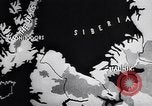
Steel manufacturing in Stalinsk and mining of coal and copper east of Ural mountains, USSR, during World War II
Map of Siberia and environs highlights the Urals, Magnitogors, and Stalinsk ( now Novokuznetsk) in Russia. Camera pans over industrial complex in the city of Stalinsk, Soviet Union, during World War 2. Numerous plants and smoke stacks are seen and narrator describes large increases in production and output to supply the Soviet war effort. Closeup of flaming coke being discharged from a coking furnace. Cooled coke being discharged into a large pile. Interior of a steel mill where workers have just tapped an open hearth furnace, amidst fire and smoke. Fiery molten steel pouring from the furnace. Hot ingots being moved to rolling mills. Russian steel workers controlling the mills. Large long ribbons of steel emerge from the top of a rolling mill. War production workers lift them up and place them back into the mill below the roller, this time, which then pulls them away in a second pass, moving away from the camera. Hot ribbon of steel moves in a circular path within a pathway atop a large machine. Men working at machinery with numerous valve handles. Closeup of a steel worker. Change of scene to a mine where a miner tends five drills boring into the ceiling of a mine cavity. He installs a shaft onto one of the drills. Small gauge rail cars transport ore out of the mine. Next, an open air copper mine is seen with Steam shovels digging the ore. A meeting of factory workers with a poster of Joseph Stalin displayed. A speaker extends thanks from Soviet leaders and from Soviet soldiers at the front. Closeups of speakers and listening workers. A woman operating controls to rotate a drum of crushed copper ore and empty it. Workers tending numerous banks of copper ore washing machines.
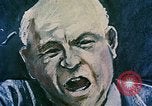
Men who led to rise of communism in Soviet Union
Sketches show an angry Nikita Khrushchev holding up his shoe at the United Nations, the Soviet hammer and sickle, and a map of the Soviet Union and various men who led to the rise and spread of Communism in Soviet Union. Karl Marx,Friedrich Engels,Vladimir Lenin,Trotsky. Czarist rule in Russia and the prisoners. Lenin,Stalin and Molotov.
Stalin's death and his successors in Soviet Union
Sketches show Soviet Union leader Joseph Stalin and Premier Vyacheslav Molotov. A sketch showing Stalin's death and a convention of Communist party. A sketch depicts a tombstone with words inscribed “Here lies Yorik Stalin”. Portrait of communist world leaders such as Mao Zedong and Nikita Khrushchev, and the Kremlin in Moscow, Russia.
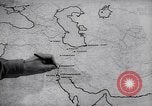
Lend-Lease material to Russian seen in Iran and Iraq; and view of General Motors plant in Khoremshar, Iran (WW2)
World War II Lend-Lease activities to Russia via American outposts in Iran and Iraq. Traces routes of American shipments from Basra to other positions in Middle East. A convoy of trucks takes war material under lend lease activities from Basra. An officer checks the papers of the shipment. Freight trains carry shipment. A map traces route of war material shipment from Basra to Tehran. Workers at General Motors assembly plant in Khoremshar, Iran.