


 Francais
 Deutsch
 Italiano
Refine Your Search
Russia 1953 stock footage and images
- Showing 91 to 96 of 1877 results more
more Hide
Hide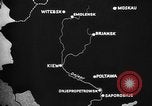
German troops engage attacking Soviet troops in Dnieper area of Russia during World War II.
What German narrator calls: The great Dnieper battle. German troops in Russia during World War II. A map of Dnieper area of Russia. Entrenched German soldiers look through binoculars, a soldier shaves. Wreckage as a result of bombings. A demolished bridge across Dnieper River. German soldiers fire guns and artillery at Russian positions. German scouts look at a map and briefed. Troops move about in the area. German Pz.III command tanks and Pz.IV's move across a field and fire artillery. StuG III Assault Gun (tank destroyer) of 24th.Pz.Div. A plane flies at a low angle. Smoke rises due to firing. Russian tanks destroyed by Germans. Russian prisoners file past a Panther tank. Dead Russian soldiers on the field.
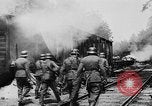
Poor conditions of Russian civilians during German campaign in Russia.
German troops advance in Russia. Transport lines destroyed by German troops. Railroad station set afire in Russia. German troops advance on streets. Billows of smoke rise from burning buildings. Troops street fight and advance under fire. Troops fire in prone positions. Russian civilian and military prisoners marching under guard of German infantry. Churches used for warehouses and factories. Poor conditions of Russian civilians show unsanitary slums and emaciated infants. (World War II period).
German troops invade Russia and Joseph Goebbels announces it on radio during World War 2.
German invasion of Russia, Soviet Union (Operation Barbarossa). Early morning in Berlin with quiet street scenes during World War II. Hands of a clock in view. A man unloads milk cans from a truck. German radio broadcasting studios. A man operates controls. View of radio tower and buildings. Men enter an office. A sign announces broadcast in progress and requests quiet and no entry. Propaganda Minister Dr Joseph Goebbels enters the room and sits on a sofa. He announces Germany has launched an offensive on the Eastern Front as Germany's actions represent declaration of war against the Soviet Union. Officers stand in the background. Several men seated in cars, listen to radio broadcast. German Foreign Minister Joachim von Ribbentrop makes the announcement to journalists at a crowded news conference. Newspapers carry the story. Cameramen take photographs. Animated map depicts the Eastern front extending more than 5 thousand kilometers from Finland in the North to Romania in the South. This is Operation Barbarossa. German troops invade Russia. A ship underway and a bridge in view. Heavy German guns bombard targets. Smoke rises up. Street signs such as "Eydtkau" are shown as evidence of advances. German troops dismantle border barriers. German tanks and artillery advancing Eastward, encountering resistance. They blow up a building.
Russia near end of WWI. U.S. and Japanese warships in Vladivostok.White Russians execute Communist Reds.
Near the end of World War 1, United States naval ship underway in rough seas. A United States flag on the ship. Allied troops on the march, through a town, in the snow. A map of Soviet Russia, highlighting cities of Khabarovsk and Vladivostok. American warship in Vladivostok harbor. A Japanese warship in Vladivostok harbor. Japanese Naval officers pose. Relaxed, smiling, unarmed American soldiers pose, playfully, on the wharf, with two armed Japanese sailors. Contingent of Japanese sailors, with arms stacked, seen with officer, on the wharf. Officials on a British ship in Vladivostok harbor. Several men of the 'White Army' (White Russian Army) in Russia. The White Army executes members of the 'Red Army' proximate to time frame of Russian Civil War following Russian Revolution. Map display highlights cities of Simferopol and Sevastopol. Crowd jams wharf as White Russian soldiers disembark from troop ship (several ambulatory wounded, first). A man offers officers a plate of refreshments. Crowd follows troops marching off the wharf. Map shown highlighting cities of Tbilisi and Baku. Russian communists celebrating.
Russian people enjoy in theaters clubs, music and traditional dancing in Moscow Russia, Soviet Union; also scenes of Tolstoy's house
Theater Square and other places in Moscow, Russia. The view of Moscow at night. Brightly lit buildings and neon signs of Theater Square, including a lit Soviet hammer and sickle symbol. Audience in a theatre building. A woman dances. Men play musical instruments. Other people also perform. A group of men dances traditional Russian dances. An international dance representing different countries is performed, including a dancer dressed like Uncle Sam to represent the United States. Views of Club houses for workers. Interior of a clubhouse. Men play chess. Men and women dining and dancing in the club houses. A man playing accordion. Close-up views of hands of a man playing piano. People dance in the night club. Next scene shows a symphony orchestra playing in a large hall during a concert. Next is scene of traffic on a street including streetcars, horse carriages, and pedestrians. Russian novelist Leo Tolstoy's house known as Yasnaya Polyana, and the surrounding park area near Tula, Russia. Avenue of Birch trees leading to the house. Exterior and interior views of the house. A picture of Tolstoy. Elevated, sweeping views of countryside near Tolstoy's Yasnaya Polyana home.
Bolshevik leader Lenin, Commander of the Red Army Leon Trotsky and Russian soldiers during the Civil War in Russia.
Scenes from the Russian Revolution and years immediately after in Russia, roughly 1918-1921. Troops moving in the snow. Vladimir Ilyich Lenin, the Bolshevik leader, makes peace with the Germans. The Civil War breaks out in Russia. White Russians continue war with World War 1 allies, against Germany. Czarist Cossacks seek to restore the monarchy of Nicholas II. Photograph of the Russian Czar and family sitting outdoors on the ledge of a wooden building. Secret police seen arresting people. Bolshevik firing squad executes three prisoners, who fall dead into a mass grave behind them. Lenin, holding a kitten in his hand, seated at a table. March 7, 1921: Workers and sailors gathered on the streets, in Kronstadt, demanding peace, freedom, and bread. Red Army Troops disperse the crowd, shooting many of them. Leon Trotsky, Commander of the Red Army, states that the slaughter was necessary. Trotsky seen walking with other officers. People on the sides of a path watching Trotsky. Families looking over dead workers and sailors in a field.