


 Francais
 Deutsch
 Italiano
Refine Your Search
Russia 1953 stock footage and images
- Showing 1531 to 1536 of 1877 results more
more Hide
Hide
Airmen of 8th Fighter-Bomber Wing, Suwon Air Base (K-13), South Korea, handle 1000-pound bombs
Activities at U.S. 8th Fighter-Bomber Wing, Suwon AB (K-13), South Korea, during the Korean War. An F-86F Sabre, number FU-367, on the ramp. The F-86 belongs to the 36th Fighter-Bomber Squadron. A few 1000-pound bombs on a truck. An airman atop the truck beside the bombs. The bombs being lifted out of the truck on hooks. Two airmen standing beside the truck. A few men directing the bomb to a wheel cart. The wheel cart rolled away with the bomb. The ground is covered in pierced steel plank.
The USAF F-86 Sabre prepared to refuel by the airmen at a USAF base in South Korea during Korean War.
Airmen at a USAF base in South Korea during the Korean War. An airman showing arm signals to a USAF F-86 Sabre taxiing on the runway at the USAF air base. The aircraft in the parking area of the air base. A truck loaded with a few bombs moving on the airfield. The airman climbs on to the aircraft and stands beside the cockpit. A fuel tanker approaches the aircraft and parks beside it. The airmen sitting on one of the wings of the aircraft. Two airmen taking the fuel pipe from the tanker, preparing to refuel the aircraft.

People in the English colonies led by George Washington moving against the English Army during the American Revolutionary War.
The history of the United States. A pictorial map shows the path followed by Christopher Columbus in 1492 across the Atlantic Ocean. He found a group of islands where other explorers from Spain, Portugal, Netherlands, England, Italy and France found two continents. The representation of the area in the northern continent over which the English and the French fought and the French were defeated. The French gave up their colonies and in 1763 they belonged to England. People in the English colonies at work. English officials during a meet. The workers rebelling against English troops. Farmers, who became soldiers, moving with guns. The army led by George Washington moving against the English Army. The thirteen colonies of the English became independent, during the American Revolution, leading to the birth of American nation.
The United States Constitution created at the Philadelphia Convention in Philadelphia, Pennsylvania.
The history of the United States. 1783: Soldiers of the new republic after their victory in the American Revolutionary War. Soldiers on horseback meet new citizens. They watch as men carrying baggage walk away. A banner on a road separating two states reads 'New Hampshire Boundary'. A merchandiser demands money from two men to cross the border. Pictures of the land which farmers gave up because they could not pay back. Bankers inside a building. People on the streets. Delegates at the Philadelphia Convention in Pennsylvania. Pictures of people demanding new central government. Benjamin Franklin, one of the Founding Fathers of the US, walks supported by two men to the convention building. Several people stand around and watch. General George Washington, the elected President of the convention. He delivers a speech. He states the need for unity, a sound financial system, war debts to be paid, trade to be encouraged, national government to protect rights and perform functions. The delegates speak at the convention. The convention in progress. President George Washington with Benjamin Franklin and a few men at a final private conference during which they decide the government should have clearly defined substantial powers. The Preamble to the United States Constitution created on 17 September 1787, read out at the convention. Benjamin Franklin gets up with the help of two men. George Washington signs the constitution. Benjamin Franklin with George Washington. The carving on George Washington's chair. George Washington, the first President of the United States. People greeting the President. Alexander Hamilton, the Secretary of the Treasury, organizes a bank to receive taxes and import duties that pays off national debts.
Illustrations and reenactments about America around 1800
Pictures and reenactments illustrating American history. U.S. First Lady, Martha Washington, presiding over discussions of fashion and politics. Reemacted footage of 17th century and 18th century shipwrights and carpenters at work in a colonial-era shipyard. Men sawing logs outdoors. Blacksmiths at work in a colonial village. Picture of Thomas Jefferson. Picture of Potomac River separating Virginia and Maryland, where Washington DC will be founded. Sketch of a farmer with horse-drawn cart, in hills of Virginia. The capital is shifted to Washington. Map showing Colonial States and interior waterways of commerce, including the Ohio and Mississippi rivers down to the Port of New Orleans.
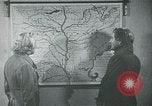
Dramatization: President Thomas Jefferson buys the Louisiana territory from Napoleon and sends Lewis and Clark on expedition
Dramatization of historical American events. United States President Thomas Jefferson looks at a wall map of the Louisiana Purchase, acquired from Napoleon Bonaparte, the leader of France. Jefferson sits with a few officials seated at a table. A pictorial map showing the Columbia River and the Missouri River flowing into the Pacific. The Lewis and Clark expedition is sent to western territory. The life of the Native American Indians. The Indians wearing traditional costumes. Indians hunting buffalo. Scenic views of a hillside with a flowing river. Lewis and Clark cross a water body led by an Indian guide. A large waterfall. The expedition members sleeping in trees to avoid predators. The rapids of the Columbia River. Men crossing the river with water up to their necks. The men wading through the water holding their guns up. Natives watching the men. The course of the Columbia River. Two men from the expedition team lying beside a tree. The expedition watches English men in boats on the river who have come from Canada to establish outposts.