


 Francais
 Deutsch
 Italiano
Refine Your Search
Russia 1953 stock footage and images
- Showing 1705 to 1710 of 1877 results more
more Hide
Hide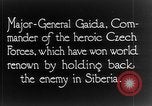
Soldiers of Czechoslovakia and United States in Siberia during the Allied intervention in Siberia, during Russian Civil War.
The Entente Powers intervention in Siberia during the Russian Civil War and World War 1. Commander of Czech forces, General Gaida, and his staff, sit with Commander of U.S. forces, Major General William S Graves, and one of his staff officers. A wounded Czech soldier is carried on a stretcher, by U.S. soldiers wearing campaign hats and red cross armbands, from a railroad train car labeled Expeditionary Forces Siberia. The stretcher bearers place the wounded into a field ambulance.
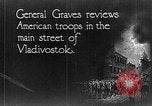
U.S. General William S Graves reviews American troops in Vladivostok during Russian Civil War (and World War I)
An American Army brass band marches along Svetlanskaya Street in Vladivostok, Siberia, during the Allied Intervention in Russian Civil War, in World War 1. They lead a contingent of American troops, primarily elements of the U.S. Army's 27th and 31st Infantry Regiments plus some volunteers from other Regiments. They march on only one side of the street, allowing traffic to pass on the other. Major General William S Graves reviews the troops and salutes as the colors pass.
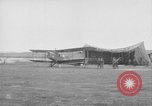
American De Havilland DH-4 airplane takes off from field in France in World War I
A U.S. Army Air Service De Havilland DH-4 airplane taxis away from a make-shift canvas structure, near a railroad train, in France, during World War 1. Aviators occupy both front and rear cockpits. The airplane displays a tricolor roundel on its fuselage. A machine gun is installed in front and bomb racks (empty) are installed under the lower wing. The airplane takes off from large grass field. (World War I; World War 1; WWI; WW1)
Evacuation of Russian White Guards from Vladivostok, and departure of American troops. U.S. warship departs
Gun fired from a boat. Shell strikes near opposite shore. Wounded Russian White Guards carried on stretchers, being loaded on boats at the beach, for evacuation. A doctor in white coat and medical hat accompanies them. Boats loaded with evacuating White Guards, head for Vladivostok harbor, where they pull up beside a large steamship. American troops lined up on wharf. Large American flag flying from docked American warship. Officers inspect American troops readying for departure. Troops are loaded aboard launch flying American flag, and depart from the wharf. The American warship is seen steaming out of the harbor.
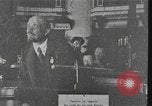
Vladimir Ilyich Lenin speaking at 2nd Congress of the Communist International and at the funeral of Y. M. Sverdlov
Vladimir Lenin addressing delegates at meeting of the Second Congress of the Communist International ("Comintern"), held in the Tauride (Tavrichesky) Palace, in Moscow, on July 19, 1920. Some illuminated candles on tables behind the speaker. (The sign on the speaker's stand, in Russian and French, simply asks attendees to refrain from smoking.) Next, Lenin is seen outdoors on a cold day, on March 18, 1919, in Red Square, Moscow. He is speaking at the funeral of Yakov Mikhailovich Sverdlov, his close associate, and Chairman of the Central Executive Committee of the Congress of Soviets of the Russian Soviet Federative Socialist Republic (SFSR). (Sverdlov died on March 16th at age 33.)
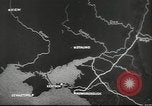
German commando operations in the Kuban Lakes region, Northwest Caucasus, World War Two
German commando troops attack Russian positions in the Kuban Lakes area near Russian Black Sea Port of Novorossiysk, Northwest Caucasus, during World War II. Map depicts the area of operations. German commando units in motor launches raid Russian positions. View of a bay from mountain. The commandos load in motor boats and move through marshes and lakes . The troops wade through water and move on land to attack Russian targets. They fire machine guns. Commandos returning to their base, where several are seen at a pier with their boat, as other boats arrive.