


 Francais
 Deutsch
 Italiano
Refine Your Search
Russia 1953 stock footage and images
- Showing 439 to 444 of 1877 results more
more Hide
Hide
Civilians bid farewell to Italian soldiers as they march to trains bound for Russia during World War II.
Italian troops mobilize during World War 2. Italian soldiers pack their back packs and prepare to march forward. The troops begin to march to trains bound for Russia. The military band plays as they march. A huge crowd of civilians on the streets. Men, women, and children watch as the troops march towards the trains. People hold miniature Italian flags and cheer the soldiers. Civilians gather on either side of the road as the soldiers move ahead.

T.Y. Lin discusses proposed highway connecting the U.S. with Russia across the Bering Sea
Animated pictures of a proposed bridge from Alaska to Siberia, over the Bering Sea, linking the U.S. with Russia. Interview with Dr. T.Y. Lin (Tung-Yen Lin) of the University of California, Berkeley, as he describes his Intercontinental Peace Bridge proposal. Narration by Lee Marvin.
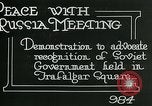
Crowd at Trafalgar Square gathers to advocate recognition of Soviet government in Russia.
Civilians meet in rally at Trafalgar Square, London, to advocate British recognition of the Soviet government in Russia..
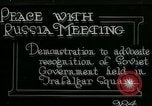
British Communists campaign at Trafalgar Square for recognition of Soviet Russia
Slate reads; "Peace with Russia Meeting. Demonstration to advocate recognition of Soviet Government held in Trafalgar Square." A large crowd is gathered at the Square. Several speakers address them from the base of Nelson's Column (A400 Trafalgar Square, London, United Kingdom), next to the lion statues. One banner seen reads: "prepare to lay down tools," pointed at working men. A call for "copper donations" results in an outpouring of pennies, which men pick up from the ground and carry to the front where one of the only women seen, is consolidating the contributions. Two men converse. One wears a fez.
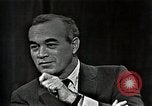
Senator J.William Fulbright talks about decision regarding Russia and China, during television conversation in United States.
Senator William J Fulbright in United States. Interviewer asks Fulbright about the decisions of United States. Fulbright replies that he perceives Russia to be danger and China be the eventual danger. Fulbright talks about communist conspiracies.

Senator J William Fulbright discusses trading with Russia and denounces Senator Joseph McCarthy.
A Television Journal titled 'Longines Chronoscope'. Co-editors of the program ask Senator Fulbright about trading with Russia. Fulbright says that there would be no trading with red China i.e. Communist China. Fulbright talks about Senator McCarthy of Wisconsin and the McCarthy subcommittee and the Army-McCarthy hearings. Fulbright says that Senator Joseph McCarthy is "a menace to our system of government. I think he's much more dangerous than most people believe that he is. I think that he is confronting this country with the greatest test that it has had since the war between the states. His approach to the problems of government is quite similar to that of the fascists or communists, if you like. His actions in the present hearings remind me very much of the actions of the communists in the old hearings...in other words it's to obstruct, to take advantage of every technicality to destroy the hearings. And that's what he's intending to do. He's done it in every hearing." He further states, "if this country cannot destroy this senator's influence I see no real future for it because it will undermine the very moral basis for our kind of government." If McCarthy, as a result, is removed from his committe or expelled from the senate, Fulbright says, "then I think there might be a rebirth, I might say, of the enthusiasm of the people for self government in this country." He continues, "I think given the opportunity I think the people of this country will recognize a demagogue such as he is -- well, that's only faith -- I have nothing to base it on other than on a faith in the discrimination of the people of the country."