


 Francais
 Deutsch
 Italiano
Refine Your Search
Russia 1953 stock footage and images
- Showing 487 to 492 of 1877 results more
more Hide
Hide
German army vehicles move along the snow covered roads in Russian territory; also Russian troops and officers in World War 1
The German Army in conflict with Russia in World War I. A map of Soviet Russia, showing cities of Kiev and Odessa. Snow covered roads in Russia. German army vehicles move along the snow covered roads. Scene from First World War, of German General Paul von Hindenburg and his deputy, General Erich Friedrich Wilhelm Ludendorff, leading procession of officials and officers across a railroad train platform. Lieutenant General Helmuth von Pannwitz, Cossack Cavalry Commander, on horseback in a public square. Lieutenant General Anton Denikin with Cossack troops in winter weather coats and hats, talking and laughing. German troops on the march. German commanders review troops occupying a city (Odessa, 1918?) What appears to be a baroque-style cathedral in background. Occupying German troops parade through streets of city. German soldiers on guard at a large building entrance. A sign on a building reads in German 'German Commander'.
Czar Nicholas II, his son Alexei , and Grand Duke, Nicholas Nikolaevich at military review in Petrograd in World War I
Tsar Nicholas II is seen with Grand Duke, Nicholas Nikolaevich (the tall officer in his retinue) during a military review at beginning of World War 1. Along with senior Russian officers, they review troops in formation at a parade ground near St. Petersburg (Petrograd) Russia. After reviewing the formation, they walk past a low platform in the center of the field, where Russian Orthodox Metropolitan vladimir (Bogoyavlensky) of Petrograd (St. Petersburg) stands with several priests. With their hats removed, The Tsar and his party review a military unit in formation, whose members also have their their hats removed. The Tsar and party approach the Bishop and stop to cross themselves. The Bishop responds with a slight bow to the Tsar. Scene changes to members of the French military mission to Russia standing at the edge of the parade grounds. Next, the Tsar and his retinue walk to take up a position from which to review Russian troops on parade. Alexei Nikolaevich, Tsarevich of Russia, in uniform, walks with his father. As troops pass in review, young Alexei is seen at left of the screen standing at attention. Scene shifts to another part of the grounds, where camera pans across the Tsar and party to military representatives from other nations.
White Russian leader, Admiral Kolchak and White Russian troops during the Civil War.
Admiral Aleksandr Vasiliyevich Kolchak, Leader of the White Russian (anti-Bolshevik) forces during the Russian Civil War that followed the Russian Revolution. He descends steps from palace at Omsk, Russia. He salutes an honor guard and enters an open car accompanied by his aides. Scene shifts to peasant recruits drilling in a field. They stand in formation and practice shouldering arms. Final scenes show White Russian troops assembled and on parade in Barnaul, Altai Krai (Russia). A group of soldiers stand by artillery field pieces. Others parade and include contingents of infantry, mounted cavalry, and horse-drawn artillery units. Troops seated on ground beside heavy machine guns. Troops bringing supplies ashore from a small ship on the Ob River.
Russian soldiers advance toward battlefield and civilians find frozen dead bodies of other civilians and soldiers
Soviet Russian troops in Volokolamsk, Russia during World War II. Destroyed buildings and houses in the area. Tanks and soldiers advance. Soldiers on military vehicles pass through the streets. General Govorov's troops prepare for an attack in Mozhaisk. Street fighting in Mozhaisk against German forces. Truck transports roll into the city. Civilians watch the soldiers passing through the area. They wave at the soldiers. Newspapers are distributed. Russian posters are pasted on the walls. Scenes of atrocities committed by Nazi German forces: Frozen corpses including those of women and children. A woman cries after seeing the frozen dead body of her loved one. Bodies of Russian soldiers and murdered civilians hanging from a mass line of gallows. Soviet soldiers advance towards the front. View of a historic war memorial. Soldiers fire artillery. Troops march through Moscow. A map of Russia showing places.
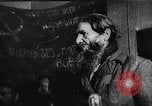
Rural Russian villagers listen to leader discussing efforts to improve their lot during period of hardship and famine in 1921
Meeting of men in a rural village of Russia, during the hard times following world war I and the ensuing revolution and civil war. Closeup of local leader speaking to men of the village. Behind him hangs a homemade flag with hammer and sicle and various slogans written on it. Camera pans back and forth from the speaker to the audience during the film, showing closeups of faces of some of the working class village men as they listen intently. An intervening slate, in cyrillic, seems to allude to the U.S. and a working relationship with the village (possibly related to efforts of the U.S. American Relief Administration, in Russia, during this period). At the conclusion of the talk, the villagers are obviously delighted with what they heard. Some of the men express their exuberance by lifting the speaker, bodily, up and down several times.
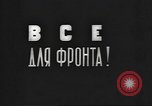
Russian oil field and Russian women workers contribute to the war effort during World War II.
A Russian factory and an oil field in Russia during World War II. Men at oil well tower on an oil field in Russia. Workers at controls. Man takes reading from an instrument at tower. Russian women workers at sewing machines in a factory. Instructor with Russian woman.