


 Francais
 Deutsch
 Italiano
Refine Your Search
Russia 1953 stock footage and images
- Showing 541 to 546 of 1877 results more
more Hide
Hide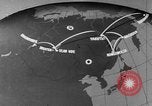
U.S. Vice President Henry A. Wallace along with American visitors visit Shushenskoy in Russia.
U.S. Vice President Henry A. Wallace on a journey to China through Soviet union. A animated portion of a globe shows his next destination. The Vice President visits Shushenskoye. The American visitors and Wallace visit Vladimir Lenin's home . Vice President and party aboard a river steamer in Yenisei river and leave for trans Siberian railway. Mountains all around the river.
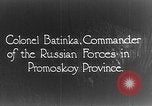
Colonel Batinka, Commander of Imperial Russian Forces in Promoskoy Province, Russia.
Colonel Batinka, Commander of Imperial Russian Forces in the Maritiime Province, poses with members of his staff in Vladivostok. They all wear uniforms of the Imperial Army. Also seen is U.S. Army Chaplain Joseph S. Loughran, who was attached to the U.S. Army 27th Infantry Regiment. He poses with them and smiles and shakes hands with Colonel Batinka. (Russian Civil War and World War 1 period.)
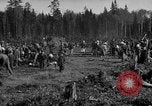
Russian men and women clean farm land in Archangel, Russia.
Russians clean farm land. Tall trees in the background. Russian women work in fields. Groups of men and women clear debris. Large group of women remove debris.
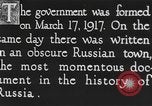
Mobs and Imperial Russian soldiers participate in revolts in Petrograd, Russia in time of Russian Revolution
Slate refers to March 17, 1917, when Russian Tsar Nicholas II abdicated, and a Provisional Government was formed in Petrograd (St. Petersburg) during World War 1. It is followed by a few scenes from what appears to be a staged film enactment of a mob storming a palace. Soldiers and citizens, carrying sticks and clubs, rush up a stairway inside, while others are seen charging an entrance and beating on palace gates. A statue of the Russian Imperial Seal is seen with one eagle head broken. Next, actual footage shows a prison courtyard littered with debris. Bars on the doors and windows are bent and broken. Several persons are seen moving about in the debris. Later a group of people are seen at work cleaning up debris, placing it into a horse-drawn wagon. Slate compares this event to the fall of the Bastille during the French revolution. Russian soldiers loyal to the Bolsheviks and the Soviet cheer in streets of Petrograd. Armored cars and an artillery field piece are manned by the revolutionary Russian soldiers. A street is filled with Russian soldiers and some civilians.
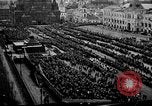
Lines of marchers in a peaceful demonstration at Red Square, Moscow, Russia, in World War I
View from a high point overlooking a peaceful demonstration at Red Square in Moscow during World War 1. The State Museum in the background. The square filled with several parallel lines of marching people. Others sit in grandstands watching. Some marchers carry banners.
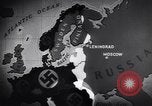
German Operation Barbarossa on the Eastern front in World War II
Animated map shows extent of German controlled areas in Europe following their conquest of the Balkans in World War 2. Norway is under their control and German forces threaten Leningrad and Moscow. A soviet defense line is shown on the map. The German attack is shown to come from 5 directions on June 22, 1941, with the launch of German Operation Barbarossa. A sky filled with German Heinkel He 111 bombers is shown. German Panzer III tanks with 75 mm guns. Army trucks carry German troops into battle. German soldiers on motor cycles and infantry advance under fire. Animated map shows principal German targets as Leningrad, Moscow, and Kiev. It then shows beginning a drive from the North to encircle Leningrad. Arrows show where German Marshal Fedor von Bock's forces drove 480 miles into Soviet territory. Slates identify cities being overrun by German invaders, including: Pskov, Novgorod, Brest-litovsk, Minsk,Mogilev, and Vitebsk. On July 17, 1941, a German tank is seen entering Smolensk, past the Dnieper River threatening Moscow, itself. To the south, German forces, under Marshal Gerd von Rundstedt, cut deep into the Ukraine. Newspapers world-wide consider the Soviet forces close to defeat. Slate shows communique from the German High Command stating: "The issue in the East is already settled. Smolensk is the last halt on the road to Moscow." German infantry marching. Scene shifts to heavy artillery being fired by Soviet forces in a snowy scene clearly later in the year. Animated map shows German forces very close to Moscow on October 15, 1941, forcing the Soviet Government and all foreign missions to move to Kuibyshev, 700 miles to the east. Adolf Hitler, in a speech on October 3, 1941, states that the enemy is broken and will never rise again. Animated map shows 500 thousand square miles of Soviet territory occupied by German forces. Views of fires burning in Russia. Damaged and abandoned Soviet industrial plants. A German guard atop a hill looks down on thousands of Soviet people in the occupied areas of Russia. Damaged and abandoned Soviet T-26 tanks. Glimpse of damaged Soviet aircraft and field artillery. Headline in New York World Telegram newspaper reads: "Berlin Admits Russ War May Last Winter." Another headline reads: "Red Army Holds Push On Moscow." Weary German soldiers traveling in horse-drawn wagons, pulling field artillery. Soviet and German war planners are seen at work. Slate quotes Adolf Hitler saying: "A single blow must destroy the enemy, without regard for losses... A gigantic all-destroying blow." German armor moving along a road. Animated map shows this technique in the German invasions of Poland, France, the Balkans, and Yugoslavia. In contrast, the Soviet planners are seen, as map illustrates how they intend to take advantage of the vast area of their land by holding lines of defense an falling back as necessary to keep engaging the invaders across interior of the Soviet Union. Soviet infantry are seen marching along a road. German troops riding atop their tanks. Soviet troops forcing German invaders into close combat in her cities. Soviet soldiers running in a city and firing heavy machine guns. Bomb damage and rubble inhibit German armor mobility in cities. Cities where this kind of Soviet resistance prevailed were: Rostov, Kharkov, Kiev, Kursk, Smolensk. German troops leaving a city with heavy black smoke rising in the background. More views of cities where Soviet troops are engaged German forces in House-to-house battles, including: Odessa, where the Old Opera Theater building is shown sandbagged and relatively undamaged. The Odessa NI tank, created from an STZ-3 agricultural tractor.