


 Francais
 Deutsch
 Italiano
Refine Your Search
Russia 1953 stock footage and images
- Showing 565 to 570 of 1877 results more
more Hide
Hide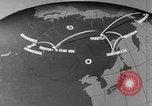
U.S. Vice President Henry A. Wallace addresses the people during a public meeting at an opera house in Russia.
U.S. Vice President Henry A. Wallace on a journey to China through Soviet Union. An animated portion of a globe shows his next destination. The Vice President lands in Novosivirsk. A signal officer in a jeep gives signal. People on streets and the view of buildings in the city. Vice President visits the Yak fighter plane industry. American fliers and others look at the plane. The plane in flight. The biggest opera house in the world. Wallace addresses the people at a public meeting. He addresses them in Russian language. Civilians applaud. Wallace speaks into a microphone. People seated in a hall and listen to his speech.
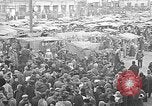
People gathered on streets and open marketplace in Moscow, Russia.
A huge crowded open-air market in Moscow, Soviet Union, seen in wintertime. Merchants' stalls are partly covered against the weather. Throngs of customers patronize the merchants. Crowds fill a space between large buildings and a river. View of fence at the river, with snow and ice below. Scene shifts to outdoor market is a more rural area. Sign above one booth advertises lighters. Back at the city market, several smiling children and two older men converse at a booth containing papers and pencils. A small girl, wearing mittens, holds a piece of bread. Adults and children stand near a hand-cranked spring driven phonograph machine playing a record. The machine uses a needle and external horn to transmit the sound. Scene shifts to a structural sign identifying the Gubrosta (Government news telegraph agency) where people read information posted there. Finally, film focuses on a monolithic memorial with a figure, near its base, that appears to by holding a globe.

Moscow, Russia, in Springtime of 1949.
The Kremlin viewed from Borodinsky bridge over Moskva (Moscow) River, in May, 1949. Cathedral Square can be seen to the right (East) dominated by the tall Ivan, the Great, Bell tower. The Metropolitan Hotel viewed from across a square. Buses moving on the streets. Camera pans across members attending meeting of a USSR legislature (Duma), focusing on the wide variety of ethnicities and cultures represented by the persons and dress of the delegates. A speaker delivers a dramatic poetic speech and is applauded. Huge illuminated images of Lenin and Stalin flank the backdrop of the stage and podium. The film ends with the Chairman of the Gosduma, rising and applauding, quickly accompanied by others on the stage and then, by those seated in the hall.

A film produced in 1957 containing glimpses from Soviet Russia's revolutionary past.
Faces of ordinary Russian workers. Historic footage of Russian leader Vladimir Lenin giving a speech circa 1917.Cheering Russian revolutionaries waving rifles with fixed bayonets around time of Russian revolution by Bolsheviks. Another view of Lenin speaking, followed by view of cheering civilians. Men wave their hands and their caps. A nighttime rally in street. Illuminated monument. Leaders stand in moving vehicle as surrounding crowd cheers. Fixed bayonets reflected in partial light.
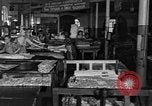
People in Moscow, Russia, return to civilian pursuits and ending war time production following end of World War II
The end of World War 2 is reflected in cheerful faces as Russian women workers fold bolts of cloth at a fabric plant. Civilian production has started up again as factory workers and production turns from war production to peace time commerce. Scenes of new ZIS 110 luxury automobiles being manufactured on a Russian production line. Soviet workers place a hood on a car. Mechanics check engines of cars. Cars move along assembly line. A marriage ceremony in the countryside. An artist makes painting of Soviet leader Joseph Stalin. A crowd of civilians cheers and waves their hands as a parade procession passes through streets. Marchers carry large portrait of Joseph Stalin. Girls greet war heroes with flowers as the parade moves along a tree-lined boulevard, stopping at an equestrian statue, where the portrait of Stalin is placed.
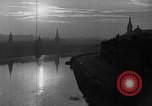
Views of Moscow, and other parts of Russia, at evening and nighttime.
Views of Moscow and the Volga River during sunset and early nighttime. Sentries at Lenin's Tomb. Lighted star on top of a building. Scene changes to a seaside setting as moonlight reflects on water. A sentry patrols the seashore.