


 Francais
 Deutsch
 Italiano
Refine Your Search
Russia 1953 stock footage and images
- Showing 589 to 594 of 1877 results more
more Hide
Hide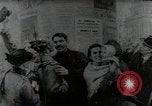
Nations in various stages of mobilization before and during World War I
Nations mobilizing for World War 1 (The Great War).from 1914 through 1917-18. Civilians in a Slavic country react to information fastened on a large circular post. Closeup of British Mark II tanks moving near the camera, followed by view of British Whippet tank in front of army trucks. Uniformed, armed, German troops assembling in a town square. German General Paul von Hindenburg leading members of his staff and a diplomat, on inspection of troops. A Russian officer on horseback with troops assembled in a city park. Unusual grouping of Military officers from Germany (wearing Picklehaube helmets); France; and Russia (including a Cossack), gathered in front of a Russian Orthodox Church (presumably somewhere in Russia) prior to World War 1. Anachronistic view of middle-aged Winston Churchill giving an address, before numerous microphones. U.S. Marines hurrying along a waterfront pier, past a variety of boats docked in a city marina. American soldiers looking at a U.S. Connecticut-class battleship docked at a pier, displaying a large American flag, during World War 1. Camera pans across the pier. Crew members seen on Japanese battleship, Settsu. Japanese troops disembarking from a transport ship covered with ice.
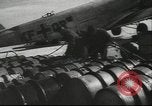
Junkers Ju 52 aircraft are fueled and loaded with supplies which are dropped for German troops in Eurasia during World War 2
German troops and supplies in Eurasia during World War II. German transport aircraft Junkers Ju 52 are fueled and loaded with supplies. A Junkers Ju 52 aircraft taxis. Aircraft in flight. In Russia : Supplies are dropped for German troops in Russia. Men and munitions behind German lines. Aircraft parked in a line in the background. German soldiers driving horse drawn sleds or sledges meet the airplanes to unload supplies on snow covered terrain. Soldiers unload munitions.
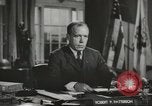
American Undersecretary of War speaks to difficulties facing Allies in confronting Germany and Japan in World War II
Undersecretary of War, Robert Porter Patterson, Sr. speaks about a report from the General staff outlining the needs for combating Germany and Japan in World War 2. He cites Operation Husky, the invasion of Sicily, as an example of what will be needed. He continues to narrate in the background as an animated map appears showing the buildup of supplies and Allied forces in North Africa; Allied air forces flying 60 thousand sorties over Sicily and, the direct amphibious assault using 3,200 vessels. Map also depicts opposing forces of 12 (“unwilling”) Italian Divisions and 3-1/2 German Divisions. View of Allied troops carrying some of their 31 thousand casualties on stretchers from field ambulances. Allied medics attending to the wounded. Some are seen lying on stretchers in a row on the ground near a wall. Interior of a field hospital where surgeons and other medical personnel treat the wounded. Animated map shifts to Europe with Germany at its center, showing , in contrast to Sicily that was only an “outpost,”, the heavily fortified perimeter of Axis controlled areas; the axis industrial might; and the disposition of 300 German Divisions (mostly on the Eastern front) defending the region. Next, the map illustrates Japan’s defended regions in the Pacific Image returns to Undersecretary Patterson i n his office, speaking of the Allied offensives planned for next year (1944), and emphasizing their challenge and difficulty. Scene shifts to General Jonathan Wainwright and his garrison at Corregidor, in the Philippines, surrendering to Japanese forces in 1941. Japanese military camera pans over the Americans being taken prisoner. Other Americans and Filipinos are seen being marched together under guard. Scene shifts to classic views of the Japanese attack on Pearl Harbor, Hawaii, on December 7, 1941. View of Japanese soldiers executing two Chinese civilians in 1937. Dangling bodies of persons hung by Nazis during Operation Barbarossa in Russia, in 1941 A Russian soldier comforts a little girl as he escorts her across a snowy landscape. Time bomb left by German forces retreating from Naples, Italy, in 1943, blows up a Post office building . Views of damage to building and bodies of victims. American Military Police assisting a victim. American soldiers carrying an injured civilian on a litter. Scene shifts to British Foreign Minister, Anthony Eden, Soviet Foreign Minister, Vyacheslav Molotov, and U.S. Secretary of State, Cordell Hull, entering a hall in the Spiridonovka Palace, during the 1943 Moscow Conference in Russia. Close-up of the American, Soviet, and British flags on a table. View of many delegates seated around the table. Close-up of Molotov, Eden, and Hull signing conference document.
Montage of World War 2 scenes from all theaters of Allied operations and scenes of the U.S.A.
Peaceful scenes of pre-war England, showing a church with sheep grazing on its lawn, and a college building with ivy growing on the walls. In contrast, explosion and results of German bombing is shown, with buildings collapsing and ruined from the German blitz over England. A long line of Chinese soldiers marching along the Great Wall of china. Shadows of three Japanese bombers flying over Chinese landscape. On May 4, 1942, Madame Chiang Kai-Shek decorates American fliers who made the first attack on Tokyo in World War 2. Wearing a Chinese decoration around his neck, Lieutenant Colonel Jimmy Doolittle, who led that raid by U.S. B-25 bombers from the Aircraft Carrier USS Hornet, poses with Madame Chiang and others of his group. Scenes of Moscow, Soviet Russia, including a T-70 light tank moving rapidly along a city street. A Soviet Petlyakov Pe-2 dive bomber taking off in a snow storm. U.S. troops on a halftrack in North Africa. British artillerymen firing a 25 pounder in the desert. Glimpses of smoke rising from enemy strikes at cities in England, Russia, and China. Scenes of destruction from bombing. Brief street scenes of unharmed and intact towns and cities in the United States, including brief New York City scene of pedestrians and traffic in Times Square. Defense workers in America going to work at Ranger Aircraft Engines factory (later part of Fairchild Aircraft and Engine Corporation), and a star flag showing war service by worker families. Farmers in Western U.S. harvesting grain. Railroad trains and river barges carrying harvest from U.S. farms. Herds of cattle and sheep being raised for the war effort in Western U.S. Aerial view of orchards and farms in America. A mining bucket filled with iron ore. Barge carrying the ore. A steel mill in operation. Scrap iron being recycled. View from production floor of U.S. bomber aircraft being built in a defense plant. Countless freight cars in a railroad marshaling yard at a port, where a tug boat and a freighter are seen in the water. War materiel piled up at the port. A convoy of supply ships underway.
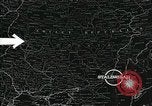
Expansion of Soviet and Communist Chinese territories from World War II through 1949
German invasion of Russia during World War II. A map showing German invasion path in Russia until defeat at siege of Stalingrad. A map showing Soviet postwar expansion into Eastern Poland, East Prussia, portions of Finland and other areas. Latvia, Lithuania and Estonia are incorporated as Republics into the Soviet Union. Russian zones of occupation in Germany, Austria and North Korea. Map depicts an "Iron Curtain" encompassing the Soviet postwar territories. Soviet troops and tanks occupying countries. Soviet ZSU-57-2 self-propelled anti-aircraft guns traveling along a city street. Crowds cheering in a stadium in Soviet East Germany. President Wilhelm Pieck of the German Democratic Republic is among people seen applauding in the stands. . Soviet cargo ships in a harbor operating under trade agreements. Chinese Communist forces moving with guns and artillery and tanks to expel Chiang Kai-Shek and Chinese Nationalists from mainland China to Taiwan, in 1949. Chinese refugees flee an area, carrying an injured civilian on a stretcher. A refugee child is shown with the group of people.
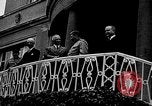
Allied National Leaders hold numerous conferences to plan and coordinate their efforts during World War II
First scene shows President Harry Truman shaking hands with Joseph Stalin on a porch of the Cecilienhof ( home of Crown Prince Wilhelm) in Potsdam, Germany. The two leaders are accompanied by their respective foreign ministers, James F. Byrnes, U.S. Secretary of State, and Soviet Minister of Foreign Affairs, Vyacheslav Molotov. Stalin descends steps from the building followed by Truman. View of the back lawn at Cecilienhof. View of its front entrance. Various views of the house and grounds. American, Soviet, and British flags flying from the building. Cars carrying the leaders on road to the Cecilienhof. President Truman and James Byrnes entering outside gate, followed by other attendees. Then Stalin is seen entering followed by Soviet officers and officials. U.S. General Dwight D. Eisenhower, Supreme Commander Allied Expeditionary Force (SCAEF) in Europea and U.S. Army Chief of Staff. George Marshall are seen walking together in a wooded glade on the meeting grounds. British Field Marshal Bernard Law Montgomery, entering the grounds for the meeting. British Prime Minister Winston Churchill, President Harry Truman, and Joseph Stalin stand on a step before an entrance to Cecilienhof. Truman places their hands together in a mutual handshake, at which Churchill and Stalin laugh. Views of the Kremlin and St. Basil's Cathedral, in Red Square, Moscow, Russia where foreign minsters of the United States, Britain, and the Soviet Union are seen meeting meeting in conference at the Spiridonovka Palace in October, 1943. Closeup of Soviet Prime Minister Vyacheslav Molotov, British Prime Minister, Anthony Eden, and U.S. Secretary of State, Warren Hull, successively signing a document. Scene shifts, to a C-47 transport aircraft flying over great pyramid of Giza in Cairo, Egypt. Next, the front of the Soviet Embassy in Teheran, Iran, is shown. The "Big Three" (Stalin, Roosevelt, and Churchill) sit on the porch of the building. Military officers from their countries stand behind them. Narrator (Franklin D. Roosevelt) says they agreed to launch a gigantic attack on Germany. Scene shifts to Germany, where German military is paraded on public display, showing artillery, Panzer I tanks carried aboard army trucks, Heinkel He 111 bombers in formation overhead, and marching troops giving Nazi salute silhouetted against bright pavement. View shifts to the Livadia Palace, in Yalta, Crimea, Russia. Brief view of the "Big Three" and their staffs sitting around a conference table. Change of location to San Francisco, California, where flags of many nations are displayed along with a United Nations Logo. Representatives of the many nations sign the Charter of the United Nations, founding the U.N. organization on 26 June 1945. Film shifts to Germany where victorious American, British and Soviet troops shake hands and celebrate victory. They share drinks and toast victory.