


 Francais
 Deutsch
 Italiano

Refine Your Search
Saigon Vietnam 1939 stock footage and images
- Showing 2401 to 2406 of 5030 results more
 Hide
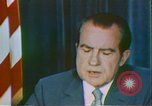
U.S. President Richard Nixon works for peaceful end of Vietnam War, improves domestic conditions and controls drug traffic.
U.S. President Richard Nixon speaks about aftermath of immediate withdrawal from the Vietnam War. U.S. military prisoners of war held by North Vietnam stand before press reporters in Vietnam. President confers with U.S. Secretary of State Dr. Henry Kissinger at his office. Vietnam War draftees being selected by traditional lottery system. Men stand in front of machines that churn out numbered balls for new draft lottery system. Nixon transforms budget expenditure on human needs. Criminals caught by police walk, some covering their faces from the media, as they are led away by police and investigators. Illegal drugs seized by efforts of Nixon administration. View of seized heroin manufacturing equipment. Nixon speaks about the opium farming in Turkey during one of his speeches and mentions agreement with the Turkish government in Ankara to cease all opium poppy production. Customs officers check illegal drug traffic on the border of Mexico and America. Drug enforcement officials search cargo hold of a ship for illegal drugs. Views of drug control officers finding illegal stashed hidden drugs in hiding places in cars and vehicles. Nixon speaks about increased budget to control illegal drug traffic and rehabilitation of drug abusers and drug addicts. He creates the office of Drug Abuse Enforcement and he speaks saying "We must wage what I have called Total War against public enemy number one in the United States: The problem of dangerous drugs." From a pro-Nixon "documentary" called "The Nixon Years: Change Without Chaos" covering President Richard Nixon's first four years in office. Released during his 1972 reelection campaign.
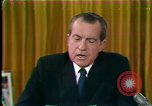
U.S. President Richard Nixon addresses nation about Vietnam War, from White House, Washington DC.
Stand of U.S. President Richard Nixon on Vietnam War. President Nixon addresses the nation about the Vietnam War from White House. He explains what has been described as "The Nixon Doctrine" regarding U.S. involvement in war, foreign policy support, and defense of freedom. He discusses the concept of helping other nations fight wars, rather than fighting wars for them. He illustrates this approach in describing U.S. efforts in Vietnam. He promises that 20% of U.S. combat forces will return by mid December. He notes he will not reveal withdrawal decisions that will compromise efforts at the Paris talks. He indicates he will pursue a path seeking a just peace through a negotiated settlement or through continued vietnamization.
Quaker-sponsored American pacifists sail from Japan in yacht "Phoenix of Hiroshima" to bring medical supplies to North Vietnam
Quaker-sponsored American pacifists sail from Misaki, Japan to bring medical supplies to North Vietnam, during the Vietnam War. Yacht "Phoenix of Hiroshima" at a dock in a Japanese harbor, before starting the first of its three trips bringing aid to both North and South Vietnam. Seven American pacifists from "A Quaker Action Group" (AQAG) set sail in the "Phoenix of Hiroshima" bound for the North Vietnamese port of Haiphong, on the group's first of three voyages. A flag flies from the yacht. Views of some of the participants on the boat including Phil Drath, Betty Boardman, Dr. and Mrs. Earle Reynolds, and Bob Eaton. People on the dock wave as the yacht leaves the harbor heading to Vietnam.
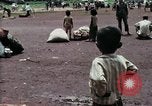
Cambodian refugees board a C-7A at Boung Long and leave the aircraft at Pleiku AB in South East Asia during the Vietnam War.
United States Air Force ( USAF ) support for the evacuation of Cambodian refugees from Boung Long, Cambodia to Pleiku AB in Vietnam during the Vietnam War. At Boung Long, Cambodia: Cambodian refugees wait to board an aircraft. They board a C-7A. A pilot at the controls and the control panel. At Pleiku Air Base, Vietnam: The C-7A taxis in. The engine of the aircraft stops. Army of the Republic of Vietnam (ARVN) troops and refugees unload the aircraft. The refugees leave the aircraft.

West Berlin Police restrain student protesters during an Anti-Vietnam War demonstration
Students gather to protest the Vietnam War in Kurfürstendamm, West Berlin. The ruins of Kaiser Wilhelm Memorial Church are seen. Anti-war protesters holding anti-Vietnam-War signs in German, such as "Wir fordern: Amis Raus aus Vietnam." (We demand: Americans out of Vietnam). Some students hold a portrait of Che Guevara. Protesters moving along the boulevard. Altercation between protesters and Berlin Police. Berlin Police attempt to control the crowds. Night time protest scenes where police officers physically restrain an unruly demonstrator, taking him away. A police van driving away from Kurfürstendamm. A truck in front of Café Kranzler (The Barn - Café Kranzler, Kurfürstendamm 22, 10719 Berlin, Germany). Policemen spray water cannons in front of the SAS (Scandinavian Airlines) sales office and Café Sarotti.
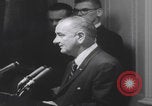
Lyndon B. Johnson speech on Vietnam War; scenes from World War II and Korean War
United States President Lyndon B. Johnson delivers a speech at a news conference in July 28, 1965 during the Vietnam War. President Johnson quotes a letter from a woman in the Midwest, "Dear Mr. President: In my humble way I am writing to you about the crisis in Vietnam. I have a son who is now in Vietnam. My husband served in World War II. Our country was at war, but now, this time, it's just something that I don’t understand. Why?”. United States Army soldiers in a Vietnamese jungle. A crying Vietnamese child. A man sits in front of a fire in the middle of a ruined house. Fascist leaders Adolf Hitler and Benito Mussolini during a parade in Munich, Germany. Flags of Nazi Germany and the United Kingdom. British Prime Minister Neville Chamberlain disembarks from in Munich for the Munich agreement. Nazi German guards turn their heads in unison. Adolf Hitler and Neville Chamberlain walk together. Crowd civilians perform the Nazi salute. Hitler and Mussolini in balcony. Neville Chamberlain reads the “Peace For Our Time” speech. “We regard the agreement signed last night and the Anglo-German Naval Agreement as symbolic of the desire of our two peoples never to go to war with one another again” Chamberlain said before smiling. Ruins of a bombarded city in Europe during World War II. Mussolini gesturing strongly during a speech. Cavalry soldiers on horseback in Ethiopia. Royal Italian Army fighting in Ethiopia during the Second Italo-Ethiopian War. Italian soldiers firing with a Fiat-Revelli M14 machine gun and advancing in field. Emperor Haile Selassie I of Ethiopia protests Italian aggression in the League of Nations. A stylized Nazi eagle statue in Austria. Austrian soldiers during the German Anschluss of 1938. Hitler and Austrian politicians perform the Nazi salute in Vienna. Explosions from night bombardment during the Korean War. Communist Chinese People's Liberation Army troops firing with Chinese Type 24 Maxim Water-Cooled Machine Gun and rifles in Korea. Soldiers’ feet climb and jump up uneven terrain in the battlefield. United States Army M46 Patton tanks pointing upwards and firing at enemy positions. An M46 Patton tank and trucks of the United Nations Forces crossing the 38th parallel line in Korea. Sign denotes the 38th parallel line. President Johnson continues his speech at the White House. “Why must young Americans, born into a land exultant with hope and with golden promise, toil and suffer and sometimes die in such a remote and distant place? The answer, like the war itself, is not an easy one, but it echoes clearly from the painful lessons of half a century. Three times in my lifetime, in two World Wars and in Korea, Americans have gone to far lands to fight for freedom. We have learned at a terrible and a brutal cost that retreat does not bring safety and weakness does not bring peace. It is this lesson that has brought us to Vietnam.” President Johnson said.