


 Francais
 Deutsch
 Italiano
Refine Your Search
Saigon Vietnam 1939 stock footage and images
- Showing 319 to 324 of 5026 results more
more Hide
Hide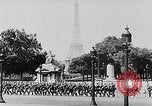
German troops occupy Paris in 1940, during World War II, and scenes from Bastille Day Parade in 1939
A contingent of German army troops marches loosely along road at Champ de Mars, during World War 2, as music of a fife and drum corps plays in the background. The Eiffel Tower looms in the mist. Some soldiers on bicycles bring up the rear. View shifts to the Champs Elysees, with Arc de Triomphe (Pl. Charles de Gaulle, 75008 Paris, France) dominating the empty street. German military cars move along one edge of the road. Camera moves closer to the Arch. Suddenly there is a flashback to the 1939 Bastille Day parade, in Paris, showing British Grenadier Guards in dress uniforms with bearskin hats, parading on the Champs Elysees, along with French colonial Tirailleurs Sénégalais (Senegalese Riflemen), French Sailors, and French infantry. Then, from a high point overlooking the parade, vehicles are seen pulling artillery along the Champs Elysees. Back at street level, French Renault UE Chenillette tankettes drive in the parade, followed by a formation of Panhard AMD armored cars. Film cuts back again to a year later (1940) with German occupation troops marching past the Arc de Triomphe. As the German troops pass, camera focuses briefly on German Field Marshal (Generalfeldmarschall) Fedor von Bock, Commander of Army Group B, reviewing the troops from the sidelines with another German general. View from Eiffel Tower of spectators and column of German troops below. Closeup of German officer on horseback, leading contingent of troops. Marshal von Bock, saluting. Closeups of parading troops. Aerial view looking down on the city of Paris, with Arc de Triomphe near center of the view. German artillerymen towing guns and caissons by means of horses. Ground views of the Arc de Triomphe, and Eiffel Tower. German troops riding on horse-drawn wagons, towing field artillery at the Place de la Concorde. The French Naval Ministry building (Hôtel de la Marine, 2 Pl. de la Concorde, 75008 Paris, France) seen behind them. More horses with troops, and artillery. Grim-faced Parisians watching from sidewalks. German sentries standing guard at the Hôtel des Invalides (Hôtel de la Marine, 2 Pl. de la Concorde, 75008 Paris, France), where the narrator notes, Napoleon is buried. French policemen talking with a German soldier, as they consult a map. German troops proceeding down the side of a commercial district street. Two French women smiling as they realize the camera is focused on them. Cheerful German soldiers marching informally, along a French countryside road, with a German marching chorus song heard singing in the background.
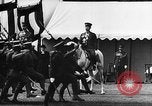
Actions of Axis and Allied powers on brink of World War II in period 1937-1939.
Japanese troops parade for Emperor Hirohito, mounted upon a white horse. Italian troops goosestep and German troops goosestep on parade. View of an Austrian town with snow-covered Alps mountains in background as German troops enter Austria on March 13, 1938 during the Anschluss. Local citizens welcome them, displaying swastika flags and giving Nazi straight arm salutes. Troops, military vehicles, tanks, motorcycles, and horse-drawn artillery comprise the German invading force. Shifts to Spain, where war torn buildings reflect effects of German and Italian intervention during the Spanish Civil War. A donkey standing near field artillery piece. Artillery being fired from an urban park in Spain. Artilleryman using a range finder. German gun crew with heavy artillery piece. Soldiers wearing Adrian steel helmets, firing a two-wheeled water-cooled machine gun. Spanish carrying wounded on stretcher. Spanish civilians inadvertently slain during civil war conflict. Starving dog walking in street. Huge poster of Francisco Franco and view of him on reviewing stand saluting marching Nationalist troops. Repeat of Hirohito reviewing troops and Italian and German troops goosestep. Adolf Hitler and Benito Mussolini stand together in open car heading to Fuhrerbau in Munich, Germany, for signing of Agreement between Germany, Italy, Britain, and France in 1938. Neville Chamberlain, and Edouard Daladier riding in car to Fuhrerbau. Views of the principals signing the accords. First is Adolf Hitler, followed by Prime Minister Neville Chamberlain, Benito Mussolini, and Edouard Daladier. After the signing, the principals, plus Hermann Goering, mingle and converse. Change of scene to nighttime in Rome, Italy, where Benito Mussolini addresses a huge throng gathered near the Victor Emmanuel Memorial to cheer him after his return from Munich. Next, German troops are seen entering Sudetenland (Czechoslovakia) greeted by joyous ethnic German inhabitants. Banners are stretched across a street. One gives thanks to the Fuhrer. Several scenes of cheering population. A woman strews flowers in a roadway. Hitler arrives, standing in an open car, and is met with cheers of adulation. A military brass band plays from the open beds of two moving army trucks. Signpost points to Prag (Prague), Eger (Cheb), Joachimstal (Jáchymov), and Komotau (Chomutov) after German annexation. Scene shifts to Prague, where German troops are seen occupying the city. High ranking German officers in a car are seen coming through the gateway from the Court d´honneur of the Prague Castle into the Hradčany Square. The next sequence shows an Italian Freccia-Class destroyer in the Albanian Port of Durrës. An Italian L3/35 Tankette is driven off a large cargo ship. Italian troops on bicycles ride in a city street. A German 88mm antiaircraft (flak) gun is shown, mounted at a fort overlooking a river and city. Final scene shows Adolf Hitler addressing a meeting of the Bundestag in the Kroll Opera House (alternate meeting place after burning of the Reichstag). He reads, contemptuously from an April 14, 1939 letter sent to him by U.S. President Roosevelt, asking him to give "assurance that your armed forces will not attack or invade the territory or possessions of the following independent nations: Finland, Estonia, Latvia, Lithuania, Sweden, Norway, Denmark, The Netherlands, Belgium, Great Britain and Ireland, France, Portugal, Spain, Switzerland, Liechtenstein, Luxembourg, Poland, Hungary, Rumania, Yugoslavia, Russia, Bulgaria, Greece, Turkey, Iraq, the Arabias, Syria, Palestine, Egypt and Iran." As Hitler reads through the litany of nations, the Bundestag erupts in laughter.
Analysis of the German labor force from 1939 to 1943 (WW2)
Analysis of the Germany's labor force, military strength and effects of World War II on manpower. German soldiers march. Men work in factory on equipment and machinery. Women work in factory. A cemetery of World War 1 soldiers in Germany. Narrator explains how loss of man power from world War 1 deaths, and subsequent lower birth rate leads to war production worker needs being filled by many young German women and even German boys and girls working in industrial factories also. Wounded German soldiers being treated in field during World War 2. A map points Germany, Sudetenland and Austria. Graphs examine labor force by sex, age and military replacement availability; compare the labor force according to sex from 1939-1943; detail the increase of work force through the women part time workers and the veterans. Women weld equipment in a factory. Men do mining work. Narrator speaks of foreign workers (such as from Poland, Netherlands, Czechoslovakia, Yugoslavia), and how some now serve "under economic pressure and compulsion" (as forced labor or slave labor). Views of forced labor crews working digging earthworks. Laborers also work on building or repairing railroad stations and track work. Lines of prisoners of war, also used for labor, walk under German guard as lines of German uniformed troops walk in the opposite direction. Graphs compare the labor force in agriculture, industry, trade services, transport and government.
The comparison of Germany's total labor and military manpower from 1939 to1943.
Estimation of Germany's total working manpower. People walk with their equipment towards a factory. They read a notice pasted on the wall. They work in the factory. Vehicles parked on the street. Soldiers walk. Comparison of the military manpower from 1939 to 1943. The number of soldiers missing is also estimated. Destroyed military vehicles on the battlefield. Soldiers advance with tanks on the battlefield. Dead body of a soldier lay on the field. (World War II period).

Dr. Langmuir's Nobel Prize, industrial factories, 1939 World's Fair, and aerial views of cities.
Graphic: "This film is restricted". Group of industrial smoke stacks emitting smoke and pollution. Aerial view of Hoover Dam. Large power lines coming from Hoover Dam. View of George Washington Bridge in New York City with traffic. Aerial view of early highway interchange. Aerial view of Manhattan, New York City and New York City skyline. Aerial view of smoggy city with railroad switching yard in foreground. Early highway crowded with car traffic. People wading in water at the beach. People looking out from high vantage point. 1939 World's Fair Trylon and Perisphere. Interior view Grand Central Station or early Penn Station railroad train station. Porters and travelers walking in train station. View of Egyptian ruins and pyramids. Ruins from 300 BC. Moving timeline graphic depicts dates of modern advances in geometry, arabic numerals, physics, and industrial revolution with electricity, chemistry, railroads, telegraph, and automobiles. Factory with smoke stacks, pollution, and view of a large grain elevator. Foundry with sparks flying. Line of turbine generators. General Electric company building with GE logo on top. Dr. Irving Langmuir works in a lab at the plant demonstrating creation of thin films of oil in a pan. View of Noble Prize won by him for his research about the basic structure and behavior of molecules. View of non-reflective glass demonstrated on General Electric meter. Scientist with beakers and test tubes. Scientists in laboratory and looking through microscopes.
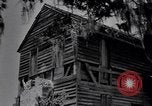
Forks of Cypress plantation home and other sites, likely in Alabama, circa 1939; African American man tending a large bell.
From the U.S. Department of Agriculture documentary "The Land." A seemingly abandoned, dilapidated house at an unidentified farm or former plantation location, possibly in Alabama, during the Great Depression. Spanish moss hanging from nearby trees. Views of a different, wooden, rundown house with a front porch, possibly at a different location. Scene changes again to a third different house, this one made of brick. A lone African American man emerges from double doors of the house. He walks up to a bell, cleans it, and rings it. Distant open view in front of the bell includes a valley and river (possibly the Tennessee River in western Lauderdale County, but not confirmed.) Scene changes again to show the first house and the trees with Spanish Moss. View returns to the location with the man tending the bell. Next scene shows the Forks of Cypress plantation house in Florence Alabama, (Lauderdale County). View of the old main Greek Revival Forks of Cypress house built in 1830 for James Jackson. View of the west elevation of the house. The smokehouse is seen behind and to the side of the main house. A clothes line with clothes on it is beside the smokehouse. Chickens walk on the porch of the house, past its tall colonnade of 24 ionic columns. (Note: The house burned completely in a 1966 fire). Next scene is again the elderly African American man at the brick house location. He looks around, mumbling to himself, walks back towards the house, and pauses on the front steps. The first wooden house with Spanish moss in nearby trees is shown again. Scene returns to the elderly African American man who enters the brick house and closes the doors behind him. Film directed and narrated by Robert Flaherty.