


 Francais
 Deutsch
 Italiano
Refine Your Search
Saigon Vietnam 1939 stock footage and images
- Showing 361 to 366 of 5026 results more
more Hide
Hide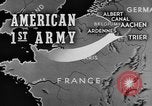
The United States First Army enters Roetgen and supplies are dropped to and retrieved by the Belgian White Army (WW2)
The United States First Army enters Roetgen, Aachen and other German border towns without opposition during World War II. Map showing the capture of the Ardennes, Albert Canal, Aachen, and Trier by the First Army. View of Luxembourg’s Ardennes. A dugout in Wallendorf, in the state of Rhineland-Palatinate. A captured pillbox displays sign in German reads “Der führer besichtigte diese anlage am 15. mai. 1939” (“The Führer visited this facility on May 15, 1939” in English). The town of Wallendorf with heavily damaged buildings from recent Allied shelling. Civilians saving their belongings outside the bombed “Gastwirtschaft von Franz Wenzel” in Wallendorf. Troops on moving M4 Sherman tanks and Jeeps. Soldiers climb the hill and enter Germany. The troops maneuver over fields. Troops occupy the Roetgen, located approximately 16 km (10 mi) south-east of Aachen. 'Roetgen' written on building. White flag on building of 'The Deutsche Reichsbahn'. View of village and huts. Belgian White Army lights fire for supplies by airborne. They gather hay to make bonfires. A White Army soldier with bayonet scans the sky. Another soldier holds a rifle. Soldier watches through binoculars towards plane. A passing bomber drops supplies for the Belgian White Army. Parachutes landing on earth. Supplies and arms are dropped to and retrieved by Belgians. Parachute are rolled and returned to England. Men load supplies into a truck. Horse cart moves away.

American workers and OSS in World War 2 work to estimate the loss of German military manpower in battle.
Film outlines process of U.S. military and War Department to estimate the German military manpower losses from 1939-1943 during World War II. Scenes of German military forces in battle. German tank on the battlefront smashes down a tree and German soldiers follow, running behind it. Dead bodies of soldiers lay on the battlefield. Airplane falling from sky to ground after being hit. German Soldiers fire rifles during battle. German soldiers carry wounded on litters and German medical staff treat the wounded soldiers. A wounded soldier on a hospital bed. Nurse leans over hospital bed and talks to a wounded soldier. A study made to find out the number of soldiers returning to their jobs after being injured. A man reads a magazine which reads: 'Estimate of non battle causalities'. German soldiers march through Arc de Triomphe in Paris during occupation of Paris by Nazi Germany. Headline of a newspaper reads: 'Germans silent on Russian gain'. Brief scene of Soviet leader Stalin speaking at a microphone. Cavalry soldiers, likely Soviet, crossing a battlefield. Scenes of World War I German troops being reviewed by officers. Civilian or OSS men lean over a German map and discuss among themselves. They study the map. Scene of men and women at a German news stand buying German newspapers in order to obtain obituary information. OSS personnel translate casualty reports from German newspapers to help estimate deaths of German soldiers and determine force strength. An operations room with American staff analyzing German newspapers. View of a Boeing 314 Clipper Flying Boat aicraft taking off from water. The reports from World War I and II, allied forces, chart, graphs and NARS computers used to estimate German Army's manpower loss. African American women workers operate keypunch machines recording battle casualty statistics which yield punch cards for further data analysis. Punch cards being created and being loaded in sorting and reading machines bearing brand "International" (for International Business Machines or IBM). A document entitled "analysis of obituaries." Man in an office studying a map and a document. A woman helps him as she enters numbers into a Remington Rand adding machine. They estimate the officers killed in war and the number of the killed enlisted men, in order to estimate the total battle loss. They compare the data of soldiers missing, killed, wounded, and unfit for duty from 1939 to 1943.
Germany invades various nations of Europe during opening years of World War II; civilian refugees evacuating war torn cities.
Past events show German invasions during World War II. German flags in view. German soldiers march. German planes fly in formation during Nazi Party rally at Luitbold Arena in Nuremberg Germany. Adolf Hilter salutes a parade as armored cars and German soldiers pass by. German Luftwaffe aircraft pass overhead in formation during a rally. Comparison shot shows German Wehrmacht army soldiers marching in close ranks, followed by a close up shot of United States Army soldiers marching in close ranks. Both shots shows large numbers of marching soldiers close-up. German Chancellor Adolf Hitler in discussion with Hermann Goering (Göring). They approach a map and then turn their backs. British soldier on lookup watches the sky over London for signs of German bombing raid as parliament buildings and the River Thames are seen in the background. Elevated view of city center, streets, bridges and Russia Orthodox Church in the Soviet Union; possibly Moscow. View of the United States Capitol building in Washington DC. Animated map shows the German positions. Aerial view of devastation from German Luftwaffe bombing of Poland on September 1, 1939. Damaged buildings and houses in Poland due to German bombing in World War II. Polish civilians lined up. Polish people near wrecked horse cart and equipment. Polish citizens carry dead bodies on litters and dig graves for citizens killed in bombing. British people near Big Ben and Parliament buildings on September 3, 1939, the date England declared war against Germany. In London, British children walking toward railroad station near signs that read "To Evacuation Trains", to be evacuated from the London area for safety during the war. Scenes of anguished citizens in England and in France saying goodbye to loved ones including boys and girls being evacuated to safety away from cities, and French women saying goodbye and kissing French soldiers. Close-up view of a French child's arm band with his name and other identifying information, as he leaves in an evacuation. Men leaving for war service. They hug and embrace with emotion. Women wave handkerchiefs at a bus departing with children, then weep. German soldiers march invading Denmark and Norway in April 1940. Sad civilians flee in trucks.
German invasion of Poland and Denmark at start of World War II
Adolf Hitler addressing the Reichstag, meeting in the Kroll Opera House makes fun of an April 1939, letter from President Franklin D. Roosevelt. Hitler reads a list of countries that FDR asked him not to invade. As he drones on through the extensive list, it becomes comical and the Reichstag member burst out in laughter. Next heavy guns are seen firing and formations of German Junkers JU-52 airplanes flying overhead as narrator cites September 1st 1939 and the German invasion of Poland as start of World War 2. Motorized German forces, and infantry are seen rushing across the landscape. German 17 cm Kanone 18 guns are seen firing. Formations of German JU 87 Stuka dive bombers in flight and Heinkel He 111 bombers dropping bombs on Poland. Bombs exploding and devastation on the ground with buildings burning and collapsing. Aerial view of Polish city being bombed. Huge number of disarmed Polish Army prisoners of war walking along roads. German troops marching into Copenhagen, Denmark in 1940
Tripartite Pact signed by Germany, Italy and Japan in Berlin, Germany. Ensuing attacks by Germany and Japan in World War II
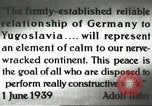
This film is a scattering montage of World War 2 scenes from 1939 through 1945. Part of an agreement between Nazi Germany and Yugoslavia is shown in English. It is dated June 1, 1939 and ostensibly signed by Adolf Hitler. Next, German Ju 87, Stuka dive bomber aircraft are shown peeling off from formation, on April 6, 1941, to attack Yugoslavia. Bombs bursting on the ground. Closeup of a Stuka airplane in a dive, making its characteristic whine, and dropping bombs. Bombs exploding just outside some concrete walls. German infantry running along railroad tracks and entering backyard of house in a village. German soldiers observing from overlooking hill; climbing over rubble; and marching along a road toward a village. Animated map showing German invasion areas early in World War II, extending through most of Europe and into Norway, by 1941. Animated map shows further invasions into France, Belgium, low countries, the Balkans, and Eastern front towards the Soviet Union. Map highlights Tokyo, Rome, and Berlin. Delegations walking in hall of Reich Chancellery in Berlin, to sign Tripartite pact, on September 27, 1940. The group is led by by Count Galeazzo Ciano (Italian Foreign Minister, and Mussolini's son-in-law); Joachim von Ribbentrop, Germany's Foreign Minister and Japan’s Ambassador Saburō Kurusu. The diplomats are seen, next, standing near a table as Adolf Hitler enters rendering Nazi salute. He shakes hands with Count Ciano and Ambassador Kurusu. Hitler is seated to watch the proceedings. Von Ribbontrop is seen signing for Germany. Next scenes show German armored units heading East in Operation Barbarossa (June of 1941). A sign identifies the town of Eydtkau (Eydtkuhnen) on the German-Lithuanian border. German armor and artillery moving eastward. German troops destroying international crossing barriers. German troops firing siege guns. Montage with glimpses of German battle scenes showing tanks, guns, rockets in action with attendant explosions, fires, and destruction. Formations of German warplanes in flight, including Junkers Ju-52s that carry troops, including paratroops. View from above of Junkers Ju-87 Stuka dive bombers in formation. Battle of Britain scenes, with view of St. Paul's Cathedral in London, England (which miraculously survived the Blitz). The Tower Bridge in London, seen through a haze following blitzkrieg. German Junkers 87 Stuka dive bombers peeling off from formation to attack. British anti-aircraft searchlights shining beams skyward. Diving bombers illuminated by the lights. Anti-aircraft guns firing. Nighttime scenes showing gunfire flashes, explosions, tracer bullets and fires in London. British fire brigades fighting fires in London buildings as some collapse from the German bombing during the so-called "Blitz." Scene shifts to Pearl Harbor, December 7, 1941, as a Japanese bomb explodes on a U.S. Navy warship. The USS Arizona billowing smoke and listing as it succumbs to Japanese bombing. Another view of the Arizona sinking. Smoke rising from Battleship Row, at Pearl Harbor. Glimpse of postwar Nuremberg trial.
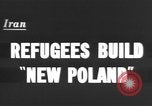
Polish Refugees travel three years and 3 thousand miles to Iran during World War II.
Many Polish refugees are seen in the final phase of their monumental trek of three years and three thousand miles from Poland, during World War 2. Scene shifts to Poland in 1939, where polish refugees crowd roads carrying their belongings in wooden carts and other conveyances. They are seen at a rest stop where they obtain food. Animated map shows path of refugees fleeing East into the Soviet Union, following the German invasion in August, 1939. The path continues Southeast in 1941, as they flee from the German campaign, Operation Barbarossa, into the Soviet Union. Their journey continues along the west coast of the Caspian Sea, through the Caucasus, to Persia (Iran). Views of refugees arriving at the Persian border, where they are seen near many tents, and being provided with articles of clothing from British and American Red Cross Stations. Refugees donning new shoes and other items. Young girls having their hair styled. Refugees sit at long tables where they receive hot meals. A teacher conducts an outdoor class for Polish refugee children. Closeup of children at their desks. Refugee women are seen tilling soil to plant crops, while fathers and grown sons and daughters leave to join the new armies of the Polish Government in Exile. Views of Polish women, in uniforms marching and of uniformed armed Polish soldiers, as well becoming part of the Allied war against the Axis powers. Polish refugees at an outdoor shrine, offering prayers for the safety of their members in the military. New polish refugee arrivals at the Persian border being greeted by others, many of whom are family members.