


 Francais
 Deutsch
 Italiano

Refine Your Search
Saigon Vietnam 1939 stock footage and images
- Showing 433 to 438 of 5030 results more
 Hide
Color Sound
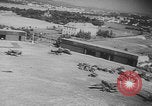
German military use of airport in Bromberg, Poland as a base during World War 2
Long shot aerial view from a low-flying airplane shows airport in Bromberg (Bydgoszcz), Poland. View of many German Air Force planes, as well as various outbuildings. Narrator describes that after the German invasion of Poland during World War II, the Germans took over the airfield to use for their own military aircraft and operations. Bomb craters on ground from German bombing on September 1st, 1939. View from inside a hangar looking outward on destroyed aircraft debris. More shots of debris on the airfield. Several Polish aircraft are shown in various states of ruin. German soldier approaches a Polish biplane with gun damage to the skin of the fuselage.
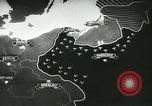
United States Navy 3rd fleet carriers shell Japanese oil reserves in the South China sea.
U.S. Navy carrier planes hit oil fields in the China Sea. A storm in the China Sea. U.S. Navy 3rd fleet carriers on a ship. A diagram shows an arrow on the South China Sea. The fleet moves forward towards Japanese bases. U.S. airplanes bomb Japanese targets. Carrier planes return back to the ship. A plane crash lands on the ship. The pilot of ship is hurt and stuck in the cockpit. The crew runs toward the plane and gets him down. A diagram shows an arrow from the South China sea to IndoChina, Saigon. A tanker is torpedoed by U.S. planes. Bombing on Saigon. An oil reserve on fire. (World War II period).
British officials meet in England as Adolf Hitler prepares his troops in Germany during World War II.
The first phase of German assault on France and the Low Countries during World War II. Animated maps illustrate Czechoslovakia and Poland defenses against Germany, and the East Prussian Corridor. Civilians including children flee war violence. German troops and tanks parade. England: UK Prime Minister Neville Chamberlain addresses a gathering. Britain's Foreign Secretary Lord Halifax (Edward Fredrick Lindley Wood, 1st Earl of Halifax), Winston Churchill, Leon Blum, and other officials. Germany: Hitler arrives at the Reichstag in Berlin. He addresses the Nazi officers and officials. A sign for the custom border district at Kreis. Bullet ridden walls and bomb damaged buildings. German troops load and fire artillery. German Panzer tank units invade Poland in 1939. Hitler looks through an artillery periscope. Black smoke rises due to numerous explosions.
The invasion of Poland, Dunkirk evacuation, Second Armistice, and London Blitz during World War II.
'50 Years of Cinematography' depicts the role of military and news cameramen during World War II. Germany starts the War. Invasion of Poland in 1939: German Nazi Luftwaffe bombers in flight over Warsaw. Explosions due to the bombardment. Burning and damaged buildings in the war torn city. Civilians amidst rubble and ruins. Soldiers and civilians look at corpses on a sidewalk. A woman with her child cries. A man walks on a street. Dunkirk Evacuation in 1940: Allied troops evacuated from the Dunkirk coast. Allied troops on ships. Smoke rises from a ship under German attack. Soldiers wade through the water towards waiting ships. Burning ships. The Second Armistice at Compiegne after the German victory in the Battle of France, 1940: German troops stand at attention. German Fuhrer Adolf Hitler, President of the Reichstag Hermann Goering, German Field Marshal Wilhelm Keitel and other German officers arrive at the venue. The leaders and officers walk past the soldiers at attention. Hitler gives the Nazi salute. The Blitz, London in 1940-1941: Bomb damaged buildings. Cars and pedestrians amidst ruins and rubble on the streets. A train over a collapsed wall. Civilians in a horse cart. A wrecked bus in a damaged building. Rescue workers among the rubble. Clouds over the city.

German Field Marshal Fedor von Bock and Field Marshal Georg von Kuchler review the German Victory Parade in Paris, France.
The Germans capture Paris in June 1940 during World War II. 1939: British troops march with French troops during the French National Day parade. The troops and tanks parade before the Arc De Triomphe on Champs Elysees. The German Victory Parade on Chams Elysees after the fall of Paris. German Field Marshal Fedor von Bock and Field Marshal Georg von Kuchler review the German troops. Civilians watch the parade. Aerial view of the parade.
35th anniversary of Wright Brothers' first flight. Advances in travel due to rail and airplane. Howard Hughes' round the world flight.
Film notes 35th anniversary of Wright Brothers' first flight and reviews history of transportation and advances in transportation brought about by railroad and aircraft. An animated map of the United states before the advent of mechanized transport methods. It illustrates the difficult and long overland journey to travel from the East Coast to the West Coast. Travel by horse and wagon over the Santa Fe Trail in 1849 is recreated in a brief film clip. Next, a locomotive is shown pulling a passenger train at high speed along a railroad at the base of a mountain. Animated map charts fairly direct path from Coast to Coast, taking only 4 days by railroad. Next a nearly straight course is traced across the map illustrating the path of an airplane taking only seven and a half hours for the journey. Change of scene shows aerial view of Howard Hughes' Lockheed 14 Super Electra Special, Model 14-N2 ( NX18973), christened "New York World's Fair 1939," in flight over New York harbor with the skyline of Manhattan, New York City in the background. Camera follows the plane as it passes over lower Manhattan. The Empire State building is seen prominently with other skyscrapers below the aircraft. This was filmed, on July 14, 1938, as Hughes and his crew were returning from Minneapolis, Minnesota, to Floyd Bennett Field, on Long Island, at the conclusion of their around-the-world flight (circling the Northern Hemisphere) from July 10 - July 14, 1938.
CRITICALPAST.COM: About Us | Contact Us | FAQs - How to Order | License Agreement | My Account | My Lightboxes | Shopping Cart | Advanced Search | Featured Collections | Website Terms & Conditions | Privacy Policy ©2026 CriticalPast LLC.
License Agreement |
Terms & Conditions |
Privacy Policy
©2026 CriticalPast LLC.