


 Francais
 Deutsch
 Italiano

Refine Your Search
Saigon Vietnam 1939 stock footage and images
- Showing 4669 to 4674 of 5030 results more
 Hide
Color Sound

United Auto Workers and Congress of Industrial Organizations union members celebrate new contract with General Motors Corporation
As film opens, United Auto Worlers (UAW) and CIO (Congress of Industrial Organizations) union workers are celebrating their unprecedented labor contract with the General Motors Company (GM) , covering union workers in all GM plants. Men and women of the union Auxiliary celebrate, including many gathered at the entrance to the GM headquarters building in Detroit, Michigan. Scene shifts to UAW leader, Walter Reuther, speaking in a broadcast microphone. Women ride atop a union loudspeaker equipped vehicle. Celebrants ride in a car displaying a sign reading: "AGREEMENT, UAWA & GM, 1. Fire all Scabs 2. Rehire strikers." Another car has a sign reading: "Victory Rally, Tonite, 7PM." Camera focuses on UAW President, R.J. Thomas shaking hands with CIO leader, Philip Murray. Walter Reuther of the UAW stands beside Philip Murray and places his hand on Murray's shoulder. Closeup of Philip Murray. Members of the women's union auxiliary march in victory. GM tool and die machinists are next, seen, looking over the contract. (Their strike initiated the broad based union response to GM, leading to the new contract.) Next scenes show the tool and die makers back to work. Some are seen using overhead crane and chain to maneuver a heavy machine part. Closeups of milling machine, power drill , and lathe in operation. A worker lowers protective gear over his head and begins welding. Two men use hand held grinders to finish parts. UAW President R.J. Thomas speaks into a microphone. Cheering women walk past a GM plant, outdoors, as viewed from behind. Cheerful closeup of a mother, father and infant.

Bamba, an African boy seeks permission to open a dispensary in a part of Belgian Congo
'The story of Bamba' Dramatization shows Bamba, an African boy meeting a white doctor and shows him his diploma certificate. He seeks doctor's permission for setting up a dispensary in the area he comes from to provide medical aid to the local people. He picks up a map and shows the area to the doctor.

Bamba, an African boy opens a dispensary in village of Belgian Congo
A dramatization shows Bamba, an African treats patients at his village in Belgian Congo. He examines his uncle suffering from illness and looks at illness causing bacteria through a microscope. He injects his uncle and other people in the village. He reads out from a book and speaks about the benefits of medical aid against believing in black magic and spirits. His uncle recovers and denounces black magic and embraces Christianity.
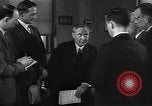
President of Southern States Industrial Council, Fitzgerald Hall, speaks about the NEC report on the economy of the south
Fitzgerald Hall, President of Southern States Industrial Council at his office at Nashville, Tennessee. He speaks to reporters as they take down notes. He speaks out against a report that he says is inadequate, exaggerated and misleading. He says that the south is not Nation's number one economic problem, but rather it is the Nation's economic hope. He is reacting to a 1938 "Report on the Economic Conditions of the South" by the National Economic Council (NEC), that had been echoed in statements by President Roosevelt.

President Franklin D Roosevelt advocates for higher wages and compares feudalism with fascism during a speech in Gainesville, Georgia.
President Franklin D Roosevelt addresses a large gathering in Gainesville, Georgia. He expresses concern regarding the poor economic condition of southern states during the Great Depression and advocates for higher wages and against a system like feudalism. He says the problems are caused by selfishness on the part of a few, leaving one third of the nation ill fed, ill clad, and ill housed. He says "Georgia and the lower south may just as well face facts." He says most wage earners get wages that are far too low, and that "there is little difference between the feudal system and the fascist system" and that he is opposed to both.A large number of people gathered outside a building as they listen to the President.
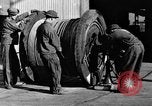
Members of 12th Coast Artillery Mine Planter Battery prepare to plant mines from a vessel, during World War II
Film on the Employment and Operation of a Submarine Mine Battery.Members of 12th U.S. Army Coast Artillery Mine Planter Battery prepare for mine planting. They unroll steel cable from a large roll and cut it into lengths of from 500 to 1600 feet, to be fastened, from their respective mines, to a distribution box. The cut cables are each coiled on a rack in a figure eight, with both ends free for connecting. A length of 135 feet is free on each cable for use on the mine planter vessel. Ends of each cable are tagged to identify their respective mines. Coast Artillerymen load the racks on the aft deck of the vessel, along with mine buoys and other equipment. They then thread the free 135 foot length of each cable segment along the sides of the planter vessel from stern to foredeck, where they will be fastened to their respective mines. As the planter vessel pulls away from the wharf, and heads for the mine fields, the mines can be seen lined along her railings. The name of the mine planter vessel, "General J.M. Schofield," is clearly visible.
CRITICALPAST.COM: About Us | Contact Us | FAQs - How to Order | License Agreement | My Account | My Lightboxes | Shopping Cart | Advanced Search | Featured Collections | Website Terms & Conditions | Privacy Policy ©2026 CriticalPast LLC.
License Agreement |
Terms & Conditions |
Privacy Policy
©2026 CriticalPast LLC.