


 Francais
 Deutsch
 Italiano
Refine Your Search
Saigon Vietnam 1939 stock footage and images
- Showing 4705 to 4710 of 5026 results more
more Hide
Hide
U.S. Navy personnel tend planes on USS Constellation (CVA-64) in South China Sea, during Vietnam War.
A-4E aircraft parked on flight deck of the USS Constellation (CVA-64). Plane captains walk along flight deck. A- 4Es parked in far background, framed by part of A-3B.Plane captain along port side of cockpit of A-4E. NK Tail code of Carrier Wing 14, seen on all aircraft. Green shirts stand looking up toward plane captain working on windshield of A-4E.Radar antennas rotating on the Island. A-4E parked on deck, tow-bar attached to nose wheel, water framed in background. Group of men, in left background, sunning themselves. A-4E parked on deck, island structure in left BG. Man standing alongside cockpit talking to plane captain seated in cockpit of A-4E. plane captain scrubbing down top inner section of starb'd wing. VA 55 Warhorses logo and USS Constellation painted on fuselage of plane. Man cleaning vertical stabilizer.View of ship's bridge. Men cleaning down vertical and horizontal stabilizers of A-4E. Man in far background cleaning port side of cockpit area as fourth man at right cleans starboard wing. Looking aft, from forward part of flight deck, island in left, shows empty flight deck and a lone yellow shirt seated on two wheel chocks.
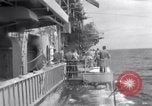
Crew of Aircraft Carrier USS Oriskany (CVA-34) successfully extinguishes fire aboard the ship, while deployed off Vietnam
Aircraft Carrier, USS Oriskany (CVA-34) extinguishing of fire resulting from accidental igniting of flares below the flight deck. Sailors on sponson deck begin recovery and cleanup after extinguishing the fire. Water from fire hose is discharging overboard. Sailors begin retrieving fire hoses. View of fire-damaged areas. Sailors begin cleanup of hangar space beneath the flight deck. Above, cleanup begins. Sailors move bombs on wheeled cradles
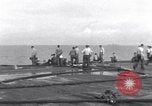
Firefighters prepare to enter area still burning on USS Oriskany (CVA-34) in South China Sea, off Vietnam
Fire aboard the aircraft carrier, USS Oriskany (CVA-34) from accident with flares. Latter stages of fire, with smoke still rising slightly on flight deck and from forward area starboard, below the flight deck. Sailors standing on flight deck with fire hoses laying all over the deck area. Man looks down the edge of the deck area. Firefighters donning Oxygen Breathing Apparatus (OBA) standing in the Sponson deck. They check each others equipment and prepare to enter the area of lingering fire. Smoke emerging from that area below the flight deck.
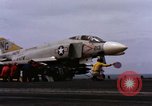
F-4B aircraft being launched from deck of USS Enterprise (CVAN-65) during Vietnam War
U.S. Navy F-4B aircraft of Carrier Air Wing 9 (CVW-9) being launched from deck of USS Enterprise (CVAN-65) in 1966. F-4B on catapult. F-4B launched. Steam rolls down catapult track. Blast fence lowered. Another F-4B taxis onto catapult. Personnel in background. F-4B being launched with after burners. Signal man in dungarees sending message on signal light. F-4B making recovery. F-4B on deck after recovery. Signal man sending message on signal light from rim of signal bridge. Red shirts wheeling bombs under aircraft. Activity on flight deck. Group of red shirted men. Island seen in far background. A-4C aircraft of Heavy Attack Squadron Four (VAH-4), Carrier Wing Five (CVW-5), taxiing over deck. Tow bars stacked. A-4C on deck. Tractor moves by. Aircraft being launched. Men leaving deck. Switch to the personnel on catapult. Steam rolling down the track. Green shirted men and red shirted men watch aircraft recover. Aircraft zips into the scene. F-4B's being lowered on deck edge elevator. Personnel and aircraft on flight deck.
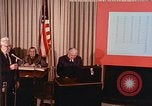
The Selective Service System (SSS) holds a draft lottery to induct men into the Vietnam War.
The December 1, 1969 Draft Lottery for the year 1970 is held at the United States Selective Service headquarters in Washington, D.C. The draft lottery is led by General Lewis B. Hershey, Selective Service Director. The ceremony begins with a benediction, and then an official pours slips of paper containing birth dates into a glass bowl. Congressman Alexander Pirnie of New York draws the first birth date. He declares the date, September 14, and another man pastes the birth date next to a number on a board. Members of the Selective Service Youth Advisory Committee draw additional birth dates and the board is filled out with the draft sequence.
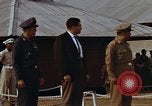
Flag raising ceremony at Udorn Air Force base in Thailand during Vietnam War
United States Air Force and Thai Air Force personnel at a parade as an official reviews the parade at Udorn Air Force base in Thailand. Base commander presented American flag. American and Thai flags raised at the ceremony.
CRITICALPAST.COM: About Us | Contact Us | FAQs - How to Order | License Agreement | My Account | My Lightboxes | Shopping Cart | Advanced Search | Featured Collections | Website Terms & Conditions | Privacy Policy ©2026 CriticalPast LLC.
License Agreement |
Terms & Conditions |
Privacy Policy
©2026 CriticalPast LLC.