


 Francais
 Deutsch
 Italiano

Refine Your Search
Saigon Vietnam 1939 stock footage and images
- Showing 5011 to 5016 of 5030 results more
 Hide
Color Sound
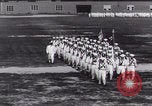
United States Navy recruits marching and performing calisthenics on drill field
U.S. Navy recruits (wearing white uniform) marching in drill field of the Naval Training Station in Norfolk, Virginia, before World War 2. Recruits marching with rifles and banners reading “Eighth Week” and “Training B Unit”. Recruits stand in place and a marching band plays music. Naval officers salute in front of recruits. United States flag in drill field. A wooden scale model of a battleship is seen near the field. A tent for guests to watch marching in drill field. Military band musicians play trumpets, flutes, and tuba (or sousaphone). Recruits and band standing in ranks. Recruits and military band march with the United States flag and banner across the drill field. Men standing in the middle of the drill field. Recruits perform calisthenics simultaneously.

Ground personnel moving USS Los Angeles (ZR-3) airship across field in Lakehurst, New Jersey
Ground personnel moving the USS Los Angeles (ZR-3) rigid airship across a field. The words “U.S. Navy” is written on the dirigible. The airship from stern to bow is moored to mast. The crew is seen standing underneath the airship. The USS Los Angeles airship’s back shows one of the engines. Navy men in uniform moving the stern wheel of the dirigible. A group of Navy men push the dirigible’s stern wheel around the field. View of the handling gear and control car of the USS Los Angeles Zeppelin.

United States Navy crew landing drills with two type of parachutes
Parachutes descent landing in Lakehurst New Jersey. Navy personnel with square parachute gradually descend and land in a field. A man with a basket weave parachute lands in a field.
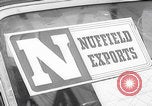
Dock crane lifts 1947 Morris automobiles and Matador truck in the United Kingdom
Sign on car reads “Nuffield Exports.” A 1947 Morris Eight Series E automobile is pushed onto a lift platform by dock workers. Car is secured and then foreman gives the signal to lift. Another car is loaded on the platform and lifted. Close up of foreman giving the lift signal. A Matador truck chassis with drivetrain dangling via crane above a ship's cargo hold area. Workers rotate truck while it is lowered.
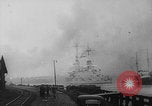
German battleship SMS Schleswig-Holstein bombards the Westerplatte fort in the port of the Polish town of Danzig (Gdansk)
Wide views of the German training ship SMS Schleswig-Holstein as it sails into the Polish port city of Danzig (Gdansk), beginning the German invasion of Poland in World War II. The Deutschland class battleship had been stationed close to the harbor since August 25th under the pretenses of a ceremonial visit, but 225 German soldiers were hiding belowdecks. In the morning of September 1st, the battleship fires on the fortified Polish munitions depot on the Westerplatte Peninsula, the first shots of World War II. Views onboard the Schleswig-Holstein of German sailors firing guns and Captain Gustav Kleikamp looking on through binoculars. After the bombardment, a white Polish surrender flag is visible flying from a building onshore. A "Westerplatte" peninsula sign and the ruined walls of the Westerplatte fort are shown from onboard a boat in the port of Danzig. German and Polish officers discuss surrender terms. German soldiers distribute cigarettes to battle-weary Polish Navy prisoners of war.

German troops invade Poland and fire Howitzer artillery
A procession of German troops composed of armed infantry, horse-drawn artillery and supply vehicles, and some mounted cavalry walk through rural Poland at the beginning of the German invasion of Poland during World War II. Large plumes of smoke can be seen rising in the distance. Low tight shots focus on horse-drawn guns, particularly a caravan containing a Howitzer gun. German soldiers fire what appears to be long range 15cm sFH 18 artillery. Skirmish lines of German soldiers push forwards, with wide shots of troops running across large open fields. Heavy artillery fires at trees. A tight shot focuses on a horse-drawn wagon driven by two soldiers and lead by a bicyclist.
CRITICALPAST.COM: About Us | Contact Us | FAQs - How to Order | License Agreement | My Account | My Lightboxes | Shopping Cart | Advanced Search | Featured Collections | Website Terms & Conditions | Privacy Policy ©2026 CriticalPast LLC.
License Agreement |
Terms & Conditions |
Privacy Policy
©2026 CriticalPast LLC.